










ASK Automotive solar use more than triples to 33.3 million kWh
Key highlights
- ASK Automotive's solar usage rose from 9.6 million kWh in 2025 to 33.3 million kWh in 2026.
- ASK Automotive operationalised an 11.55 MWp captive solar plant in Rajasthan in October 2026.
- ASK Automotive reported 100% conversion from diesel to PNG in melting furnaces.
- ASK Automotive's PNG usage increased from 4.3 million SCM in 2025 to 7.0 million SCM in 2026.
powered by IRIS
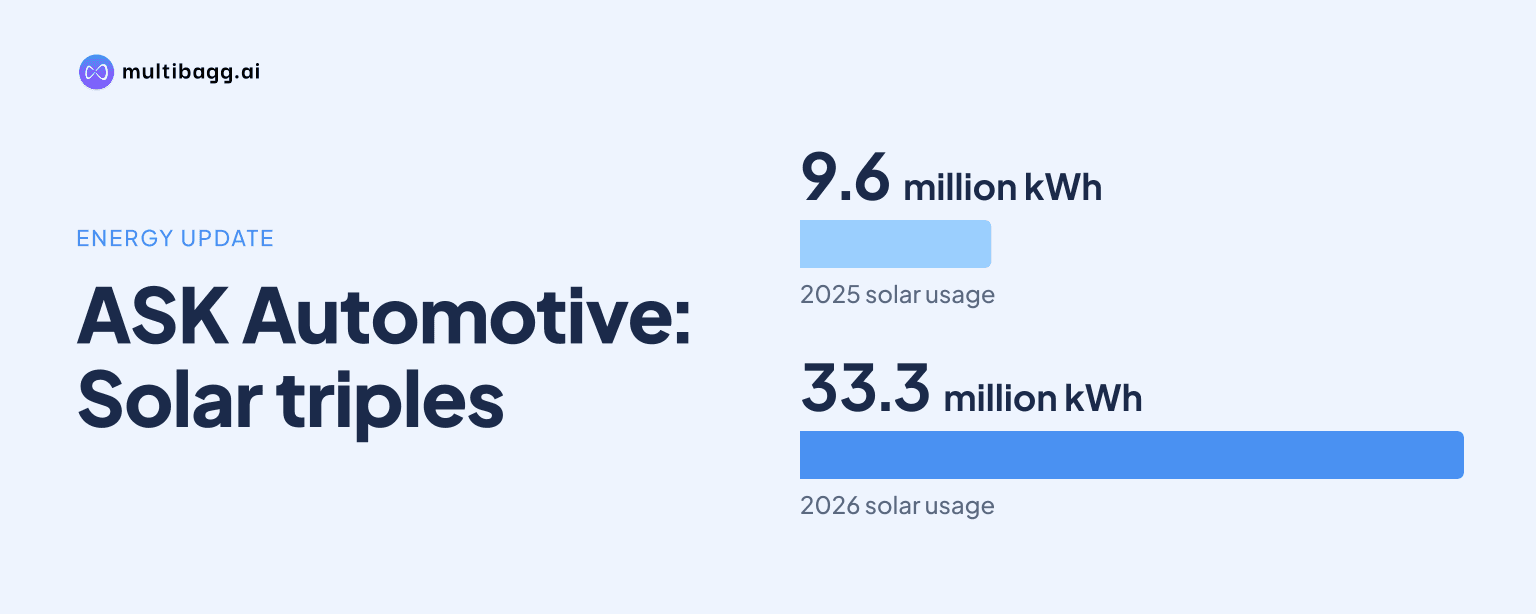
ASK Automotive Limited reported solar usage of 33.3 million kilowatt-hours in 2026, more than triple the 9.6 million kilowatt-hours recorded in 2025, and said an 11.55 MWp captive solar plant in Rajasthan was operationalised in October 2026. It also reported complete conversion from diesel to piped natural gas in melting furnaces.
Know ASK Automotive inside out
Results, valuation, peers and who's buying, in one view.
What drove ASK Automotive's solar-use increase in 2026?
ASK Automotive's solar usage rose by 23.7 million kilowatt-hours, from 9.6 million kilowatt-hours in 2025 to 33.3 million kilowatt-hours in 2026. The 2026 figure was 3.47 times the prior-year level and was the highest annual solar-use reading in the six-year series disclosed from 2021.
Solar use had changed more gradually before 2026. It increased from 6.3 million kilowatt-hours in 2021 to 7.5 million in 2023, slipped to 7.3 million in 2024, and then reached 9.6 million in 2025. The 23.7 million-kilowatt-hour rise in 2026 was larger than the total solar usage reported for any earlier year in the series.
ASK Automotive's disclosure measures solar electricity usage rather than solar generation or the share of its total electricity demand supplied by renewable sources. The presentation does not give total power consumption, emissions data, solar procurement by asset, or the contribution of the Rajasthan plant to the 33.3 million-kilowatt-hour figure.
How much captive solar capacity has ASK Automotive disclosed?
ASK Automotive disclosed an additional 11.55 megawatt-peak, or MWp, captive solar power plant in Rajasthan that was operationalised in October 2026. MWp is the rated peak capacity of a solar installation, while captive consumption means the plant is intended to supply the company's own electricity use.
The Rajasthan project follows a separate 9.9 MWp solar power plant that ASK Automotive said was operationalised for captive consumption. Together, the two disclosed facilities have 21.45 MWp of rated capacity. The presentation does not provide the commissioning date or location of the 9.9 MWp plant.
The October 2026 timing places the Rajasthan plant within the same year as the 33.3 million-kilowatt-hour solar-use disclosure. However, ASK Automotive does not state how much electricity the 11.55 MWp site generated during 2026, whether it operated throughout October, or its expected annual output.
ASK Automotive also does not disclose capital expenditure, operating costs, electricity savings or utilisation rates for either the 11.55 MWp Rajasthan plant or the 9.9 MWp facility. The stated capacity establishes the scale of the projects, but it does not establish their financial contribution or their share of the company's electricity needs.
Got a follow-up? Ask IRIS
How did ASK Automotive replace diesel in melting furnaces?
ASK Automotive reported 100% conversion from diesel to PNG in its melting furnaces. PNG means piped natural gas, and the disclosure identifies this fuel switch separately from the expansion in solar electricity use. It does not state the number of furnaces converted, their sites or the date on which the final furnace conversion was completed.
PNG usage rose to 7.0 million standard cubic metres, or SCM, in 2026 from 4.3 million SCM in 2025, an increase of 2.7 million SCM. Usage had risen from 0.3 million SCM in 2021 to 0.6 million in 2023, then increased to 2.8 million in 2024 and 4.3 million in 2025.
The solar and PNG series describe different energy mechanisms and cannot be directly compared as like-for-like energy volumes. Solar usage is measured in million kilowatt-hours of electricity, while PNG usage is measured in million SCM of fuel. ASK Automotive provides no diesel volumes before conversion or fuel-by-fuel emissions comparison.
What other sustainability information did ASK Automotive disclose?
ASK Automotive reported customer sustainability outcomes of Excellent from Maruti, Gold from TVS, and 100% compliant from Hero MotoCorp and Yamaha. These outcomes were disclosed alongside the 33.3 million-kilowatt-hour solar-use figure and the 100% diesel-to-PNG conversion, but the presentation does not provide assessment dates, scoring criteria or site coverage.
The named customers also appear in ASK Automotive's customer relationship disclosure, which lists 33 years with Hero MotoCorp, 24 years with Yamaha and 23 years with TVS. Those relationship durations provide customer context, but they do not show whether the cited sustainability outcomes apply to all supply programmes or manufacturing locations.
ASK Automotive reported H1 FY27 consolidated revenue of Rs 1,686 crore for Aluminium LW Precision Solutions, up 72% from Rs 982 crore in H1 FY26. The segment includes alloy wheels, engine covers and crankcases, products relevant to melting-furnace operations, but the presentation does not link its revenue growth to PNG conversion or solar projects.
Advanced Braking Systems revenue rose 47% to Rs 1,051 crore in H1 FY27 from Rs 715 crore in H1 FY26, while Safety Control Cables revenue increased 27% to Rs 91 crore from Rs 72 crore. ASK Automotive does not state that customer sustainability assessments, fuel conversion or captive solar capacity caused these segment changes.
Conclusion
ASK Automotive's disclosure shows two separate operational shifts in 2026: solar usage rose from 9.6 million kilowatt-hours to 33.3 million kilowatt-hours, while PNG use increased from 4.3 million SCM to 7.0 million SCM after full diesel conversion in melting furnaces. Its disclosed captive solar facilities total 21.45 MWp, including the 11.55 MWp Rajasthan plant.
The next disclosed milestone is the October 2026 operationalisation of the Rajasthan facility. ASK Automotive has not provided generation, cost, total-energy or emissions data for the 11.55 MWp plant, so subsequent disclosures would be needed to show its annual output and contribution to the 33.3 million-kilowatt-hour solar-use total.