










ASK EV Revenue Mix Is 5.9% Despite Higher Content Per Vehicle
Key highlights
- ASK reported a 5.9% EV revenue mix in Q2 FY27.
- ASK said EV kit value was Rs 1,250 to Rs 1,300 per vehicle, versus about Rs 950 for ICE vehicles.
- Management said ASK’s EV revenue grew 98% year on year in Q2 FY27.
- ASK budgeted about Rs 700 crore of capital expenditure in FY27 and about Rs 500 crore for the following year.
powered by IRIS
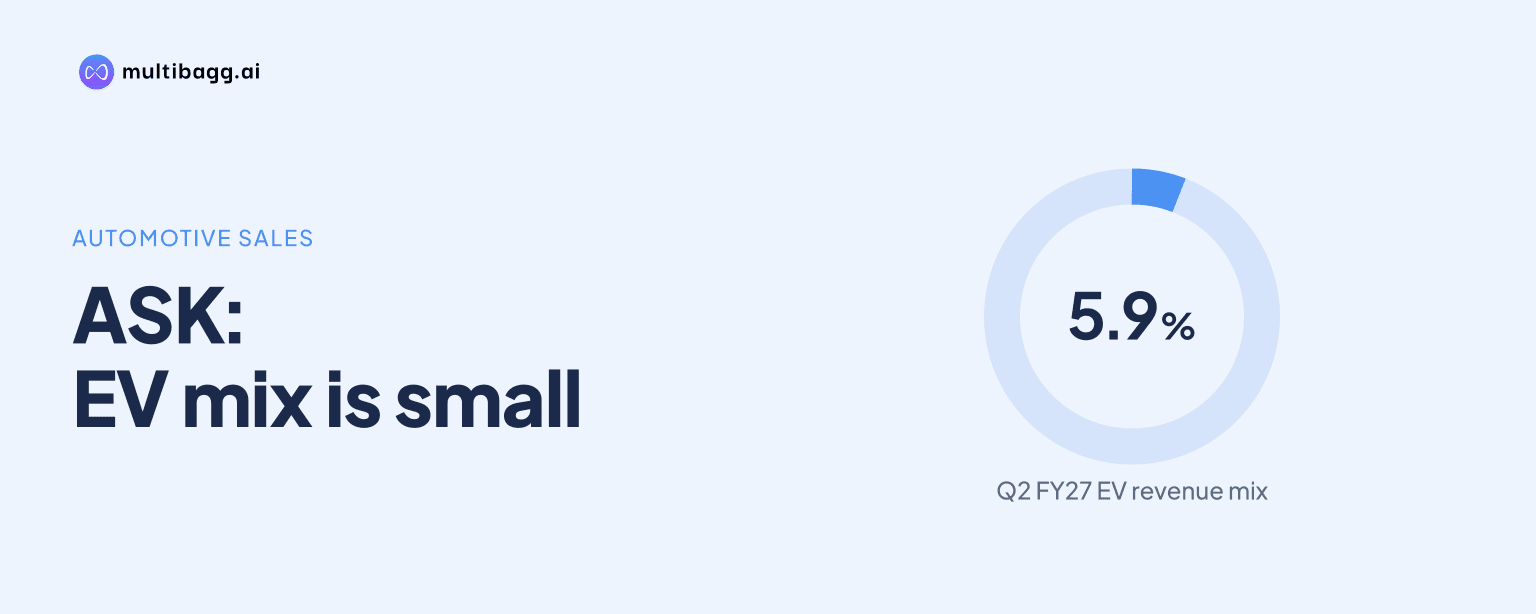
In Q2 FY27, ASK Automotive reported that EVs generated 5.9% of revenue, while its overall EV kit value of Rs 1,250 to Rs 1,300 per vehicle exceeded Rs 950 for internal-combustion-engine, or ICE, vehicles, making electrification a small but higher-content part of the business.
Know ASK Automotive inside out
Results, valuation, peers and who's buying, in one view.
What is ASK’s EV revenue mix today?
ASK’s EV revenue mix was 5.9% in Q2 FY27. An analyst on the call cited two-wheeler EV penetration of 10%, while management said ASK’s lower revenue share reflected growth in its other businesses and softer performance at Ola, which management described as one of its initial major EV customers.
EV revenue grew 98% year on year in Q2 FY27, according to management. That was faster than the 69% year-on-year revenue growth reported by Aluminium Lightweighting Precision Solutions, or ALPS, during the quarter, indicating that EV-linked revenue was expanding from a smaller base than ASK’s broader operations.
ASK said it supplies EV makers including Ola, Ather, TVS, Bajaj and Hero. Management said its Bajaj business was smaller than at the other named customers, but said it had secured significant progress with other EV customers; the call did not disclose revenue or order values by customer.
Why is ASK’s EV content per vehicle higher?
ASK’s EV kit value is about Rs 1,250 to Rs 1,300 per vehicle, compared with about Rs 950 for an ICE vehicle. Management clarified that the figures represent the overall kit, including ALPS, rather than braking-system content alone.
The disclosed EV range is Rs 300 to Rs 350 above the ICE figure per vehicle. Management agreed with the analyst’s characterisation that EV content is about 1.3 to 1.4 times ICE content, which is the mechanism behind its view that a larger EV mix could increase revenue per supplied vehicle.
Higher EV content does not by itself determine ASK’s total revenue mix because EVs contributed only 5.9% of revenue in Q2 FY27. Management said the two-wheeler population was also increasing, so ICE revenue could remain material in absolute terms even as EV revenue gradually accounts for more of the business.
ASK’s reported Q2 FY27 performance illustrates the scale of that wider base. Consolidated revenue rose 47.5% year on year, while management calculated net revenue growth at 29.5% after excluding a 23% alloy-price pass-through effect and a 5% impact from the strategic reduction of wheel-assembly business; earnings before interest, tax, depreciation and amortisation, or EBITDA, rose 30% to Rs 185 crore.
Got a follow-up? Ask IRIS
How fast does ASK expect two-wheeler EV adoption to change?
Management said EVs could account for 20% of the total market in the next two financial years. This was management’s assessment of customer expectations after the analyst cited current two-wheeler EV penetration of 10%, rather than a formal ASK revenue or market-share target.
Management said customers expected a faster transition for environmental reasons and other factors. Its stated implication was that ASK would benefit from that change because EV kit value is above ICE kit value, although the transcript did not provide an FY28 or FY29 EV revenue target.
ASK expects the mix to shift gradually over the next two to three years, with EV revenue rising and ICE revenue coming down somewhat. Management also said total two-wheeler volumes were growing, which means a higher EV percentage need not imply an immediate fall in ICE-linked revenue in rupee terms.
The company’s current customer exposure includes Ola, Ather, TVS, Bajaj and Hero, but its 5.9% EV revenue mix shows those relationships have not yet translated into a proportionate share of group revenue. The 98% year-on-year EV revenue growth in Q2 FY27 is therefore relevant alongside, rather than instead of, the reported current mix.
How is ASK building capacity for changing demand?
ASK has budgeted about Rs 700 crore of capital expenditure in FY27 and said it expects to invest about Rs 500 crore in the following year, subject to machine-delivery timing. Management said its 19th plant for friction material and brakes had been commissioned, while its 20th plant, the fourth in Bengaluru, was likely to start around January 14 or 15, 2027.
This capacity programme was not presented solely as an EV initiative. Management linked the Bengaluru expansion to orders from southern customers and said an earlier plant built with investment of about Rs 380 crore was operating at 90% capacity utilisation.
ALPS revenue growth of 69% in Q2 FY27 and 72% in H1 FY27 provides a separate indicator of expansion in lightweighting products. Management attributed growth to association with original equipment manufacturers that were outgrowing the industry and to capacity investment, saying ASK had invested at least Rs 500 crore annually on average over the previous four years.
ASK has also begun a new high-pressure die-cast, or HPDC, alloy-wheel programme. Regular commercial supply to a Japanese customer began on August 3, 2026, with management expecting about Rs 80 crore of supply in FY27 and orders of about Rs 240 crore in the next financial year from that customer alone.
Management said potential HPDC alloy-wheel supply to other Indian original equipment manufacturers remained in final-stage testing and would be a next-financial-year opportunity if approved. In H1 FY27, ASK generated EBITDA of Rs 348 crore, up 31.3% year on year, and said internally generated cash was being reinvested into expansion.
Conclusion
ASK’s 5.9% EV revenue mix shows that electrification remains a limited part of current revenue despite EV kit content of Rs 1,250 to Rs 1,300 per vehicle, compared with Rs 950 for ICE vehicles. The 98% year-on-year increase in EV revenue in Q2 FY27, alongside faster ALPS growth and broader capacity investment, establishes the basis for management’s expectation of a greater EV contribution over time.
The next disclosed markers are whether EV customer progress lifts the reported 5.9% revenue mix and whether two-wheeler EV penetration moves toward the 20% level management expects within two financial years. Execution of the Rs 700 crore FY27 capital-expenditure budget, the planned Rs 500 crore investment in the following year and the targeted January 2027 start for ASK’s 20th plant will also be important.