










Astonea Labs Limited borrowings rise to Rs 57.15 crore
Key highlights
- Astonea’s gross borrowings rose to Rs 57.15 crore at 30 September 2026 from Rs 43.00 crore at 31 March 2026.
- Astonea’s net debt to TTM EBITDA eased to 2.61x from 3.05x over the six-month period.
- Astonea’s receivable days fell to 101 from 146 a year earlier.
- Astonea’s inventory increased to Rs 43.57 crore, while inventory days remained 83 versus March 2026.
powered by IRIS
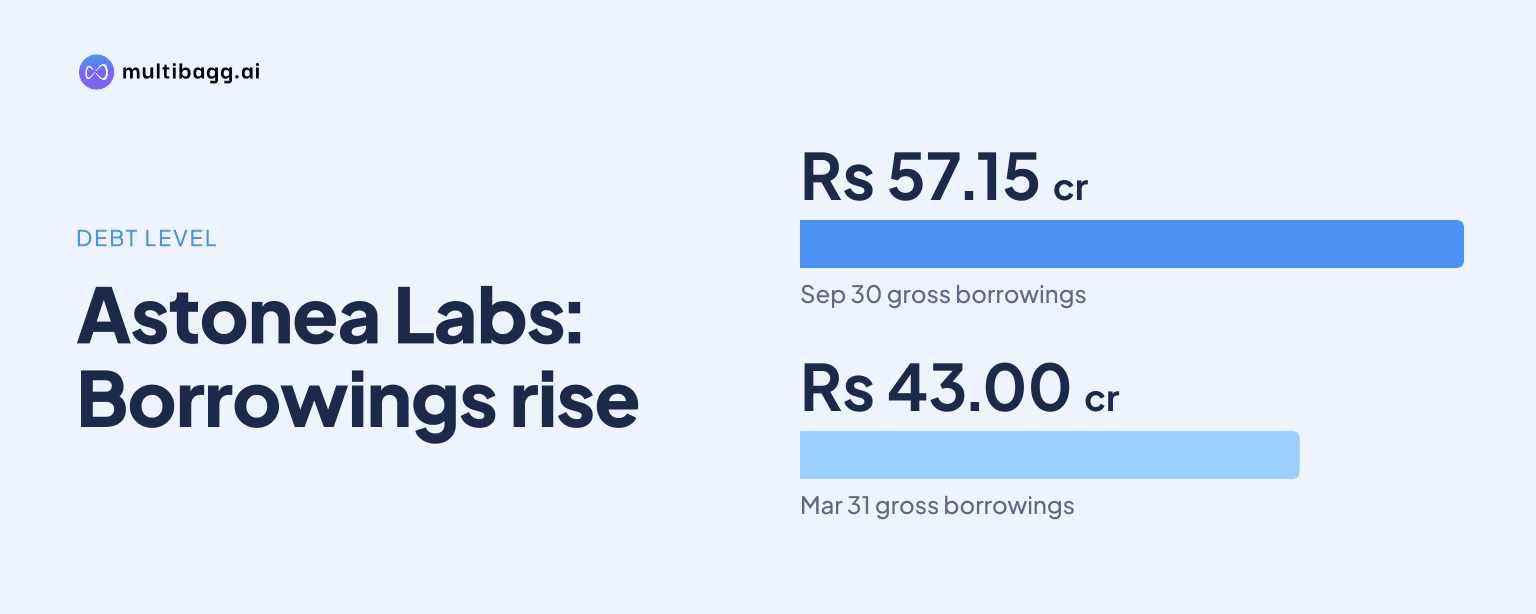
Astonea Labs Limited reported gross borrowings of Rs 57.15 crore at 30 September 2026, up from Rs 43.00 crore at 31 March 2026, while net debt to trailing-12-month EBITDA eased to 2.61x from 3.05x and receivable days fell to 101 from 146 a year earlier.
Know Astonea Labs inside out
Results, valuation, peers and who's buying, in one view.
Why did Astonea’s borrowings rise to Rs 57.15 crore?
Astonea’s gross borrowings increased by Rs 14.15 crore in the six months to 30 September 2026, reaching Rs 57.15 crore from Rs 43.00 crore at 31 March 2026. Borrowings were also Rs 18.10 crore above the Rs 39.05 crore reported at 30 September 2025. Cash and bank balances increased to Rs 47 lakh from Rs 18 lakh over the six months.
Net debt excluding lease liabilities rose to Rs 56.67 crore at 30 September 2026 from Rs 42.82 crore at 31 March 2026 and Rs 38.40 crore a year earlier. Lease liabilities declined to Rs 3.13 crore from Rs 3.40 crore at March, while net worth increased to Rs 72.12 crore from Rs 67.30 crore. The presentation defines net debt without lease liabilities.
The higher borrowing balance coincided with a larger asset base. Total assets reached Rs 181.30 crore at 30 September 2026, compared with Rs 163.08 crore at 31 March 2026 and Rs 137.60 crore at 30 September 2025. Inventories increased by Rs 9.96 crore over six months to Rs 43.57 crore, while trade receivables rose by Rs 4.45 crore to Rs 53.32 crore.
How did Astonea’s leverage measures change despite higher debt?
Astonea’s net-debt-to-EBITDA ratio eased to 2.61x at 30 September 2026 from 3.05x at 31 March 2026, even as net debt increased by Rs 13.85 crore. Trailing 12 months, or TTM, comprises H2 FY26 and H1 FY27 in the presentation, and EBITDA includes other income under the company’s reported measure.
The ratio change followed higher reported earnings. H1 FY27 EBITDA was Rs 13.20 crore, compared with Rs 5.48 crore in H1 FY26, while revenue from operations rose to Rs 95.86 crore from Rs 66.29 crore. EBITDA margin increased to 13.8% from 8.3% over the same periods.
Astonea reported EBITDA interest cover of 6.8x at 30 September 2026, compared with 4.2x at 31 March 2026 and 3.5x a year earlier. Debt-to-equity, however, rose to 0.79x from 0.64x at March and 0.60x at 30 September 2025, alongside the increase in gross borrowings.
Got a follow-up? Ask IRIS
What happened to Astonea’s receivable and working-capital days?
Astonea reduced receivable days to 101 at 30 September 2026 from 121 at 31 March 2026 and 146 at 30 September 2025. That was a 20-day reduction over six months and a 45-day reduction year on year. The presentation calculates days using closing balances divided by revenue, multiplied by 182 for half-year periods and 365 for March periods.
Trade receivables nevertheless stood at Rs 53.32 crore at 30 September 2026, up from Rs 48.87 crore at March and Rs 53.15 crore a year earlier. The lower receivable-days measure was reported alongside H1 FY27 revenue from operations of Rs 95.86 crore, which was 44.6% above Rs 66.29 crore in H1 FY26.
Net working-capital days were 107 at 30 September 2026, compared with 104 at 31 March 2026 and 150 at 30 September 2025. The year-on-year reduction occurred as receivable days fell, but the three-day increase from March reflected lower payable days, which reduced the supplier-credit offset.
How did Astonea’s inventory and payables change?
Astonea’s inventory balance increased to Rs 43.57 crore at 30 September 2026 from Rs 33.61 crore at 31 March 2026 and Rs 26.34 crore a year earlier. Inventory days remained 83 at both September 2026 and March 2026, but were 11 days above the 72 days reported at September 2025.
Trade payables were Rs 40.52 crore at 30 September 2026, broadly unchanged from Rs 40.47 crore at March but higher than Rs 24.79 crore a year earlier. Payable days declined to 77 from 100 at March, although they remained above 68 a year earlier. With inventory days flat at 83 and payable days lower, net working-capital days rose to 107 from 104 over the six months.
Astonea’s current ratio increased to 1.58x at 30 September 2026 from 1.40x at March, but was below 1.88x a year earlier. Net fixed assets declined to Rs 57.32 crore from Rs 59.64 crore over the six months, while investments were unchanged at Rs 6.26 crore, indicating that the increase in total assets was concentrated in other reported balance-sheet items, including inventory and receivables.
Conclusion
Astonea ended September 2026 with higher gross borrowings of Rs 57.15 crore and net debt excluding leases of Rs 56.67 crore. Its debt-to-equity ratio also increased to 0.79x, while net debt to TTM EBITDA fell to 2.61x, EBITDA interest cover reached 6.8x and receivable days declined to 101.
The next update will show whether Astonea can sustain lower receivable days while managing inventory of Rs 43.57 crore and payable days of 77. The presentation also discloses a 35% increase in tablet-output capacity and distributor expansion in Guatemala and Panama, which it says will contribute to FY28 business.