










Atul Auto Ltd Q1 Revenue Rises 43% as Profit Reaches ₹8 Crore
Key highlights
- Atul Auto’s consolidated Q1 FY27 revenue increased 42.97% year on year to ₹218.43 crore.
- Reported Q1 FY27 PAT rose 290.29% to ₹8.04 crore from ₹2.06 crore a year earlier.
- Three-wheeler sales increased 42.6% year on year to 9,878 units in Q1 FY27.
- Q1 FY27 EBITDA was ₹18.17 crore, down from ₹28.26 crore in the March 2026 quarter.
powered by IRIS
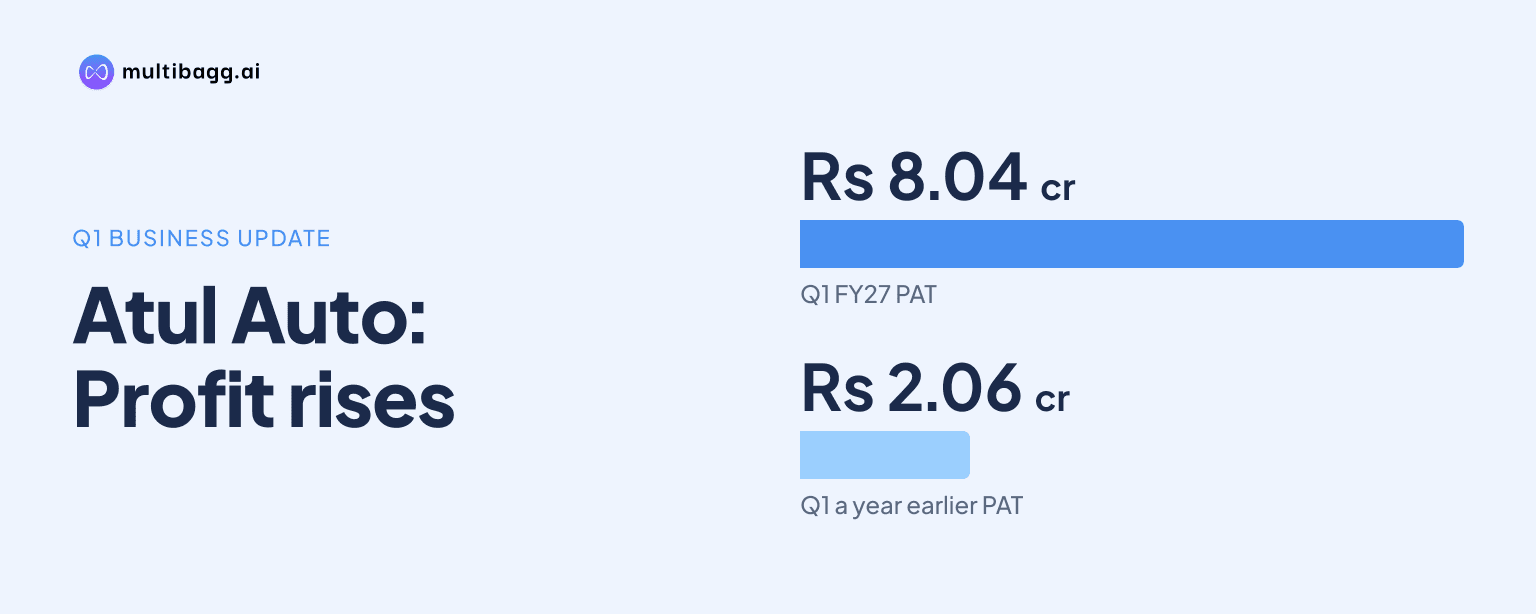
Atul Auto Ltd reported consolidated revenue of ₹218.43 crore for Q1 FY27, a 42.97% increase from ₹152.78 crore a year earlier, while reported profit after tax rose 290.29% to ₹8.04 crore. The company will consider its unaudited Q2 and first-half results for the period ended September 30, 2026, on October 31.
Know Atul Auto inside out
Results, valuation, peers and who's buying, in one view.
What did Atul Auto report for Q1 FY27?
Atul Auto reported a substantial year-on-year improvement in its Q1 FY27 consolidated performance, supported by higher three-wheeler volumes and improved profitability. Net sales turnover rose to ₹218.43 crore in the June 2026 quarter from ₹152.78 crore in the June 2025 quarter. Total income, including other income of ₹1.30 crore, stood at ₹219.73 crore.
Reported profit after tax was ₹8.04 crore, compared with ₹2.06 crore in the corresponding quarter of the previous year. The increase in profit was faster than revenue growth. The company’s filing summary attributed the performance to operational leverage and improved subsidiary performance, while three-wheeler sales volume increased 42.6% year-on-year to 9,878 units in the quarter.
The quarterly comparison also shows that the June-quarter result was lower than the immediately preceding March 2026 quarter. Revenue declined 9.21% sequentially from ₹240.58 crore, while reported PAT fell 56.11% from ₹18.32 crore. EBITDA declined to ₹18.17 crore from ₹28.26 crore in the prior quarter.
Atul Auto’s standalone business also recorded year-on-year growth in the June quarter. Standalone revenue rose 44.7% to ₹206.93 crore, while standalone PAT increased 33.7% to ₹6.74 crore. The difference between the standalone and consolidated figures reflects the inclusion of subsidiary performance in the consolidated accounts.
Which Q1 FY27 financial figures matter most?
The main Q1 FY27 figures are revenue of ₹218.43 crore, EBITDA of ₹18.17 crore and reported PAT of ₹8.04 crore. All monetary figures below are in ₹ crore and relate to Atul Auto’s quarterly results.
Expenses were ₹201.56 crore in the June 2026 quarter, compared with ₹142.77 crore a year earlier and ₹213.27 crore in the March 2026 quarter. Depreciation was broadly stable at ₹4.67 crore, against ₹4.55 crore in the comparable prior-year quarter. Tax expense was ₹2.73 crore, compared with ₹1.19 crore a year earlier.
The sequential decline in operating profit and PAT should be read alongside the stronger year-on-year base. Operating profit was ₹16.87 crore in Q1 FY27, well above ₹10.01 crore in Q1 FY26, but below ₹27.31 crore in Q4 FY26. The disclosed data therefore shows strong annual growth alongside a weaker comparison with the preceding quarter.
Why are vehicle volumes important for Atul Auto?
Vehicle sales are important because they provide context for the revenue increase. Atul Auto sold 9,878 three-wheelers in Q1 FY27, a 42.6% rise from the year-earlier quarter, according to the filing summary. This volume increase broadly aligns with the company’s 42.97% year-on-year growth in consolidated revenue.
For the fiscal year to date, Atul Auto sold 21,794 units, compared with 16,178 units in the corresponding period of FY26. This represents year-on-year growth of 34.71%. The disclosed volume trend indicates that sales growth was not solely a result of a higher comparison base in financial figures.
The company operates in the three-wheeler segment, where volume growth is closely watched by investors because it affects factory utilisation, dealer activity and operating costs per vehicle. In Atul Auto’s reported results, the year-on-year expansion in operating profit and EBITDA accompanied the growth in vehicle volumes.
However, the available quarterly data does not separately specify the contribution of product mix, realisations, geography or individual subsidiary operations to revenue. It also does not disclose the financial impact of the company’s planned Rajkot land lease. These matters remain outside the reported Q1 result figures.
Got a follow-up? Ask IRIS
What will Atul Auto’s board consider on October 31?
Atul Auto’s board is scheduled to meet on October 31, 2026, to consider and approve unaudited standalone and consolidated financial results for the quarter and half year ended September 30, 2026. The board-meeting intimation was issued on October 16.
The scheduled meeting concerns Q2 and the first half of FY27. It follows the June-quarter performance, which established a stronger year-on-year base for the financial year. No Q2 financial numbers were provided in the announcement, so the board meeting itself should not be treated as confirmation of any revenue or profit outcome.
Investors will receive both standalone and consolidated numbers when the board approves the results. The distinction is relevant because Q1 standalone revenue was ₹206.93 crore, compared with consolidated revenue of ₹218.43 crore, and standalone PAT was ₹6.74 crore, compared with consolidated PAT of ₹8.04 crore.
The results will also provide an updated view of whether the company’s sales-volume momentum continued after the June quarter. At present, the disclosed information establishes Q1 growth and the date of the Q2 and half-year results meeting, but does not provide operational or financial guidance for the September quarter.
How do the results and corporate actions affect investors?
For investors, the Q1 results present two distinct signals. First, Atul Auto delivered strong year-on-year revenue and profit growth, with PAT rising from ₹2.06 crore to ₹8.04 crore. Second, the sequential comparison was softer, as revenue, EBITDA and PAT were all lower than in the March 2026 quarter.
The company has also approved leasing its 13-acre Rajkot land to generate recurring cash flow. The available information does not state the lease value, the counterparty or the expected timing of any cash inflow. As a result, the potential financial contribution cannot be quantified from the disclosed material.
Atul Auto’s shareholders approved the adoption of standalone FY26 financial statements with 99.9981% votes in favour and consolidated FY26 financial statements with 99.9980% support. The final dividend for FY26 was also approved with a similar margin. These voting outcomes confirm shareholder approval of the cited resolutions.
The broader importance of the Q1 figures lies in the relationship between volume growth and profitability. Higher vehicle sales coincided with a much larger year-on-year increase in reported PAT. But the March-to-June movement shows that quarterly earnings can vary, making the upcoming September-quarter disclosure important for assessing the continuity of the reported trend.
Conclusion
Atul Auto’s Q1 FY27 results showed a 42.97% increase in consolidated revenue to ₹218.43 crore and a 290.29% increase in reported PAT to ₹8.04 crore. Higher three-wheeler volumes supported the annual improvement, while the decline from the March 2026 quarter showed that the year-on-year gain did not translate into sequential growth across revenue, EBITDA and profit.
The next disclosed event is the October 31, 2026 board meeting to consider unaudited standalone and consolidated Q2 and first-half FY27 results. Investors will watch the reported sales, margins, profit and any further information on the planned lease of the 13-acre Rajkot land.