










Auri Grow India Limited enters CIRP over ₹78.01 crore default
Key highlights
- NCLT Indore admitted Auri Grow into CIRP on 18 September 2026 over ₹78.01 crore of principal operational debt.
- Naksh Steel’s 20 January 2026 demand notice sought ₹91.82 crore, including ₹13.80 crore of interest.
- Rajesh Jasti was appointed as Interim Resolution Professional, and Auri Grow’s board powers were suspended.
- Auri Grow’s disclosed deadline for resolution-plan submissions is 8 January 2027.
powered by IRIS
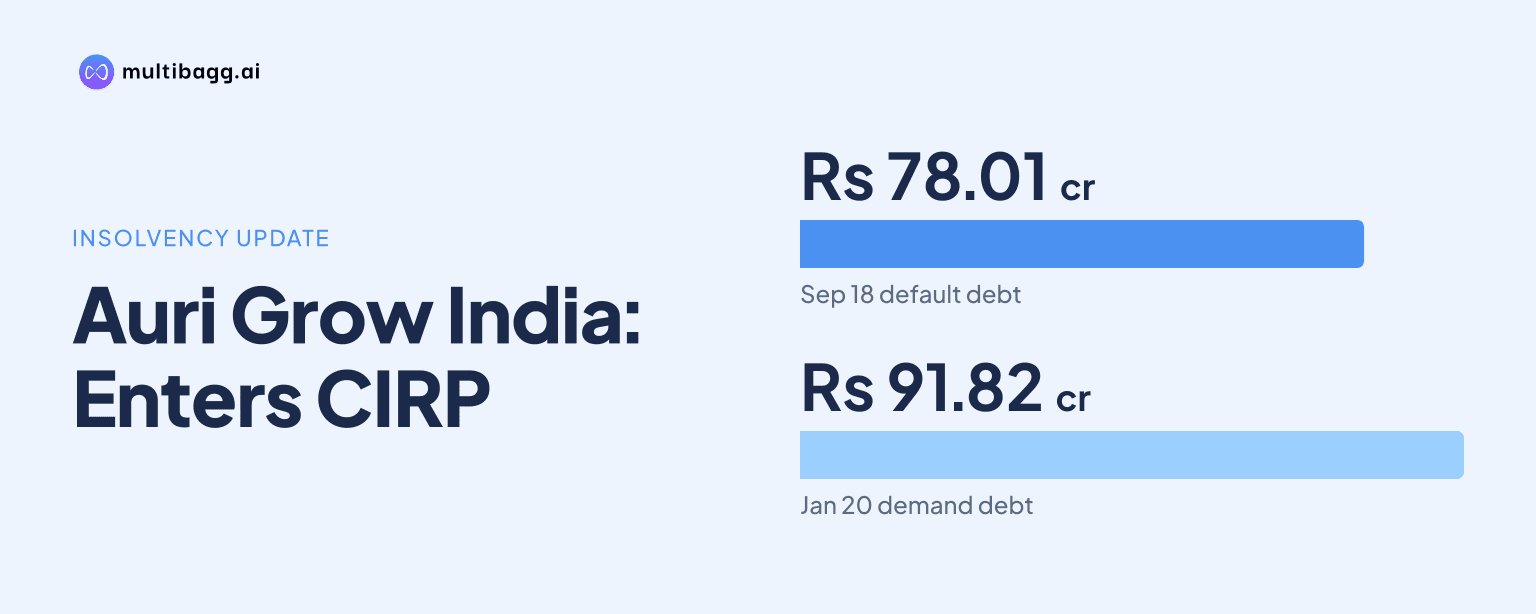
Auri Grow India Limited entered the Corporate Insolvency Resolution Process on 18 September 2026 after NCLT Indore admitted Naksh Steel Limited’s Section 9 petition over ₹78.01 crore of principal operational debt. The order shifted management control to Interim Resolution Professional Rajesh Jasti and imposed a statutory moratorium under the Insolvency and Bankruptcy Code, 2016.
Know Auri Grow India inside out
Results, valuation, peers and who's buying, in one view.
Why did Auri Grow enter the insolvency resolution process?
Auri Grow entered the Corporate Insolvency Resolution Process, or CIRP, after the Indore Bench of the National Company Law Tribunal admitted an application filed by Naksh Steel under Section 9 of the Insolvency and Bankruptcy Code, 2016. The tribunal’s order in CP(IB)/41(MP)/2026 is dated 18 September 2026, while the company said it received a copy of the order on 24 September.
The case concerns an operational default. Naksh Steel’s claim included principal debt of ₹78.01 crore and interest of ₹13.80 crore, taking the amount claimed in its demand notice dated 20 January 2026 to ₹91.82 crore. The tribunal admitted the petition on the basis of the principal operational debt rather than making a final determination on the interest amount.
The NCLT stated that Naksh Steel’s entitlement to interest under the Micro, Small and Medium Enterprises Development Act, 2006 would be subject to verification during CIRP. This distinction is important because the admitted principal debt forms the basis of the insolvency admission, while the interest claim remains subject to the resolution process.
What changes after the NCLT order for Auri Grow?
Auri Grow’s board powers stand suspended following the NCLT admission, and those powers are vested in the Interim Resolution Professional, Rajesh Jasti. Under Section 17 of the IBC, the IRP is responsible for managing the company and its operations as a going concern during the initial insolvency process.
The tribunal also imposed a moratorium under Section 14 of the IBC. The moratorium is a core element of CIRP and operates alongside the transfer of management powers to the IRP. Auri Grow’s exchange disclosures stated that its management and operations would be handled by the IRP as a going concern.
Auri Grow has also filed a list of creditors with the Insolvency and Bankruptcy Board of India as of 12 October 2026. The filing includes secured financial creditors, unsecured financial creditors and operational creditors. The supplied disclosures do not provide the amount owed to each creditor category.
The IBBI public announcement records 21 September 2026 as the date of announcement for the CIRP. It names Naksh Steel as the applicant and Rajesh Jasti as the insolvency professional, with 2 October 2026 set as the last date for submission under that public announcement.
What is the timeline for Auri Grow’s resolution process?
Auri Grow’s process has moved from the NCLT admission to the search for prospective resolution applicants. The committee has approved costs connected with registered valuers for valuing the corporate debtor’s assets and with publication of Form G, which invites expressions of interest from potential applicants.
The last date for receiving expressions of interest is 13 November 2026. A provisional list of prospective resolution applicants is scheduled for 23 November, followed by a period for objections until 28 November. The final list is scheduled to be issued on 8 December.
The information memorandum, evaluation matrix and request for resolution plans are scheduled to be issued to prospective resolution applicants on 13 December 2026. The stated deadline for submission of resolution plans is 8 January 2027. These dates set out the disclosed process schedule, rather than an assurance that a plan will be received or approved.
Got a follow-up? Ask IRIS
How does the CIRP matter to investors and creditors?
Auri Grow’s CIRP places the company under the IBC’s statutory insolvency framework, with operational control exercised by the IRP instead of the existing board. For investors, the key disclosed facts are the ₹78.01 crore principal operational debt, the ₹91.82 crore amount sought by Naksh Steel in its demand notice, and the scheduled resolution milestones through January 2027.
For creditors, the process includes the filing and verification of claims and the preparation of a creditor list. Auri Grow has disclosed that secured and unsecured financial creditors, along with operational creditors, are represented in the list filed with the IBBI. The supplied material does not disclose claim amounts, voting shares or the composition of the committee of creditors.
The process also affects the company’s counterparties and operations because the IRP must manage Auri Grow as a going concern during CIRP. The resolution process is designed to invite eligible applicants to submit plans, but the available disclosures do not identify any prospective applicant or indicate a proposed transaction value.
What background explains the insolvency case against Auri Grow?
Auri Grow was formerly known as Godha Cabcon & Insulation Limited. The insolvency petition was filed by Naksh Steel under Section 9 of the IBC, the provision used by operational creditors to seek initiation of CIRP after a payment default, subject to the requirements of the law and the NCLT’s review.
Naksh Steel served its demand notice on 20 January 2026. Its claim comprised ₹78.01 crore in principal and ₹13.80 crore in interest. The NCLT’s observation on the interest component means that the tribunal did not treat the interest claim as finally adjudicated for the purpose of admitting the petition.
The IBC framework separates the initiation of CIRP from later consideration of resolution plans. Following admission, the IRP assumes control, claims are processed, and expressions of interest are invited under the disclosed timetable. The next formal milestones for Auri Grow are therefore linked to the prospective resolution applicant list and the 8 January 2027 plan-submission deadline.
Conclusion
Auri Grow’s admission into CIRP resulted from NCLT Indore’s finding that the Section 9 petition could be admitted on the ₹78.01 crore principal operational debt claimed by Naksh Steel. The order suspended the board’s powers, appointed Rajesh Jasti as IRP and brought the company’s management and creditor claims under the IBC process.
The next disclosed event to watch is the 13 November 2026 deadline for expressions of interest. Investors can then track the provisional and final applicant lists, the 13 December release of resolution-plan documents, and whether any plans are submitted by 8 January 2027.