










United Foodbrands Revenue Rises 40.9% to ₹4,293 Million in Q2 FY27
Key highlights
- United Foodbrands reported Q2 FY27 consolidated revenue of ₹4,293 million, up 40.9% year on year.
- United Foodbrands' net loss narrowed to ₹64 million from ₹225 million in Q2 FY26.
- Consolidated same-store sales growth was 24.5%, while dine-in transaction volumes rose about 56% year on year.
- Operating EBITDA margin improved to 14.0% from 12.4%, and adjusted operating EBITDA reached ₹262 million.
powered by IRIS
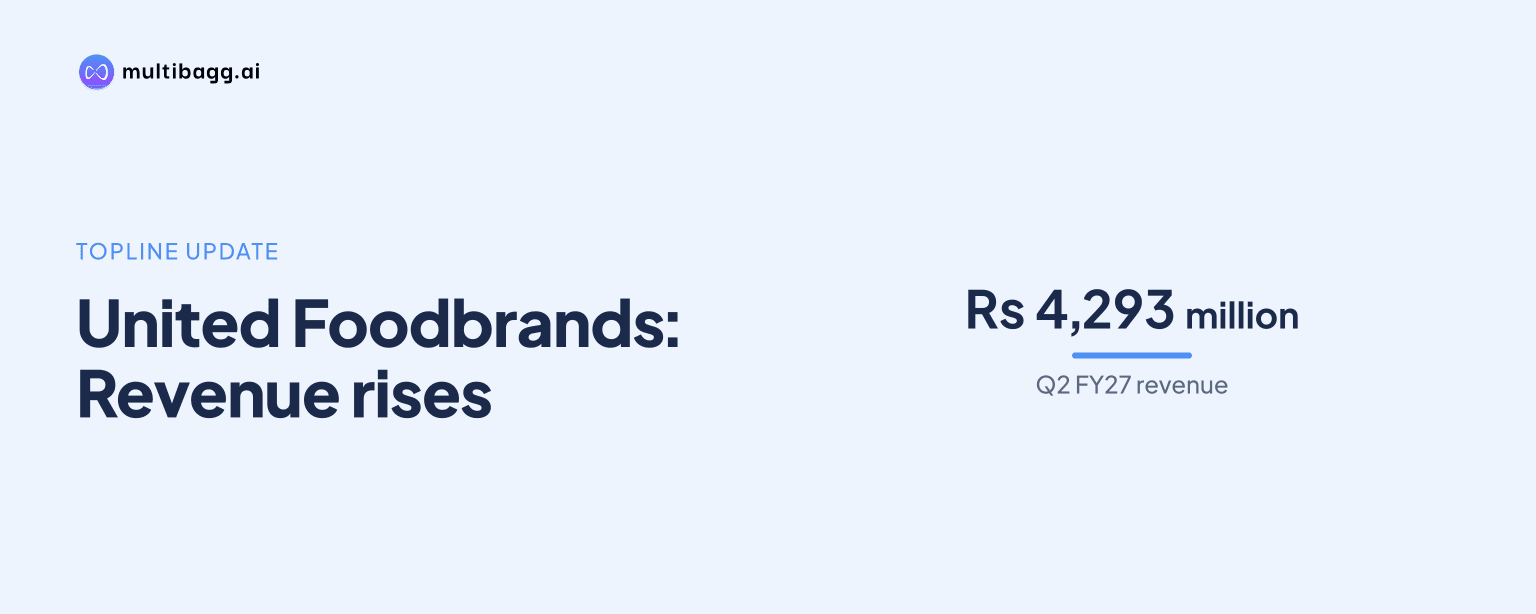
United Foodbrands Limited reported consolidated revenue of ₹4,293 million in Q2 FY27, a 40.9% year-on-year increase, supported by 24.5% same-store sales growth and higher dine-in and delivery volumes. The company also reduced its net loss to ₹64 million from ₹225 million in the corresponding quarter of FY26.
Know United Foodbrands inside out
Results, valuation, peers and who's buying, in one view.
What did United Foodbrands report for Q2 FY27?
United Foodbrands reported unaudited consolidated revenue of ₹4,293 million for the quarter ended September 30, 2026. Revenue was up 40.9% from ₹3,048 million in Q2 FY26 and rose 0.8% sequentially, according to the Q2 FY27 earnings presentation.
The company said consolidated same-store sales growth was 24.5%. Management described the growth as volume-led, with consolidated dine-in transaction volumes increasing about 56% year on year and delivery business growth at 47% year on year. The results marked the fourth consecutive quarter of broad-based performance, according to Managing Director Kayum Dhanani.
The quarterly net loss narrowed substantially to ₹64 million from ₹225 million a year earlier. However, the company had reported a profit of ₹23 million in Q1 FY27, indicating that the second-quarter reported result returned to a loss on a sequential basis. Adjusted profit after tax for Q2 FY27 was ₹16 million.
Which operating metrics supported the revenue increase?
The revenue increase was supported by stronger restaurant traffic, same-store sales and delivery demand across the business. United Foodbrands said its consolidated revenue growth was entirely driven by volumes rather than price increases.
Barbeque Nation India recorded same-store sales growth of 27.8%, revenue growth of 41.4%, and dine-in transaction volume growth of 60.8% during the quarter. The international business reported same-store sales growth of 26.5% and dine-in transaction volume growth of 64%, based on management comments during the earnings call.
The company had 274 restaurants at the end of the reported quarter. Management identified further potential in increasing restaurant throughput, particularly during underutilised weekday and weekend lunch sessions. It also cited customer engagement through captive digital channels, delivery expansion and selective pricing as its four operating levers.
Chief Executive Officer and Whole-Time Director Rahul Agrawal said pre-reservations had increased from about 70% to 80%, while loyalty adoption had risen roughly threefold. He also said the company had not taken price increases in the preceding year despite volume growth of about 60%, and that future price action would be calibrated by market and day-part.
How did United Foodbrands' profitability change?
United Foodbrands' reported operating metrics improved, although input-cost inflation and corporate overheads remained relevant to margins. Operating EBITDA margin was 14.0% in Q2 FY27, compared with 12.4% in Q2 FY26, according to the earnings presentation.
Adjusted operating EBITDA was ₹262 million, up 698.3% year on year. The adjusted operating EBITDA margin was reported at 6.1%. These measures indicate improved operating performance alongside the large revenue increase, while the reported net result remained negative.
Management said newer restaurant economics had improved through a higher proportion of recognised Barbeque Nation India formats, more disciplined site selection and a smaller format of around 3,000 square feet. Of 14 recent openings referred to during the call, 11 were Barbeque Nation India restaurants. The company linked the format to better throughput per square foot and lower fixed costs.
Got a follow-up? Ask IRIS
What does the earnings call disclosure cover?
The earnings call disclosure covers United Foodbrands' financial results for the quarter and half year ended September 30, 2026. Under Regulation 30 of the Securities and Exchange Board of India Listing Obligations and Disclosure Requirements Regulations, 2015, the company made the audio recording of its November 2, 2026 conference call available on its website's Investors section.
The call was hosted by MUFG Intime and included senior management, including Dhanani and Agrawal. The company had earlier released the transcript of an earnings conference call held on August 4, 2026, with that transcript disclosure dated August 11, 2026.
For shareholders, the recording provides management's explanation of the Q2 numbers, restaurant-level operating trends, delivery growth and the factors affecting profitability. The disclosed materials allow investors to compare the headline financial results with management's comments on volumes, store formats and customer engagement.
Why do these results matter for investors and the restaurant sector?
The Q2 performance shows that United Foodbrands expanded revenue through higher customer transactions and same-store sales while narrowing its year-on-year loss. In a restaurant business, volume growth can improve the use of fixed restaurant assets, but the financial outcome also depends on food costs, employee costs, rent and corporate expenses.
The company reported strong traffic growth in its Indian and international operations, while delivery grew 47% year on year. Management said delivery remained underpenetrated across three brands, making it a stated area of focus rather than a completed financial outcome.
The margin figures also provide context for the earnings recovery. Operating EBITDA margin rose by 1.6 percentage points year on year to 14.0%, while adjusted operating EBITDA reached ₹262 million. At the same time, the reported net loss and management's reference to input-cost inflation and rising corporate overheads show that revenue growth did not fully remove pressure on the bottom line.
Conclusion
United Foodbrands delivered a 40.9% year-on-year increase in Q2 FY27 consolidated revenue to ₹4,293 million, with growth led by transactions, 24.5% same-store sales growth and higher delivery demand. Operating EBITDA margin improved to 14.0%, and the net loss narrowed by ₹161 million from the prior-year quarter, though the company remained loss-making on a reported basis.
Investors can next track the company's disclosed operating levers: restaurant throughput, digital engagement, delivery penetration and selective price increases. Management's comments on new restaurant formats, site selection and the economics of its expanding store base will also remain relevant as future quarterly results are released.