










United Foodbrands adjusted EBITDA margin reached 6.1% in Q2
Key highlights
- United Foodbrands’ adjusted operating EBITDA rose 698.3% year on year to Rs 26.2 crore in Q2 FY27.
- Adjusted operating EBITDA margin increased 500 basis points to 6.1% from 1.1% in Q2 FY26.
- Operating revenue grew 40.9% year on year to Rs 429.3 crore, while consolidated dine-in volumes increased 56.2%.
- United Foodbrands opened 9 restaurants in Q2 FY27, taking its network to 274 locations, with 19 more under construction.
powered by IRIS
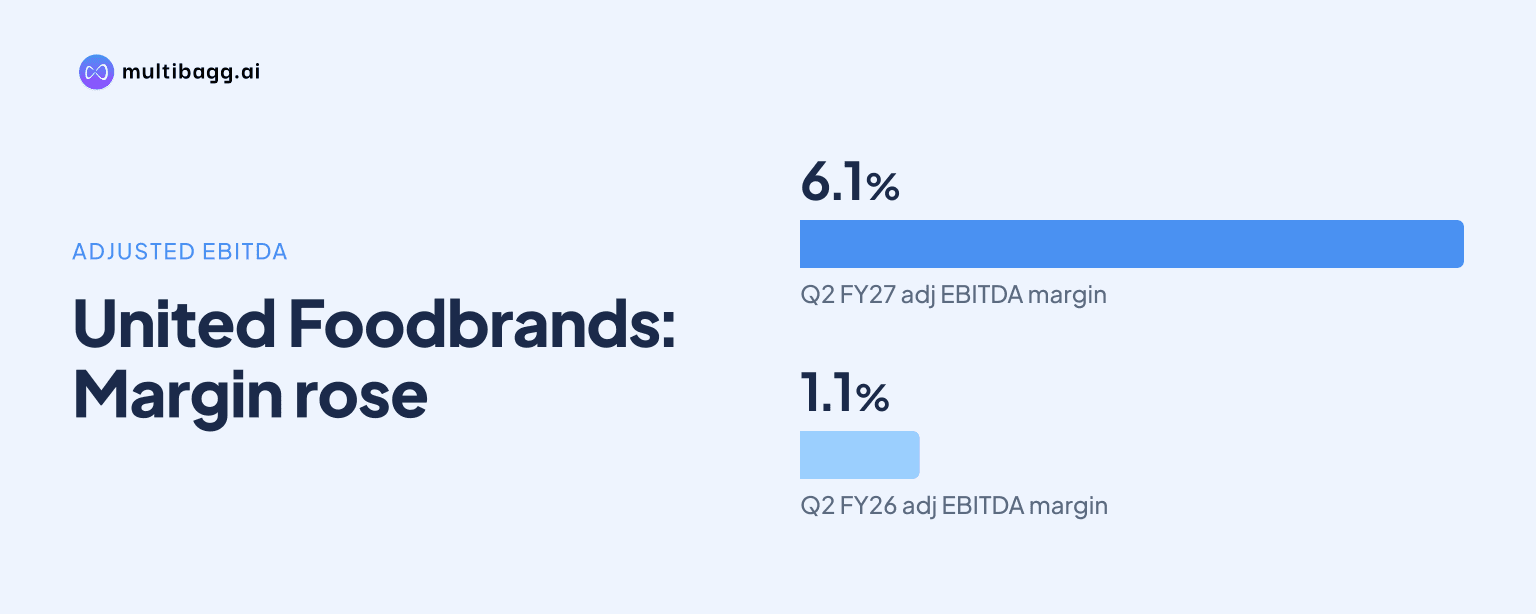
United Foodbrands Limited reported adjusted operating EBITDA of Rs 26.2 crore in Q2 FY27, up 698.3% year on year, as operating revenue rose 40.9% to Rs 429.3 crore. United Foodbrands’ adjusted operating EBITDA margin increased to 6.1% from 1.1% in Q2 FY26, while consolidated dine-in volumes rose 56.2%.
Know United Foodbrands inside out
Results, valuation, peers and who's buying, in one view.
What drove United Foodbrands’ adjusted EBITDA margin expansion?
United Foodbrands’ adjusted operating EBITDA margin rose by 500 basis points to 6.1% in Q2 FY27 from 1.1% in Q2 FY26, alongside 698.3% year-on-year growth in adjusted operating EBITDA. EBITDA means earnings before interest, tax, depreciation and amortisation. The presentation defines adjusted operating EBITDA as excluding the effect of Indian Accounting Standard 116, interest income and non-cash employee stock option plan provisions.
The margin movement coincided with faster growth in restaurant-level earnings than in revenue. Pre-Ind AS restaurant operating profit increased 129.6% year on year to Rs 57.4 crore in Q2 FY27, producing a 13.4% restaurant operating margin. United Foodbrands also reported a 14.7% pre-Ind AS restaurant operating margin for its matured portfolio, compared with 9.6% a year earlier, an increase of 510 basis points.
The operating figures show that costs below gross profit did not rise at the same rate as sales during the quarter. Gross profit grew 39.3% to Rs 281.2 crore, slightly below the 40.9% revenue increase to Rs 429.3 crore, while pre-Ind AS restaurant operating profit rose 129.6%. The presentation identifies transaction growth, same-store sales and restaurant-level profitability as the operating mechanisms behind the improvement.
How fast did United Foodbrands’ revenue grow in Q2 FY27?
United Foodbrands generated operating revenue of Rs 429.3 crore in Q2 FY27, an increase of 40.9% from Rs 304.8 crore in Q2 FY26. Revenue was also marginally above Rs 425.9 crore in Q1 FY27. For H1 FY27, revenue from operations was Rs 855.2 crore, compared with Rs 601.7 crore in H1 FY26, representing 42.1% growth.
Same-store sales growth, or SSSG, was 24.5% in Q2 FY27, following a 2.2% decline in Q2 FY26. Consolidated dine-in volumes increased 56.2%, and delivery revenue rose 47.4% year on year. The presentation says more than 65% of Barbeque Nation India dine-in transactions were routed through United Foodbrands’ own digital channels.
Gross margin was 65.5% in Q2 FY27, compared with 66.2% in Q2 FY26 and 65.8% in Q1 FY27. Although gross profit increased to Rs 281.2 crore from Rs 201.9 crore a year earlier, the gross-margin comparison shows that the reported increase in adjusted operating EBITDA margin occurred despite a 70-basis-point reduction in gross margin from Q2 FY26.
Which United Foodbrands segments grew fastest in Q2 FY27?
United Foodbrands’ international segment recorded the fastest revenue growth, at 59.0% year on year in Q2 FY27, followed by Barbeque Nation India at 41.4% and Premium CDR at 28.5%. The consolidated revenue growth rate of 40.9% was below the international and Barbeque Nation India rates, but above the Premium CDR rate.
Dine-in volume growth was also highest in the international segment, at 64.1%, compared with 60.8% in Barbeque Nation India and 25.1% in Premium CDR. The consolidated increase was 56.2%. The two Barbeque Nation businesses therefore recorded the higher revenue and volume growth rates among the three reported segments.
Barbeque Nation India had the highest same-store sales growth at 27.8%, followed by the international segment at 26.5% and Premium CDR at 7.8%. Consolidated SSSG was 24.5%. These figures distinguish growth at existing restaurants from the contribution of the nine restaurants United Foodbrands opened in Q2 FY27.
Got a follow-up? Ask IRIS
How did dine-in and delivery contribute to United Foodbrands’ sales?
United Foodbrands’ dine-in revenue increased to Rs 360.4 crore in Q2 FY27 from Rs 256.6 crore in Q2 FY26, while delivery revenue rose to Rs 68.1 crore from Rs 46.2 crore. Dine-in accounted for 84.1% of business in Q2 FY27 and delivery represented 15.9%. The presentation attributes the 39.8% increase in dine-in revenue to 56.2% growth in dine-in volumes.
Delivery grew faster than dine-in in the reported quarterly comparison, at 47.4% versus 39.8%. However, delivery’s share of business changed only modestly, from 15.6% in Q2 FY26 to 15.9% in Q2 FY27. Dine-in’s share similarly moved from 84.4% to 84.1%, leaving it as the larger channel by revenue.
For H1 FY27, dine-in revenue reached Rs 714.7 crore, up from Rs 509.1 crore in H1 FY26, while delivery revenue increased to Rs 139.8 crore from Rs 90.5 crore. Dine-in represented 83.7% of H1 FY27 business, compared with 16.3% for delivery. The presentation reported H1 delivery growth of 54.5% and H1 dine-in growth of 40.1%.
Did United Foodbrands report an adjusted profit in Q2 FY27?
United Foodbrands reported positive adjusted operating EBITDA of Rs 26.2 crore in Q2 FY27, but the supplied presentation does not disclose adjusted profit after depreciation, finance costs and taxes. It also does not provide a reported net profit or net loss figure. The disclosed turnaround is therefore in adjusted operating EBITDA, rather than in reported net profitability.
The distinction reflects the company’s stated calculation of adjusted operating EBITDA, which excludes Ind AS 116 effects, interest income and non-cash employee stock option plan provisions. The presentation instead reports Rs 429.3 crore of operating revenue, Rs 281.2 crore of gross profit and Rs 57.4 crore of pre-Ind AS restaurant operating profit for Q2 FY27. Those metrics document the operating improvement but do not establish profit after finance costs, depreciation or tax.
What is United Foodbrands’ restaurant expansion plan?
United Foodbrands opened nine restaurants in Q2 FY27, including seven in Barbeque Nation India and two in the international business, taking the network to 274 restaurants. The company said 19 restaurants were under construction and planned to make them operational in Q3 or Q4 FY27. Its stated targets are more than 300 restaurants by FY27 and 425 to 450 restaurants by FY30.
The 274-restaurant network comprised 216 Barbeque Nation India restaurants, 16 international restaurants and 42 Premium CDR restaurants at the end of Q2 FY27. The network stood at 262 in FY26, so it increased by 12 restaurants by the reported Q2 FY27 position. United Foodbrands said it had opened 14 restaurants year to date in FY27.
The expansion occurred alongside 24.5% SSSG and 56.2% dine-in volume growth in Q2 FY27. That combination indicates that the reported 40.9% revenue growth included contributions from existing restaurants as well as added locations. Management’s more-than-300-restaurants FY27 target depends in part on the 19 sites under construction opening in Q3 or Q4 FY27.
Conclusion
United Foodbrands’ Q2 FY27 presentation shows an operating-margin recovery supported by higher transactions and restaurant-level profit. Operating revenue increased to Rs 429.3 crore, pre-Ind AS restaurant operating profit rose to Rs 57.4 crore, and adjusted operating EBITDA reached Rs 26.2 crore. The adjusted operating EBITDA margin increased from 1.1% to 6.1% as consolidated dine-in volumes rose 56.2%.
The next disclosed items to watch are the planned opening of 19 restaurants under construction in Q3 or Q4 FY27 and management’s target of more than 300 restaurants by FY27. Subsequent disclosures would also be needed to assess depreciation, finance costs, taxes and reported net profitability, which the supplied Q2 FY27 presentation does not state.