










United Foodbrands sets 5%-7% long-term SSSG benchmark
Key highlights
- United Foodbrands set a 5%-7% long-term SSSG benchmark after averaging about 20% over the past year.
- United Foodbrands said customer volumes rose almost 60% over the past year without a price increase.
- Prior reservations reached 80% of customers, compared with almost 70% a year earlier.
- United Foodbrands had 274 restaurants at Q2 FY27-end and 19 sites under construction for Q3 and Q4 openings.
powered by IRIS
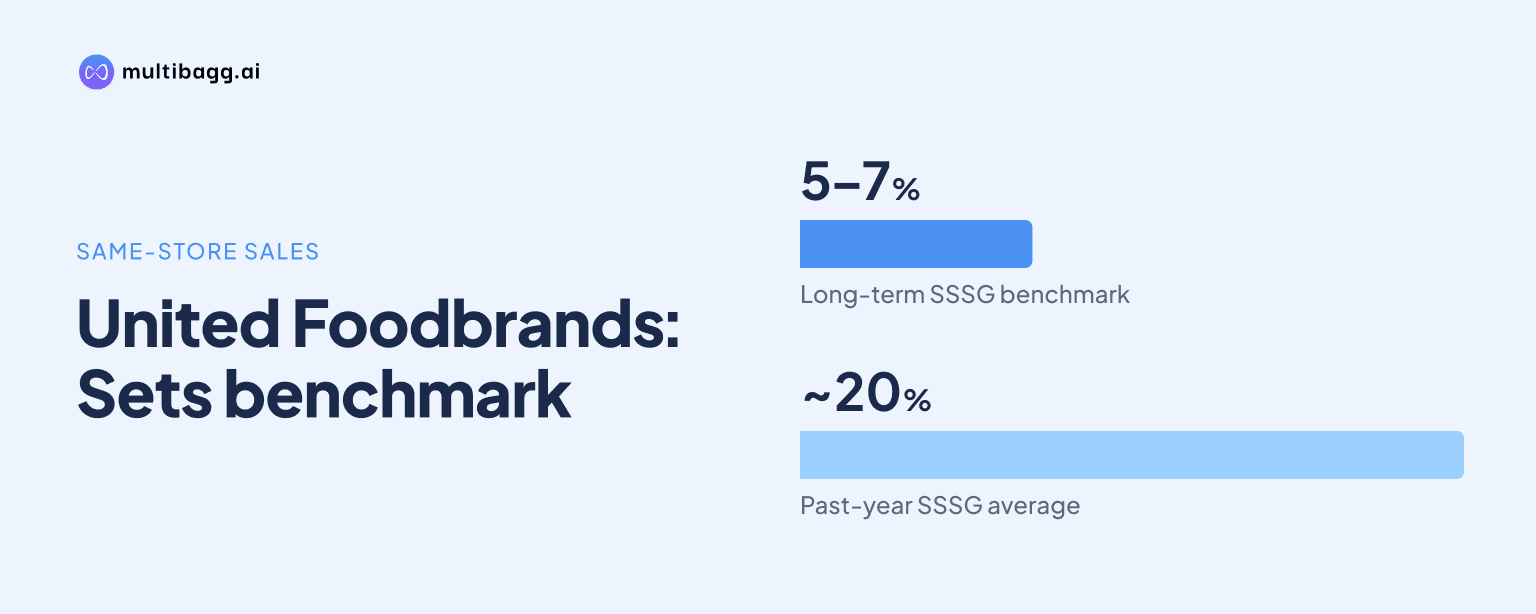
In Q2 and H1 FY27, United Foodbrands Limited set a 5%-7% long-term same-store sales-growth benchmark after averaging about 20% over the previous year, which management said was largely volume-led recovery after two years of lost business rather than a price-led expansion.
Know United Foodbrands inside out
Results, valuation, peers and who's buying, in one view.
What long-term same-store sales growth does United Foodbrands expect?
United Foodbrands expects long-term same-store sales growth, or SSSG, of 5%-7%. Management said this would represent a favourable outcome for an established restaurant business, while the roughly 20% average achieved during the past year should not be assumed to persist at the same level.
The 5%-7% range is close to United Foodbrands' reported 15-year SSSG history of about 6%. Management said the past year's 20%-plus performance partly reflected the recovery of business lost in the preceding two years, making it different from growth generated from a fully normalised trading base.
United Foodbrands did not provide an SSSG forecast for the next financial year when asked by an analyst. Management said it would continue its volume-led programmes, but noted that reported SSSG in Q3 and Q4 would face stronger FY26 comparison quarters.
Why was United Foodbrands' past-year growth above its benchmark?
United Foodbrands said the recent growth was driven principally by volumes, with no price increases taken over the past four quarters. Management said customer volumes increased by almost 60% over that period, while average realisation in Q2 FY27 was about 7%-8% below Q2 FY26 because of format and product mix changes.
The growing contribution of Big Buffet was one reason for the lower average realisation, according to management. Big Buffet has average pricing of about Rs 450 and targets value-oriented demand in Tier 2 and Tier 3 markets, whereas the regular restaurant format has a different customer and price mix.
Direct customer engagement has also increased. Prior reservations accounted for 80% of customers, up from almost 70% a year earlier and above the historical 65%-70% range cited by management. Around 90% of total dine-in business came through captive channels, including United Foodbrands' app, website, reservation centre and restaurant walk-ins.
How will United Foodbrands increase sales per restaurant?
United Foodbrands plans to raise restaurant revenue through capacity utilisation, direct digital engagement, delivery and selective pricing. Barbeque India average revenue per outlet was Rs 6.4 crore in H1 FY27, while management said it wants to move average revenue towards Rs 8 crore to Rs 9 crore over time.
The first lever is throughput. Management said weekend dinner sessions are already well utilised at most restaurants, but weekday lunches and some weekend lunch sessions have unused capacity. United Foodbrands has introduced daypart-specific pricing, weekday offers, lunch offers and prime-time offers to bring more customers into those sessions.
Delivery is the third volume lever after restaurant capacity and direct engagement. United Foodbrands said delivery grew about 50% year on year and has further potential through Barbeque in a Box for kebabs and tikkas, UBQ for daily meals, and Dum Safar for biryani.
Management said selective price increases could be considered only in specific markets or dayparts where volumes are established. That approach follows four quarters without a price rise and would supplement, rather than replace, the company's stated priority of building customer volumes.
Got a follow-up? Ask IRIS
What role will digital channels and Big Buffet play?
United Foodbrands is using its captive digital channels to build repeat visits and improve demand planning. Loyalty-programme adoption increased about three times, and management said the higher use of loyalty points and growing monthly active users give the company a more direct relationship with diners.
The higher loyalty adoption also affected costs in Q2 FY27. Management said it made provisions for expected future loyalty-point redemptions, with the impact equal to about 0.3% of overall sales and recorded in corporate overheads. It nevertheless expects corporate-overhead ratios to decline as revenue scales.
Big Buffet is operating in almost 25% of United Foodbrands restaurants, either as a standalone format or alongside the regular offering. Management said the format addresses weekday lunch and selected weekday dinner demand where the regular format had found it harder to build traffic.
Management previously saw an opportunity for around 400-450 restaurants, but said Big Buffet could support a potential network of 600 restaurants across 700 districts. That figure is management's view of the addressable opportunity, not a committed opening schedule.
How do new restaurants and margins support the growth plan?
United Foodbrands had 274 restaurants at the end of Q2 FY27 after adding nine during the quarter, with 19 restaurants under construction for opening in Q3 and Q4. Management said it remains on track to cross 300 restaurants by the end of FY27 and plans to add 40-50 restaurants annually, mainly funded through internal accruals.
New-store economics improved in Q2 FY27. The new restaurant portfolio recorded a pre-Ind AS restaurant operating margin of 7.4%, compared with 6.1% in Q1 FY27. Pre-Ind AS refers to the accounting presentation before the Indian Accounting Standards adjustments cited by management.
Management linked faster maturation to a higher share of Barbeque India openings, revised site-selection processes and smaller restaurant designs. New sites are now designed at about 3,000 square feet, compared with the earlier 4,000-4,500 square feet model, reducing rent, utilities and other fixed operating costs per outlet.
The gap between mature-portfolio restaurant operating margin and consolidated margin narrowed to 1.3% in Q2 FY27 from about 1.6% in the prior quarter. United Foodbrands said the reduction indicates that the drag from newer restaurants is declining as the FY26 cohort matures and newer stores complete their ramp-up.
Conclusion
United Foodbrands is positioning 5%-7% as its sustainable long-term SSSG range after a roughly 20% recovery year supported by nearly 60% volume growth, direct reservations and value-led formats. Its path to higher sales per outlet rests on filling underused dayparts, increasing loyalty and digital engagement, expanding delivery and applying selective pricing only where demand is established.
Investors will next watch the opening of 19 restaurants in Q3 and Q4, progress towards more than 300 restaurants by FY27-end, and whether the 80% pre-reservation share is maintained as comparison bases become more demanding. Management also plans 40-50 annual additions and has not issued specific SSSG guidance for the next financial year.