










United Foodbrands targets over 300 restaurants by FY27-end
Key highlights
- United Foodbrands ended Q2 FY27 with 274 restaurants and 19 outlets under construction for Q3 and Q4 openings.
- United Foodbrands said it is on track to cross 300 restaurants by FY27-end and add 40 to 50 annually thereafter.
- United Foodbrands' new-store pre-Ind AS restaurant operating margin improved to 7.4% in Q2 FY27 from 6.1% in Q1 FY27.
- United Foodbrands reported Q2 FY27 revenue of Rs 429 crore, up 40.9% year-on-year.
powered by IRIS
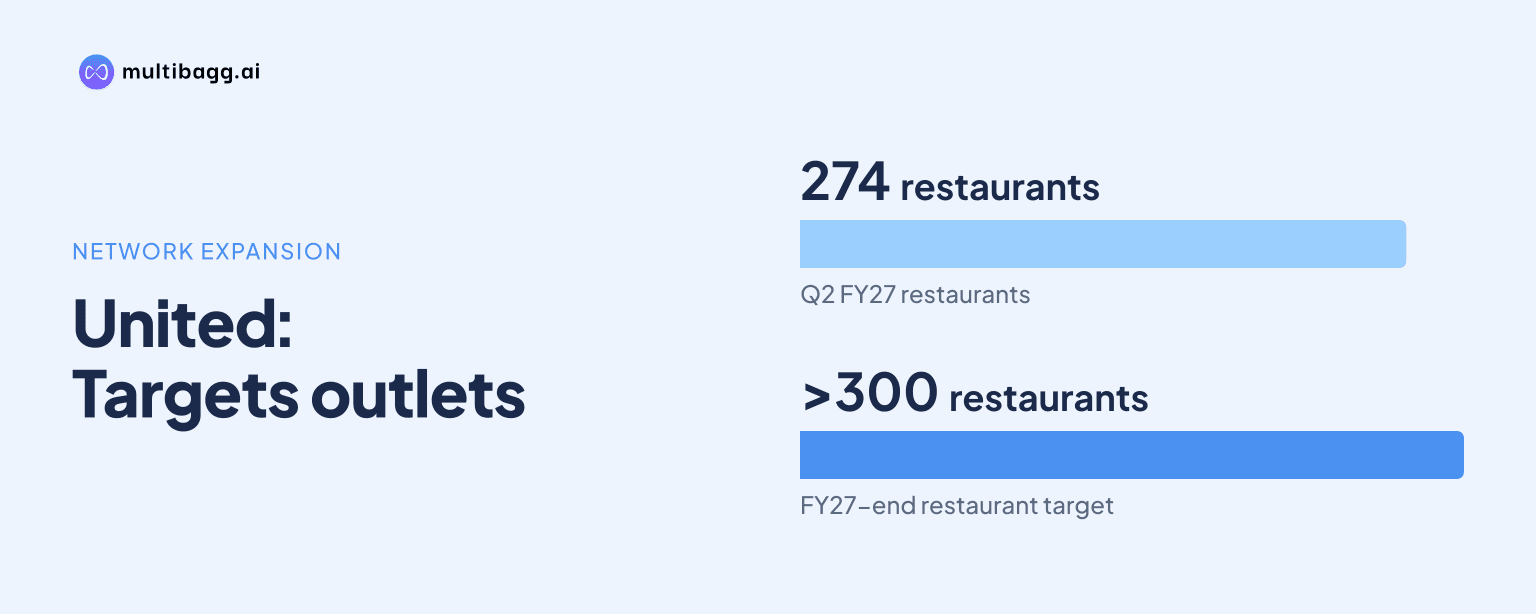
United Foodbrands Limited is on track to cross 300 restaurants by FY27-end after ending Q2 FY27 with 274 outlets and 19 restaurants under construction for Q3 and Q4 openings. Management said the expansion will be funded primarily through internal accruals, while the new-store portfolio’s pre-Ind AS restaurant operating margin rose to 7.4% from 6.1% in Q1 FY27.
Know United Foodbrands inside out
Results, valuation, peers and who's buying, in one view.
How will United Foodbrands cross 300 restaurants by FY27-end?
United Foodbrands plans to use its 19 restaurants under construction, alongside further additions from its pipeline, to cross 300 restaurants by FY27-end. The network stood at 274 restaurants after nine additions in Q2 FY27, and management said the 19 construction-stage sites would open through Q3 and Q4 of the financial year.
On simple arithmetic, the 19 identified openings would take the network to 293 restaurants if all open and there are no closures. United Foodbrands would therefore need at least seven further net additions to move beyond 300, but management did not disclose the locations, formats or opening dates for those additional restaurants during the November 2, 2026 call.
Beyond FY27, United Foodbrands said its medium-term plan is to add 40 to 50 restaurants annually across the portfolio. Management described the pipeline as healthy and said the same site-selection and underwriting discipline used for the Q2 FY27 additions would guide future expansion.
Why does United Foodbrands expect faster new-store maturation?
United Foodbrands expects newer restaurants to reach better economics faster through smaller sites, revised site selection and a higher share of Barbeque Nation India openings. The new-store portfolio generated a 7.4% pre-Ind AS restaurant operating margin in Q2 FY27, compared with 6.1% in Q1 FY27.
Pre-Ind AS refers to the measure before Indian Accounting Standards effects. United Foodbrands reported a 14.7% pre-Ind AS restaurant operating margin for its mature portfolio in Q2 FY27, compared with 7.4% for newer stores, but management said the gap between mature and consolidated margins narrowed to 1.3 percentage points from about 1.6 percentage points in the preceding quarter.
United Foodbrands opened 14 restaurants over the latest two quarters, including 11 Barbeque Nation India outlets. Management said the established Barbeque Nation India brand can help newer locations build customer throughput earlier, while operating lessons from the closure of around 15 to 20 restaurants roughly two years earlier have been incorporated into current site evaluation.
Newer United Foodbrands locations are typically rightsized to about 3,000 square feet, according to management. It said this design improves throughput per square foot while lowering rent, utilities and fixed operating costs per restaurant, mechanisms that can reduce the time required to approach mature-store economics.
Which segments are supporting United Foodbrands' expansion?
United Foodbrands’ three reported businesses all grew revenue in Q2 FY27, led by Barbeque Nation International with 59% year-on-year growth. Consolidated revenue reached Rs 429 crore, up 40.9% year-on-year, while consolidated same-store sales growth, or SSSG, was 24.5%.
Barbeque Nation India recorded 41.4% revenue growth, 27.8% SSSG and 60.8% growth in dine-in transaction volumes in Q2 FY27. Management said approximately 85% of the segment’s business came from dine-in, and that direct relationships with diners support restaurant-level operating performance.
Barbeque Nation International delivered 26.5% SSSG and 64% dine-in transaction-volume growth in Q2 FY27. Management said digital initiatives in Middle East markets, combined with session-wise and day-wise analytics, are helping the segment adjust pricing and demand at individual restaurants amid the regional geopolitical backdrop.
Premium CDR reported 28.5% revenue growth, 7.8% SSSG and about 25% growth in dine-in volumes during Q2 FY27. Management said the FY26 restaurant cohort in Mumbai and Delhi was still building its customer base and brand familiarity, while established Premium CDR markets continued to perform well.
Got a follow-up? Ask IRIS
What is lifting United Foodbrands' revenue per restaurant?
United Foodbrands is seeking to raise revenue per restaurant through fuller use of underutilised meal periods, direct digital engagement, delivery and possible selective price actions. An analyst cited average Barbeque Nation India revenue of Rs 6.4 crore per outlet in H1 FY27, while management said many restaurants already operate above Rs 9 crore.
Management identified weekday lunches and, in some locations, weekend lunches as periods with unused capacity, unlike weekend dinner sessions that are well optimised in many restaurants. It said operating interventions have already increased average revenue per outlet and that further throughput gains should support the portfolio average.
Captive channels are central to this plan. About 90% of total dine-in business came through the app, website, reservation centre and walk-ins, while more than 80% of Barbeque Nation India customers pre-reserved in Q2 FY27, up from around 70% a year earlier.
United Foodbrands also said loyalty-program adoption increased about three times year-on-year and consolidated delivery grew 47% year-on-year in Q2 FY27. Its delivery brands include Barbeque in a Box for kebabs and tikkas, UBQ for daily meals and Dum Safar for biryani; management said targeted campaigns and value stock-keeping units could extend delivery growth.
How will United Foodbrands fund expansion while managing margins?
United Foodbrands said it will fund expansion primarily through internal accruals, although net debt was marginally higher in Q2 FY27 because of capital expenditure on the development pipeline. Management said operating cash flow generated during the quarter largely offset that capital expenditure and that the business operates within its stated leverage limits.
Restaurant-level profitability rose with sales volumes in Q2 FY27. Pre-Ind AS restaurant operating margin was 13.4%, about 520 basis points higher year-on-year, while absolute restaurant operating margin increased 130%; pre-Ind AS adjusted operating margin was 6.1%, about 500 basis points above the prior-year level.
Gross profit increased 39.3% year-on-year and gross margin was 65.5% in Q2 FY27. Gross margin was about 30 basis points lower sequentially because of input-cost inflation, but management identified procurement scale, gross-margin recovery, new-store maturation and corporate-overhead leverage as the four drivers it expects to influence margins.
Management cautioned that SSSG comparisons will become more demanding in Q3 and Q4 FY27 as United Foodbrands laps stronger FY26 periods. For the longer term, management said 5% to 7% SSSG is its intended range for an established restaurant business, compared with roughly 20% average growth over the preceding year.
Conclusion
United Foodbrands’ FY27 expansion plan combines a disclosed 19-restaurant construction pipeline with a stated goal of crossing 300 outlets from 274 at the end of Q2 FY27. The strategy is supported by revenue growth of 40.9% to Rs 429 crore, contribution from all three reported segments and improved new-store margins of 7.4%.
The next measures to watch are the Q3 and Q4 FY27 opening pace for the 19 construction-stage restaurants, any further additions required to exceed 300 outlets, and the effect of input inflation on the 65.5% gross margin. Management’s disclosed plan to add 40 to 50 restaurants annually beyond FY27 and its expectation of narrowing new-store margin drag will also indicate execution progress.