










Aurobindo maps 120 KL biologics capacity build-out to 2030
Key highlights
- Aurobindo targets 120 KL of combined TheraNym biologics capacity by 2030 through two 60-KL units.
- CuraTeQ is adding 10,000 litres through four 2,500-litre mammalian cell-culture bioreactors.
- TheraNym Unit 1 qualification is expected by March 2027, with stockpiling targeted for 2028.
- Aurobindo lists 4 launched biosimilars, 3 filed products and 5 programmes advancing in development.
powered by IRIS
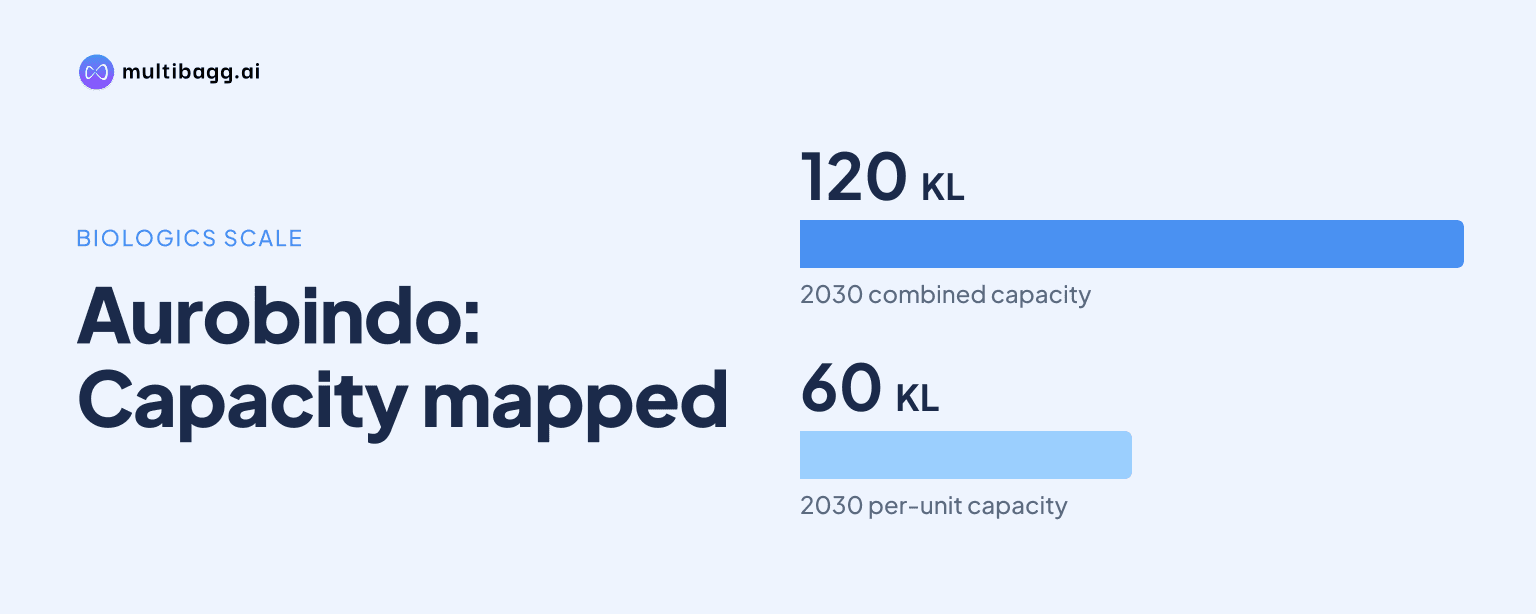
Aurobindo is targeting 120 kilolitres, or KL, of combined biologics contract-manufacturing capacity at TheraNym by 2030, split between two 60-KL units. The plan combines Unit 1 qualification expected by March 2027, a 2028 stockpiling milestone and Unit 2 qualification readiness in 2030, alongside 10,000 litres of added CuraTeQ capacity.
Know Aurobindo Pharma inside out
Results, valuation, peers and who's buying, in one view.
What biologics capacity is Aurobindo targeting by 2030?
Aurobindo is targeting 120 KL of combined mammalian cell-culture bioreactor capacity at TheraNym by 2030. The footprint comprises 60 KL in Unit 1, stated for 2027, and a further 60 KL in Unit 2, which is planned to be ready for qualification in 2030.
The 2030 plan would double TheraNym's stated capacity from 60 KL in Unit 1 to 120 KL across both facilities. Unit 1's 15-KL mammalian cell-culture bioreactors have entered equipment installation qualification and operational qualification, while Unit 2 is a greenfield drug-substance facility connected to the third product schedule with MSD.
Unit 2 construction began with ground-breaking in October 2026, but Aurobindo says full-scale construction remains pending clearances. The company estimates Unit 2 capital expenditure at Rs 1,724.85 crore, calculated from the disclosed amount using the September 2026 closing exchange rate of Rs 95.825 per US dollar.
How is Aurobindo expanding CuraTeQ for biosimilars?
Aurobindo is adding 10,000 litres of mammalian cell-culture capacity at CuraTeQ through four 2,500-litre bioreactors with integrated purification suites. The presentation identifies this as an addition to CuraTeQ's existing capacity but does not disclose the size of the installed base.
Aurobindo also targets completion of the Aurovaccines merger in 2027. The repurposed vaccines facility is expected to add microbial and mammalian drug-substance capacity as well as prefilled-syringe, or PFS, and vial-filling lines by the end of 2027, and management describes that timetable as on track.
CuraTeQ is also pursuing subcutaneous formulations and device-combination products, including auto-injectors and pens. The stated rationale is to address a shift from hospital-administered intravenous treatment to self-administered care at home; the 600-milligram subcutaneous trastuzumab programme is scheduled to enter clinical studies in December 2026.
Which Aurobindo biosimilars are launched, filed or advancing?
Aurobindo lists four launched biosimilars, three filed products and five programmes advancing through development. The launched portfolio covers pegfilgrastim, filgrastim, bevacizumab and trastuzumab, while the later-stage pipeline adds bone-health, respiratory, autoimmune, ophthalmology, immunology and oncology candidates.
DYRUPEG pegfilgrastim is approved by the European Medicines Agency, or EMA, the Medicines and Healthcare products Regulatory Agency, or MHRA, and Health Canada. ZEFYLTI filgrastim is approved by EMA and MHRA, while BEVQOLVA bevacizumab is approved by MHRA, Health Canada and India's Central Drugs Standard Control Organisation, or CDSCO, with Phase 3 work continuing for additional markets. DAZUBLYS trastuzumab is approved by EMA, MHRA and CDSCO.
Among filed products, denosumab brands FUGEVY and FILVIZY are under Committee for Medicinal Products for Human Use, or CHMP, review after filings with EMA and CDSCO. OMAZIJEV omalizumab is filed with EMA, and Aurobindo says a US Food and Drug Administration filing is planned in the current financial year. Beqvola bevacizumab has marketing authorisation in India and is expected to launch in the next quarter; it is already approved by Health Canada and MHRA.
The five advancing programmes have different timelines. BP08 tocilizumab has completed its pivotal study and is planned for filing in 2027, BP05 ranibizumab remains in Phase 3 while recruiting its last few patients, and BP58 subcutaneous trastuzumab is Phase 1-ready for a first subject injection in December 2026. BP31 secukinumab has completed process development, while BP27 pertuzumab is due to start its Phase 1 study in the fourth quarter after completing preclinical development.
Got a follow-up? Ask IRIS
How does MSD support Aurobindo's TheraNym CMO plan?
Aurobindo's TheraNym build-out is anchored by MSD, with Unit 2 forming part of the third product schedule disclosed for that customer. TheraNym is intended as a contract manufacturing organisation, or CMO, providing biologics manufacturing capacity alongside Aurobindo's internally developed biosimilar portfolio.
For Unit 1, Aurobindo expects commissioning and qualification to finish by March 2027. The presentation says the project remains on track for a 2028 milestone involving stockpiling, which is intended to lead to CMO revenue generation, although it does not disclose expected revenue, customer volumes or facility utilisation.
The operating sequence differs between the two units. Unit 1 is in equipment qualification and has a March 2027 completion expectation, whereas Unit 2 has begun at the construction stage and requires clearances before full-scale building work can proceed. That difference makes permits and construction progress material conditions for the 2030 combined-capacity target.
What milestones should readers track in Aurobindo's biologics plan?
Aurobindo's nearest disclosed clinical milestone is the December 2026 first subject injection for BP58 subcutaneous trastuzumab. Regulatory and commercial events also include expected next-quarter Health Canada and US FDA denosumab filings, first supplies of STADA's CAVOLEY and NUGEFY brands in Europe, and the expected India launch of Beqvola.
The manufacturing timetable then moves through March 2027 Unit 1 qualification, end-2027 addition of capacity and fill-finish lines through the repurposed Aurovaccines facility, and the 2028 TheraNym stockpiling milestone. The longer-dated endpoint is Unit 2's planned qualification readiness in 2030, completing the 120-KL footprint.
Conclusion
Aurobindo's biologics plan combines two distinct growth tracks: CuraTeQ is adding 10,000 litres of mammalian cell-culture capacity and broadening its biosimilar portfolio, while TheraNym is planned to reach 120 KL of CMO capacity by 2030. The stated capacity step-up is from 60 KL in Unit 1 to a combined 120 KL after Unit 2, supported by the disclosed MSD relationship.
The next events to watch are BP58's December 2026 clinical entry, Unit 1 qualification by March 2027, Aurovaccines capacity additions by end-2027 and the 2028 stockpiling milestone. For Unit 2, Aurobindo's 2030 target depends on obtaining the pending clearances needed for full-scale construction and progressing the facility toward qualification.