










AUSL can now file VMS TMT amalgamation scheme with NCLT
Key highlights
- AUSL received NSE’s no-objection letter on November 18, 2026.
- AUSL received BSE’s no-adverse-observation letter on November 19, 2026.
- The letters enable an NCLT filing but do not complete the AUSL-VMS TMT amalgamation.
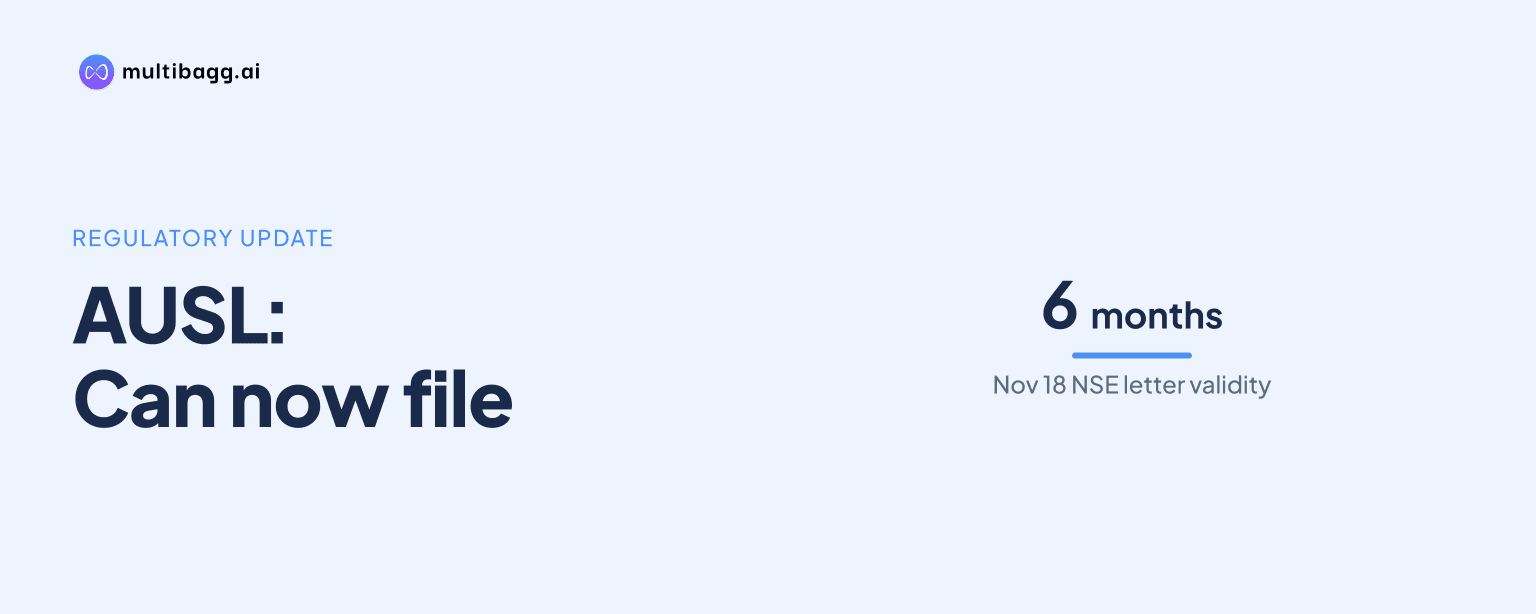
- NSE’s November 18, 2026 observation letter is valid for six months.
powered by IRIS
Aditya Ultra Steel Limited received National Stock Exchange of India Limited and BSE Limited observation letters on November 18 and 19, 2026, allowing AUSL to file its proposed amalgamation with VMS TMT Limited before the National Company Law Tribunal (NCLT). The scheme still requires NCLT, shareholder, creditor and other applicable approvals.
Know Aditya Ultra Steel inside out
Results, valuation, peers and who's buying, in one view.
What do the exchange letters allow AUSL to do?
The November 18 and November 19, 2026 letters allow AUSL and VMS TMT to submit their draft amalgamation scheme to the NCLT. National Stock Exchange of India Limited (NSE) issued a no-objection letter on November 18, while BSE issued a no-adverse-observation letter on November 19, following applications under Regulations 37 and 94(2) of the Securities and Exchange Board of India (SEBI) Listing Obligations and Disclosure Requirements Regulations, 2015.
The scheme would amalgamate AUSL, identified as the transferor and amalgamating company, with and into VMS TMT, identified as the transferee and amalgamated company. AUSL said its board approved the proposal on June 27, 2026, subject to regulatory and other approvals. The proposed court process is under Sections 230 to 232 of the Companies Act, 2013.
NSE stated that its observation was issued under Regulation 37 specifically to enable an NCLT filing. BSE similarly said it had no adverse observations, with limited reference to Listing Agreement provisions, to enable an NCLT filing. The letters therefore mark the end of the stock-exchange observation stage, rather than the completion of the transaction.
Does AUSL have final approval for the VMS TMT amalgamation?
No, AUSL does not have final approval for the VMS TMT amalgamation after the November 18 and 19, 2026 exchange letters. AUSL’s November 19 disclosure says the scheme remains subject to conditions for its effectiveness, approvals from the NCLT, shareholders and creditors where required, and further statutory and regulatory approvals.
NSE said submissions made under the applicable SEBI circular must not be treated as approval or clearance by SEBI, and that neither SEBI nor NSE accepts responsibility for the scheme’s financial soundness or the correctness of submitted statements or opinions. BSE included the same qualification in its November 19 letter, making clear that the exchange process is not an endorsement of the transaction’s merits.
Both exchanges also retained rights after issuing their observations. NSE said it may object at any stage if submitted information is incomplete, incorrect, misleading or false, or if rules, listing regulations or statutory requirements are contravened. BSE said it may withdraw its no-adverse-observation position on similar grounds, so the disclosures and compliance record remain relevant after the NCLT petition is filed.
Got a follow-up? Ask IRIS
What must AUSL disclose to shareholders before a vote?
AUSL and VMS TMT must give shareholders detailed information on the merger rationale, share-swap basis and financial implications before seeking approval under Sections 230 to 232. The exchange observations require the explanatory statement or shareholder notice to address the need for the merger, business synergies, shareholder impact, cost-benefit analysis, and the potential benefits and risks of the amalgamation.
The notice must identify the registered valuer issuing the valuation report and the merchant banker issuing the fairness opinion. It must also summarise the valuation methods considered for the share-swap ratio, explain why those methods were selected, and state the basis for the ratio. The November 19, 2026 filing does not disclose a share-swap ratio, valuation result or fairness-opinion conclusion.
Shareholders must also receive pre- and post-scheme shareholding information as of the meeting-notice date, including the rationale for changes from the draft-scheme filing date. The required materials must include three-year details of revenue, profit after tax and earnings before interest, depreciation, tax and amortisation for both entities, as well as their capital build-up since incorporation and over the previous three years.
AUSL’s assets and liabilities proposed for transfer, together with VMS TMT’s post-merger balance sheet, must also be disclosed in the shareholder materials. Where an unlisted company is involved, prescribed abridged-prospectus information must be included. Any equity shares issued under the scheme must be in dematerialised form, according to the November 18 NSE observations and the November 19 BSE letter.
What deadlines and conditions remain for AUSL?
AUSL must submit the scheme to the NCLT within six months of the respective observation letters. NSE set a six-month validity from November 18, 2026, while BSE set six months from November 19, 2026. Since the NSE letter is dated one day earlier, its validity period is the earlier disclosed timetable for completing the NCLT submission.
The companies must incorporate the SEBI and exchange observations in their NCLT petition and bring those observations to the tribunal’s attention. They must also comply with the Companies Act, 2013 and applicable rules, including obtaining creditor consent where required. The exchanges noted that, after the observations have been processed, the companies do not need to send SEBI another representation notice under Section 230(5) for comments on the same scheme.
The companies must disclose ongoing adjudication, recovery, prosecution and other enforcement actions, if any, involving the entities, promoters or directors before the NCLT and shareholders. Financial information in the scheme, including information used for the valuation report, cannot be more than six months old. Changes to the draft scheme are barred unless mandated by regulators, authorities or tribunals, or unless SEBI gives specific written consent.
AUSL must also publish the exchange no-objection letters on its website within 24 hours of receiving them. In its November 19 disclosure, AUSL said the letters and announcement would be available on its corporate-announcements webpage. NSE additionally required a compliance-status report covering each observation point through its NEAPS system under the Regulation 37/59A scheme-of-arrangement route.
Conclusion
The November 18 and 19, 2026 exchange letters allow AUSL to take its proposed amalgamation with VMS TMT to the NCLT, but they do not approve or complete it. The transaction remains conditional on tribunal proceedings, shareholder and creditor approvals where required, current disclosures, and compliance with SEBI, exchange and Companies Act requirements.
The next disclosed milestone is an NCLT submission within the six-month observation-letter validity period. Investors should watch for the NCLT petition and shareholder notice, which are required to set out the share-swap basis, valuation-method summary, three-year financial data, transferred assets and liabilities, post-merger balance sheet, and any creditor-consent process.