










VMS TMT gets exchange clearance for Aditya Ultra Steel merger
Key highlights
- NSE issued its no-objection letter to VMS TMT on November 18, 2026.
- BSE issued its no-adverse-observation letter on November 19, 2026.
- The exchange letters give VMS TMT six months to file the scheme with the NCLT.
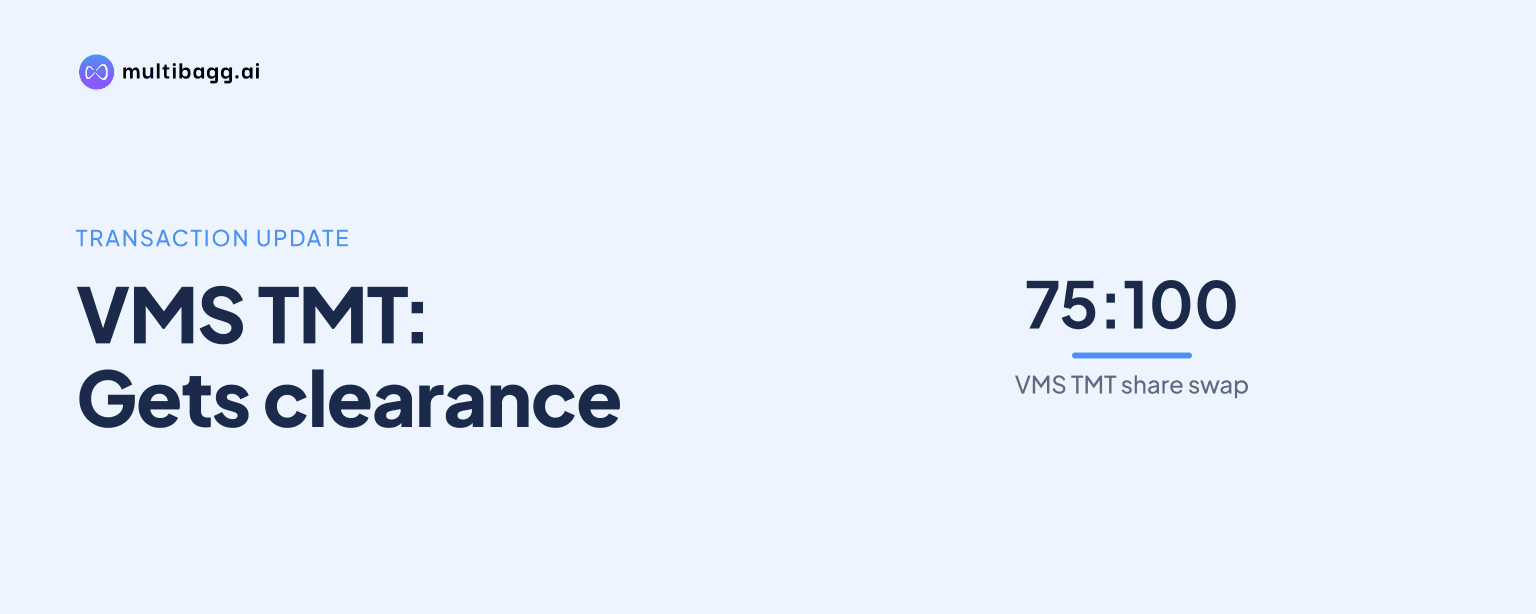
- The board-approved transaction material describes a 75-for-100 VMS TMT share swap and 3.08 lakh tonnes of installed capacity.
powered by IRIS
VMS TMT Limited received NSE and BSE no-objection letters on November 18 and 19, 2026, respectively, allowing it to file the proposed amalgamation of Aditya Ultra Steel Limited with the National Company Law Tribunal within six months. The transaction remains subject to tribunal, shareholder, creditor and other approvals.
Know Aditya Ultra Steel inside out
Results, valuation, peers and who's buying, in one view.
What did the exchange letters allow VMS TMT to do?
The letters allow VMS TMT to move its draft Scheme of Amalgamation to the National Company Law Tribunal, or NCLT. Aditya Ultra Steel is proposed to be merged into VMS TMT under Sections 230 to 232 of the Companies Act, 2013. In the transaction structure disclosed, Aditya Ultra Steel is the transferor and amalgamating company, while VMS TMT is the transferee and amalgamated company.
The National Stock Exchange of India Limited issued its no-objection letter on November 18, 2026, under Regulation 37 of the SEBI Listing Obligations and Disclosure Requirements Regulations, 2015. BSE Limited issued its no-adverse-observation letter on November 19, 2026. VMS TMT disclosed receipt of both communications on November 19.
The exchange observations followed comments received from the Securities and Exchange Board of India. They are an important procedural clearance because a listed company needs to complete the exchange-review stage before pursuing the scheme before the NCLT. But the letters do not make the amalgamation effective or amount to approval of its commercial terms.
How did the Aditya Ultra Steel amalgamation progress?
The amalgamation progressed from board approval in June 2026 to exchange review and now to the tribunal-filing stage. VMS TMT's board approved the scheme on June 27, subject to regulatory and other required approvals. The November letters remove the exchange-observation hurdle but leave the judicial and stakeholder approval process pending.
The exchanges have required adherence to disclosure standards intended to protect shareholder interests. The supplied disclosures refer to requirements concerning ongoing proceedings, website updates, and compliance with provisions governing the transfer of financial obligations and liabilities. Such requirements are relevant because the scheme involves combining two corporate entities and transferring Aditya Ultra Steel into VMS TMT.
NSE also stated that its no-objection should not be interpreted as approval under other laws, regulations, rules or exchange bye-laws. Its communication further clarified that the submitted documents are not a clearance by SEBI, and that SEBI and NSE do not take responsibility for the financial soundness of the scheme or opinions contained in the submitted material.
What approvals are still needed for the merger?
The merger still needs approval from the NCLT and, where required, the shareholders and creditors of both companies. The scheme can take effect only after these conditions and any other statutory or regulatory requirements are fulfilled. This means the exchange letters are not a final merger approval.
VMS TMT must submit the scheme to the NCLT within six months from the dates of the observation letters. The stated validity period gives the company a defined window for the tribunal filing. The available information does not disclose a hearing schedule, shareholder-meeting date, creditor-meeting date or an effective date for the amalgamation.
The transaction must also meet the conditions set out in the scheme and comply with applicable legal processes. Investors should therefore distinguish between permission to file the draft scheme and completion of the corporate restructuring. The latter requires the NCLT process and the remaining stakeholder approvals.
Got a follow-up? Ask IRIS
What are the disclosed terms and operating context?
The supplied announcement material describes a board-cleared share-swap arrangement of 75 VMS TMT shares for every 100 Aditya Ultra Steel shares and refers to annual installed capacity of 3.08 lakh tonnes after consolidation. It also states that the proposal is intended to consolidate Kamdhenu-branded TMT operations in Gujarat.
However, the exchange letters themselves do not state that they have approved or validated the financial terms, valuation, swap basis or financial impact of the scheme. Separate material accompanying the disclosures notes that further detail is required on the rationale, valuation, financial impact and risks. This distinction matters because exchange no-objection letters address the ability to proceed with filing, rather than the merits of the transaction for investors.
No revenue, profit, debt, valuation or expected synergy figures were disclosed in the provided material. As a result, the immediate financial implications for either company cannot be measured from these announcements alone. The announced installed-capacity figure provides operating context, but it does not establish future production, sales or earnings.
How does the clearance affect investors and the steel business?
The clearance advances VMS TMT's corporate-restructuring process, but the supplied information does not report a share-price movement or a quantified market reaction. For investors, the key current fact is that the transaction has cleared an exchange-review step while remaining conditional on NCLT, shareholder, creditor and other approvals.
The proposed combination concerns TMT steel operations in Gujarat and could consolidate the identified operations under VMS TMT if all conditions are met. Until then, the companies remain in the approval stage. The absence of disclosed financial-impact data, as well as the need for further information on valuation and risks, limits a definitive assessment of the effect on VMS TMT's earnings or balance sheet.
The next formal development is expected to be the NCLT filing within the six-month validity period of the exchange letters. Any subsequent tribunal directions, stakeholder voting process, revised disclosures or scheme conditions will be relevant to shareholders because they will determine whether and on what terms the amalgamation becomes effective.
Conclusion
VMS TMT has obtained NSE and BSE observations that permit it to take the proposed amalgamation of Aditya Ultra Steel to the NCLT. The letters are a material regulatory step following the June 27 board approval, but they do not complete the merger, approve its financial soundness or settle the remaining legal and stakeholder conditions.
Investors should watch for confirmation that the scheme has been filed with the NCLT before the six-month validity window ends, along with tribunal directions and disclosures on valuation, financial impact, risks and the approval process for shareholders and creditors.