










Autofurnish profit rises 74% but operating cash flow is negative
Key highlights
- Autofurnish's standalone revenue rose 30% to Rs 25.54 crore in the half year ended September 30, 2026.
- Autofurnish reported standalone profit after tax of Rs 2.87 crore, up 74% from Rs 1.65 crore a year earlier.
- Autofurnish recorded an Rs 8.45 crore operating cash outflow after inventory, receivables and advances increased.
- Autofurnish had utilised Rs 13.60 crore of Rs 14.60 crore IPO proceeds by September 30, 2026.
powered by IRIS
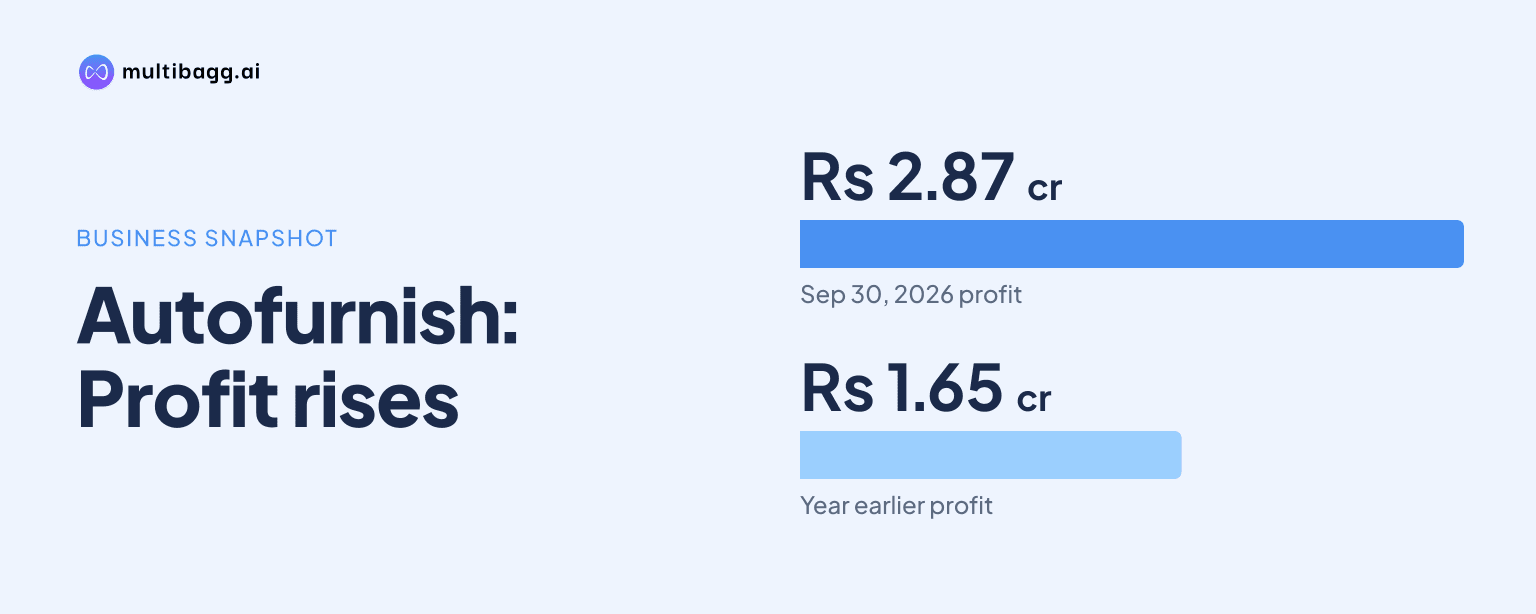
Autofurnish Limited reported standalone profit after tax of Rs 2.87 crore for the half year ended September 30, 2026, up 74% year on year, as revenue rose 30% to Rs 25.54 crore; operating activities nevertheless used Rs 8.45 crore of cash, led by increases in inventories, receivables and advances.
Know Autofurnish inside out
Results, valuation, peers and who's buying, in one view.
How did Autofurnish perform in the half year ended September 2026?
Autofurnish increased standalone revenue from operations to Rs 25.54 crore in the half year ended September 30, 2026, from Rs 19.67 crore in the half year ended September 30, 2025. Total income rose to Rs 26.15 crore from Rs 20.27 crore, including other income of Rs 61.06 lakh, compared with Rs 60 lakh a year earlier.
Profit before tax increased to Rs 3.87 crore from Rs 2.40 crore, while profit after tax reached Rs 2.87 crore from Rs 1.65 crore. Tax expense was Rs 99.36 lakh, compared with Rs 74.58 lakh in the prior-year half. The filing does not give a management explanation for the faster increase in profit than revenue.
Autofurnish also reported higher results than in the half year ended March 31, 2026, when standalone revenue was Rs 17.18 crore and profit after tax was Rs 1.55 crore. The September 2026 figures are unaudited standalone results that received a limited review from the statutory auditor, rather than audited annual accounts.
What costs changed at Autofurnish during the period?
Autofurnish reported cost of materials consumed of Rs 15.48 crore for the September 2026 half year, up from Rs 11.34 crore a year earlier, while purchases of stock-in-trade increased to Rs 7.30 crore from Rs 6.24 crore. Materials remained the largest disclosed expense line in the standalone statement.
The change in inventories of stock-in-trade and finished goods was negative Rs 3.43 crore, compared with negative Rs 1.93 crore in the prior-year period. Employee benefits expense was Rs 1.10 crore, finance cost was Rs 77.22 lakh, depreciation and amortisation was Rs 9.99 lakh, and other expenses were Rs 95.89 lakh.
Total expenses rose to Rs 22.29 crore from Rs 17.87 crore. Finance cost increased from Rs 51.55 lakh and other expenses rose from Rs 67.36 lakh, while revenue grew by Rs 5.87 crore. Autofurnish identifies its activity as a single reporting segment, covering the design, manufacture and trade of automobile accessories for four-wheelers and two-wheelers, so the filing provides no product-level revenue or cost split.
Why was Autofurnish's operating cash flow negative despite profit?
Autofurnish recorded an Rs 8.45 crore operating cash outflow after tax payments despite reporting Rs 3.87 crore of profit before tax. Operating profit before working-capital changes was Rs 4.74 crore, but cash generated from operating activities was negative Rs 8.39 crore before Rs 6.46 lakh of income-tax payments.
The cash-flow statement attributes the outflow to a Rs 5.17 crore increase in inventories, a Rs 4.04 crore increase in trade receivables, and a Rs 3.72 crore increase in loans, advances and other assets. A Rs 29.45 lakh increase in trade creditors partly offset these uses, while liabilities and provisions decreased by Rs 49.20 lakh.
At September 30, 2026, inventories stood at Rs 21.66 crore, compared with Rs 16.48 crore at March 31, 2026, and trade receivables rose to Rs 19.48 crore from Rs 15.44 crore. Short-term loans and advances were Rs 1.62 crore, against Rs 32.24 lakh at March 31, while cash and cash equivalents increased to Rs 1.75 crore from Rs 48.71 lakh following financing inflows.
Got a follow-up? Ask IRIS
How did IPO proceeds affect Autofurnish's balance sheet and cash?
Autofurnish raised Rs 14.60 crore through an initial public offering of 35.61 lakh equity shares at Rs 41 each, and its shares were listed on the BSE SME platform on May 29, 2026. The cash-flow statement records Rs 14.60 crore of share-capital proceeds and Rs 1.53 crore of IPO expenses within financing activities.
By September 30, 2026, Autofurnish reported utilisation of Rs 13.60 crore from the fresh issue and unutilised proceeds of Rs 99.94 lakh. Working capital used Rs 8.69 crore against the disclosed allocation of Rs 9.30 crore, while capital expenditure used Rs 1.50 crore against Rs 1.89 crore allocated.
The company said Rs 1.96 crore allocated to general corporate purposes and Rs 1.45 crore allocated to issue expenses had been fully utilised. Net cash from financing activities was Rs 10.87 crore after share proceeds, IPO expenses, net loan repayment and interest paid, resulting in a Rs 1.27 crore increase in cash and cash equivalents during the half year.
What new businesses and corporate actions did Autofurnish disclose?
Autofurnish disclosed that it acquired a 55% stake in Chhariot Emob Private Limited during the period by purchasing 5,500 equity shares at face value of Rs 10 each. The stated purpose is entry into trading, distribution, assembly and manufacturing of two-wheeler electric vehicles, electric-vehicle parts and batteries.
The consolidated auditor's report shows Chhariot Emob contributed revenue of Rs 87.02 lakh and a loss after tax of Rs 3.87 lakh from September 4, 2026, the acquisition date cited in the filing, to September 30, 2026. Golden Mace Private Limited, the other named subsidiary, recorded revenue of Rs 90.67 lakh and profit after tax of Rs 3.84 lakh before consolidation adjustments.
On November 12, 2026, Autofurnish also disclosed a memorandum of understanding concerning a share acquisition in jointly established Wagenlov Private Limited. The venture is intended to develop, market and sell Wagenlov-branded automotive fragrance and car-care products in India and, in due course, manufacture them; no stake percentage, transaction value, timetable or financial target was disclosed.
Conclusion
Autofurnish combined 30% standalone revenue growth with a 74% increase in profit after tax in the September 2026 half year, but the reported earnings did not translate into operating cash generation. Inventory, receivables, advances and other assets absorbed more cash than the Rs 4.74 crore operating profit before working-capital movements, leaving an Rs 8.45 crore operating outflow.
The next disclosed item to watch is deployment of the remaining Rs 99.94 lakh of IPO proceeds, including Rs 61.04 lakh earmarked for working capital and Rs 38.90 lakh for capital expenditure. Autofurnish has also set out plans for its 55% Chhariot Emob holding and the Wagenlov venture, but has not disclosed implementation dates or financial targets for either initiative.