










Automotive Axles ties margin continuity to demand stability
Key highlights
- Automotive Axles expects required in-house capacity by early next quarter.
- Gear production can take six to eight weeks from steel receipt to finished components.
- Management said similar margins depend on market consistency, product mix and efficient revenue conversion.
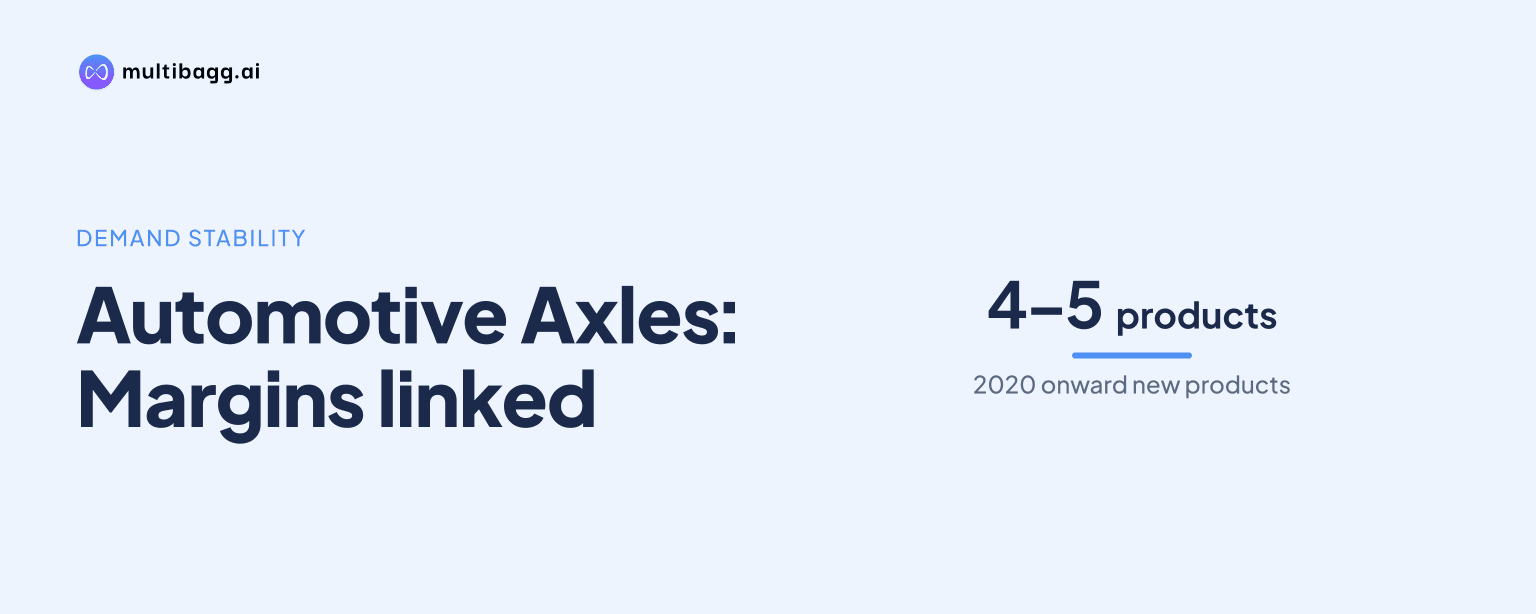
- Automotive Axles said it launched four to five new products from 2020 onward.
powered by IRIS
Automotive Axles Limited said it could sustain margin levels similar to the current period if market conditions remain consistent, because higher revenue improves capacity absorption and operating efficiency. Management did not disclose a 13.7% earnings before interest, tax, depreciation and amortisation, or EBITDA, margin target, and cited product mix, steel availability and supply-chain capacity as variables.
Know Automotive Axles inside out
Results, valuation, peers and who's buying, in one view.
What is driving Automotive Axles' margin outlook?
Automotive Axles said higher revenue is producing absorption benefits and efficiency gains, which management identified as the central drivers of margin expansion. Raman K. said the outcome also depends on product mix and on how efficiently higher revenue is converted into output, making demand conditions in the second half material to the margin outlook.
Management did not provide reported EBITDA, EBITDA margin or a numerical margin target in the supplied discussion. Instead, it said Automotive Axles could deliver similar margin levels if the market remains consistent through the second half, while its operational aim is to remain lean and protect margins. In closing comments, management said realised capacity and strong demand could help convert incremental opportunities at higher margins.
The heavy-duty commercial-vehicle segment has been predominant during the past couple of quarters, including tractor, tipper and some air-suspension applications. Automotive Axles did not assign a fixed margin outcome to this mix, saying that even within heavy-duty axles, the specific product configuration affects profitability alongside production efficiency, commodity costs and inventory management.
Can Automotive Axles meet higher customer demand?
Automotive Axles said it expects to have the required in-house capacity by early next quarter, with a portion of the capacity investment already being realised. Management gave that response to an analyst asking whether the company could accommodate second-half volumes 20% above the prior year's second-half level, but it did not make an unconditional volume commitment.
Management said its ability to fulfil customer schedules is also determined by steel availability, supplier capacity and changes in requested product mix. It said it is engaging with these constraints and expects to meet customer demand as capacity comes on stream, but described the outcome as dependent on converting available opportunities rather than solely on the installed in-house capacity.
The supply-chain timing is especially relevant for gears, which management said can take six to eight weeks from receiving steel through completing the finished component. Automotive Axles also said it faces a wide range of customer requirements, so a sudden change in an original equipment manufacturer, or OEM, forecast can affect both material planning and the speed of response.
How do commodity costs and inventory affect Automotive Axles?
Automotive Axles said commodity and material-price increases are passed through back-to-back with customers, with corresponding arrangements involving suppliers. Management described the direct effect of these arrangements as neutral, unless another factor intervenes, and did not quantify how much first-half revenue reflected higher metal prices because that calculation varies by product mix.
Inventory planning remains a constraint because Automotive Axles serves multiple product variants and OEM forecasts can be volatile. Management said it has customer agreements intended to prevent it from stocking slow-moving or non-moving material, while the operations team is pursuing productivity measures to improve turnaround time and optimise inventory.
The company said that capacity and material planning must account for both demand volume and configuration changes across its axle range. In the heavy-duty segment, larger axles may provide a different revenue opportunity, but Nagaraja Gargeshwari said the result is not determined by axle size alone because commodity headwinds, inventory management and conversion efficiency also matter.
Got a follow-up? Ask IRIS
Which product changes could alter Automotive Axles' mix?
Automotive Axles said its product portfolio for the next three to four years is positioned for a shift toward higher-tonnage and tractor-trailer vehicles in India. Management said its global portfolio includes products already used in markets that adopted safety, anti-lock braking system, electronic braking system and suspension requirements over the past 20 years.
Management cited the 185 product as an example of preparation for this transition, saying it was available three to four years before it began reaching higher volumes. Automotive Axles said it is discussing next-generation axle products with customers and OEMs, particularly products designed to improve efficiency as vehicle power and axle-platform requirements evolve.
From 2020 to the call date, Automotive Axles said it had launched four to five products that were not previously in its portfolio. Management said the range addresses market changes across gross vehicle weight, or GVW, applications from 7 tonnes to 60 or 70 tonnes, although it did not forecast the future split between domestic sales, exports, axle types or vehicle categories.
What could interrupt Automotive Axles' margin delivery?
Automotive Axles identified market consistency as the primary condition for maintaining comparable margins in the coming half. Higher revenue can improve capacity absorption, but management said the benefit depends on having steel, supplier capacity and in-house operations available to convert demand efficiently when customer schedules change.
Exports have remained at broadly the same level as the previous year, according to management, while domestic-market traction is the immediate focus. The company said the recent mix has favoured heavy-duty applications, but it declined to predict how that mix will develop, leaving future results dependent on the specific tractor, tipper, air-suspension and other axle configurations customers order.
Automotive Axles also said it has technology available for future market requirements, including telematics-related Smart Axle solutions and more efficient gears and bearings. However, management said Smart Axle systems are not currently a commercial focus for Indian OEMs, while axle-efficiency norms that could drive wider adoption have not yet been introduced in India.
Conclusion
Automotive Axles' margin outlook is based on an operating mechanism rather than a disclosed percentage target: higher revenue can increase capacity absorption and efficiency. The company expects required in-house capacity by early next quarter and says back-to-back commodity arrangements limit direct material-cost effects, but steel availability, supplier constraints, gear lead times and product-mix changes can influence the result.
The next point to watch is whether the second half is as strong as the first half, as management expects, and whether the added capacity converts demand without supply-chain disruption. Management's disclosed plan also points to monitoring demand for higher-tonnage products and the pace at which OEMs adopt efficiency-focused axle technologies from its global portfolio.