










Automotive Axles says global portfolio prepares for India shift
Key highlights
- Automotive Axles said relevant safety, braking and suspension technologies have been used in overseas markets for about 20 years.
- Automotive Axles launched four to five products from 2020 onward for changing commercial-vehicle demand.
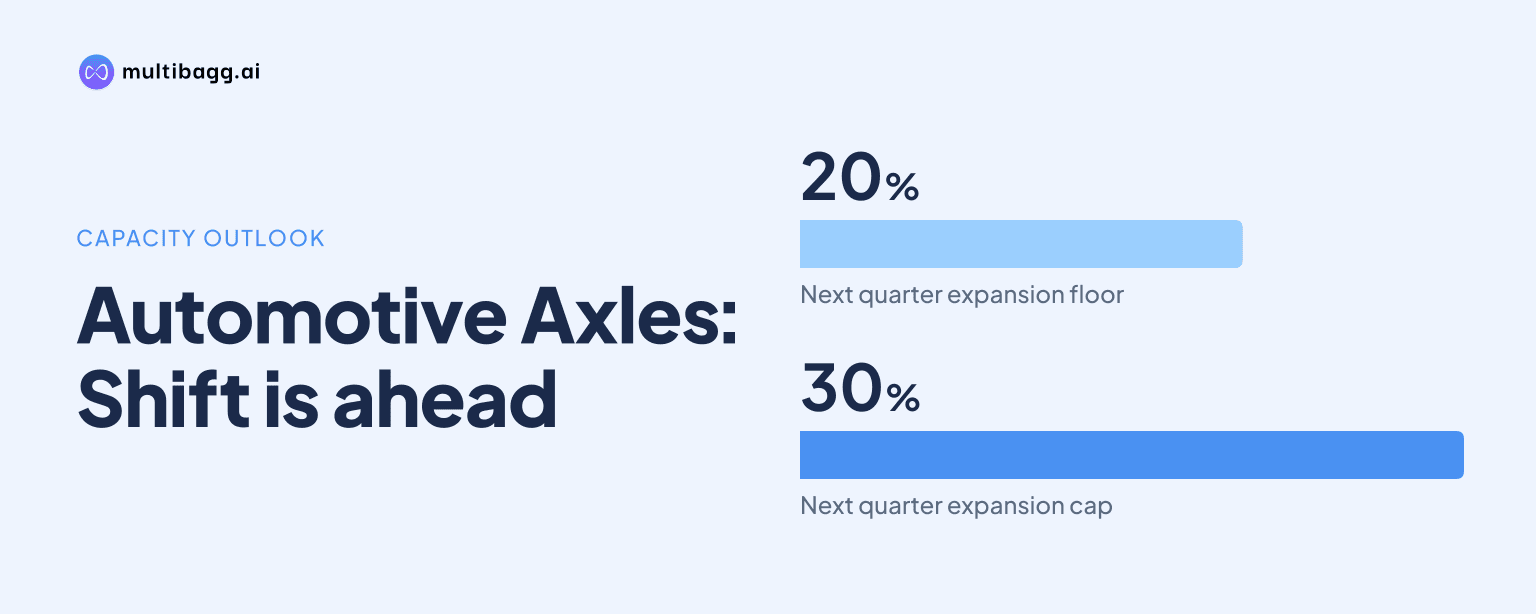
- Automotive Axles expects its capacity expansion of at least 20% to 30% to be completed by the next quarter.
- Automotive Axles said its tandem axle should enter production and begin ramp-up in the fourth quarter.
powered by IRIS
Automotive Axles Limited says its global portfolio prepares it for India’s shift to higher-tonnage commercial vehicles and future axle-efficiency requirements, with safety, anti-lock braking system, electronic braking system and suspension technologies proven in overseas markets for the past 20 years. Management said it has launched four to five products since 2020 for this market shift.
Know Automotive Axles inside out
Results, valuation, peers and who's buying, in one view.
How is Automotive Axles positioned for changing commercial-vehicle regulations?
Automotive Axles is positioned for safety and suspension-related regulatory changes because its Indian products are already proven in overseas markets that adopted such systems about 20 years ago. Management cited anti-lock braking system, electronic braking system and suspension technologies, while saying India is introducing multiple commercial-vehicle regulations each year. Anti-lock braking system prevents wheel lock, while electronic braking system electronically controls braking functions.
Automotive Axles said emissions regulations do not directly affect its axles or brakes because they concern engines, although higher horsepower can change axle-platform requirements. The company has shifted to the largest axle in its current portfolio and said two or three additional product levels are available for evaluation. Management said its portfolio is protected for the next three to four years against an anticipated move toward higher-tonnage, higher-horsepower tractor-trailers.
What is driving Automotive Axles’ higher-tonnage strategy in India?
Automotive Axles said heavy-duty demand has been predominant over the last couple of quarters, led by tractors, tippers and some air-suspension models. Management linked the expected shift toward higher-tonnage tractor-trailers to better roads, infrastructure and regulation, but did not forecast the future mix of vehicle categories or products.
The company cited its “185” product as evidence of earlier preparation: the product was available three to four years before management said volumes began reaching high numbers. Automotive Axles also said it can serve a 5 lakh tonnage market in the medium and heavy commercial vehicle segment with its current portfolio. Management confirmed that current capacity should manage peak demand in that market, subject to material availability and changes in customer mix.
Which products are Automotive Axles launching for changing demand?
Automotive Axles said its coach axle for 13.5-metre and 15-metre buses was launched two quarters earlier and is in production. A separate bus axle associated with floor-height vehicle configuration is still under development, as management said the relevant regulation affects how original equipment manufacturers, or OEMs, configure a vehicle rather than the axle itself.
The second bus axle is 90% to 95% validated, but Automotive Axles has slowed its development to free laboratory capacity for alternate-supplier validation. Management said it will launch the product when market conditions are appropriate, while present demand is concentrated in heavy-duty trucks. It also expects its tandem axle, the second heavy-duty product, to enter production and begin ramp-up in the fourth quarter of the year.
Got a follow-up? Ask IRIS
What axle technologies could Automotive Axles bring to India next?
Automotive Axles identified axle efficiency as the next technology issue likely to reshape product design in India. Management said India currently has no rule requiring OEMs to demonstrate axle efficiency, unlike Western markets where suppliers may declare axle efficiency and OEMs may report axle and vehicle efficiency together. When such a norm emerges, gears and bearings could become lighter and more efficient without materially changing the axle’s outward form.
Automotive Axles said these efficiency technologies have already been demonstrated in global markets and can be introduced when Indian demand is ready. Smart Axle systems are another available option: the company has completed telematics projects in India that can send axle-health data to a cabin or vehicle-level system. However, management said OEMs are currently focused on safety, engines and emissions, and Smart Axles are not broadly commercialised even in Western markets.
Does Automotive Axles have capacity to support the strategy?
Automotive Axles said its ongoing programme is designed to increase capacity by at least 20% to 30%, with some benefit already realised and completion expected by the next quarter. Management said Rs 26 crore of capital work in progress was the final implementation phase of a previously committed Rs 120 crore investment. The spending was intended to meet current customer demand rather than being a newly announced technology programme.
Management said capacity alone does not determine deliveries because steel availability, supplier capacity and abrupt product-mix changes can constrain output. Gears can require six to eight weeks from steel procurement through finished-part production. Automotive Axles said it works with customers to avoid inventory of slow-moving or non-moving materials, while commodity-price changes are generally passed through back-to-back with customers and suppliers.
Conclusion
Automotive Axles’ stated technology case rests on transferring products and know-how already used abroad into an Indian market moving toward higher-tonnage trucks, safety systems and eventually efficiency-focused requirements. Management’s evidence includes overseas use of relevant technologies for about 20 years, four to five launches since 2020, and product coverage across gross vehicle weights of 7 tonnes to 60 or 70 tonnes.
The next milestones are the planned fourth-quarter tandem-axle production ramp-up, a possible launch of the 90% to 95% validated bus axle, and completion of the 20% to 30% capacity expansion by the next quarter. Management also said it will work with its board on investments, products and technologies supporting its stated Rs 5,000 crore top-line ambition by 2030, while Indian axle-efficiency rules remain unresolved.