










Avalon box-build supplied 61% of H1 FY27 total revenue
Key highlights
- Avalon said box-build solutions supplied 61% of revenue in H1 FY27.
- Avalon has 17 manufacturing facilities: 13 in Chennai, three in Bengaluru and one in Atlanta.
- India accounted for 73% of Avalon’s geographic revenue contribution, compared with 27% from the US.
- Avalon enhanced its box-build capabilities in 2016 after acquiring design capabilities in 2009.
powered by IRIS
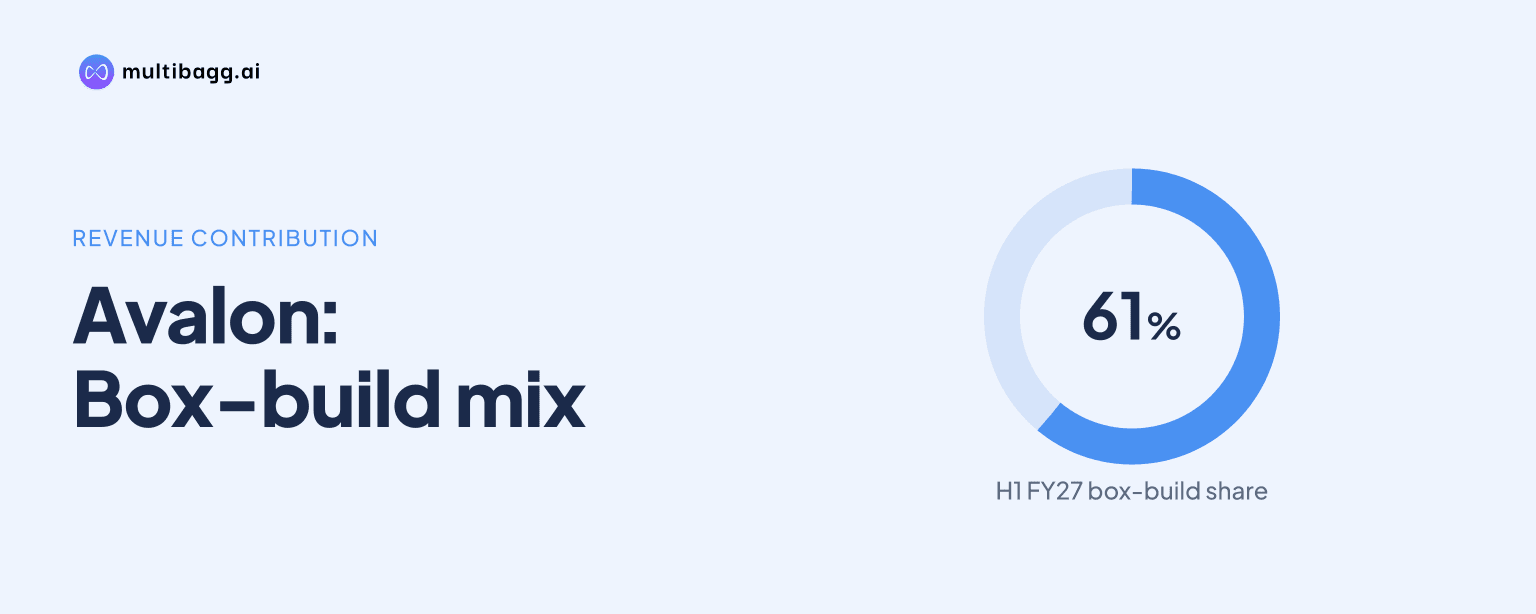
Avalon Group said box-build solutions supplied 61% of its revenue in H1 FY27, making integrated system assembly a reported majority of its sales mix. Avalon combines printed circuit board design and assembly, cables, metalwork, plastics, system integration and testing across 16 Indian facilities and one US facility through its hybrid delivery model.
Know Avalon Technologies inside out
Results, valuation, peers and who's buying, in one view.
What share of Avalon revenue came from box-build solutions?
Avalon said box-build solutions represented 61% of its revenue in H1 FY27. The presentation does not disclose the rupee revenue represented by that percentage, sales by customer, or the equivalent share for FY26, so it establishes the H1 FY27 mix without providing a year-on-year comparison.
Box build is positioned after rapid prototyping, design and new-product development and before logistics, repair and reverse logistics. The process therefore extends beyond a single component or a printed circuit board (PCB), bringing multiple manufactured elements into a finished system that can undergo functional testing before delivery.
Avalon’s timeline identifies 2016 as the year it enhanced box-build capabilities, while its current focus is fully integrated solutions and in-house box-build solutions. This marks a stated shift from its first phase of serving small clients and supplying PCB work, followed by a phase focused on larger customers and diversified product offerings.
The 61% box-build figure is a product and service mix measure. It differs from Avalon’s 73% India and 27% US figures, which the presentation identifies as revenue contribution by geography; the material does not state that box-build sales follow the same 73:27 geographic split.
How does Avalon produce a box-build solution?
Avalon produces a box-build solution through a vertically integrated sequence from PCB design and analysis to functional testing. Its listed build stages include PCB assembly, cable assembly, sheet metal, magnetics, machining, plastics and system integration, allowing several parts of an end product to be handled within its manufacturing network.
Avalon separately lists cable assembly and wire harnesses, sheet-metal fabrication and machining, and injection-moulded plastics among its vertically integrated capabilities. The presentation describes box build as end-to-end assembly of these elements, rather than only electronic assembly, with new-product development included alongside the production process.
Rapid prototyping and design and new-product development precede the build stages in Avalon’s product offering. Logistics, repair and reverse logistics follow box build, creating a disclosed chain from prototype development through delivery and post-delivery handling.
The capability base broadened over several years. Avalon commenced metals and plastics production in 2003, expanded manufacturing capabilities in the US in 2007, acquired design capabilities in 2009, entered aerospace in 2010 and railways in 2011, and enhanced box build in 2016 before becoming a fully integrated electronics manufacturing services provider.
Got a follow-up? Ask IRIS
Where does Avalon manufacture under its hybrid delivery model?
Avalon operates 17 manufacturing facilities: 13 in Chennai, three in Bengaluru and one in Atlanta, Georgia. Its presentation assigns 73% of geographic revenue contribution to India and 27% to the US, outlining the India-US footprint used in its hybrid delivery model.
The client-delivery model describes three routes: Make in India for India and export, Make in US for US customers, and a hybrid route between them. Avalon associates this model with building locally and expanding globally, while also listing labour-intensive work, automation and configuration as operating considerations.
India has 16 of Avalon’s 17 listed facilities across Chennai and Bengaluru, compared with one in Atlanta. That site distribution differs from the stated 73% India and 27% US geographic revenue contribution, although the presentation does not disclose output, capacity or box-build activity by individual location.
Avalon’s US manufacturing presence predates the current 17-facility network. Its timeline records customer presence in Fremont, California and Atlanta, Georgia, and says it expanded US manufacturing capabilities in 2007; the current presentation describes local customer service and hybrid delivery but gives no facility-addition schedule.
Which markets use Avalon’s integrated manufacturing capabilities?
Avalon applies its integrated manufacturing capabilities across railways, aerospace, automotive, industrial, communication, medical devices, clean energy and semiconductor equipment. Listed applications include aircraft cabin and engine parts, railway signalling and braking systems, battery energy storage systems, telecom equipment and satellite systems.
In railways, Avalon lists electronic interlocking, the Kavach train collision avoidance system, braking systems, traction systems and metro platform-door control systems. Its aerospace applications include seating systems, cabin systems, smoke detectors, combustion liners, engine parts, wiper assemblies and lighting enclosures.
Avalon’s industrial products include instrumentation and analyser systems, high-voltage direct current control panels, high-current semiconductor test boards, inverter modules, semiconductor manufacturing equipment and delivery-robot camera systems. Its communication products include base-band units, digital antennas, fleet-management equipment, vehicle-tracking systems, telematic device control units, mining-worker wearables and high-performance servers.
Avalon lists quality and process certifications including ISO 9001, ISO 13485:2016 for medical devices, IATF 16949 and ESD S20.20 certification for an electrostatic-discharge control programme. The presentation does not specify which certification applies to each of the 13 Chennai, three Bengaluru or one Atlanta manufacturing units.
Conclusion
Avalon’s 61% H1 FY27 box-build revenue share shows that integrated system assembly is the central disclosed feature of its current sales mix. The model combines design, PCB work, cables, metal fabrication, plastics, magnetics, integration, testing and post-delivery services, supported by 73% of geographic revenue contribution from India and 27% from the US.
The next disclosed execution point is Avalon’s stated focus on box-build solutions and hybrid delivery across 13 Chennai facilities, three Bengaluru facilities and one Atlanta facility. The presentation provides no box-build growth target, capacity-expansion timetable, FY26 comparator for the 61% measure or segment-level revenue split, leaving those measures unresolved.