










AvenuesAI H1 cash flow turned negative amid settlements
Key highlights
- AvenuesAI reported negative H1 FY2027 operating cash flow of Rs 192 crore, primarily linked to faster merchant settlements.
- AvenuesAI’s H1 FY2027 revenue from operations rose 71% year on year to Rs 5,560 crore.
- AvenuesAI’s Q2 FY2027 TPV rose 19% sequentially to Rs 1.77 lakh crore, while the net take rate was 5.06 basis points.
- AvenuesAI held Rs 546.5 crore of cash and cash equivalents at September 30, 2026.
powered by IRIS
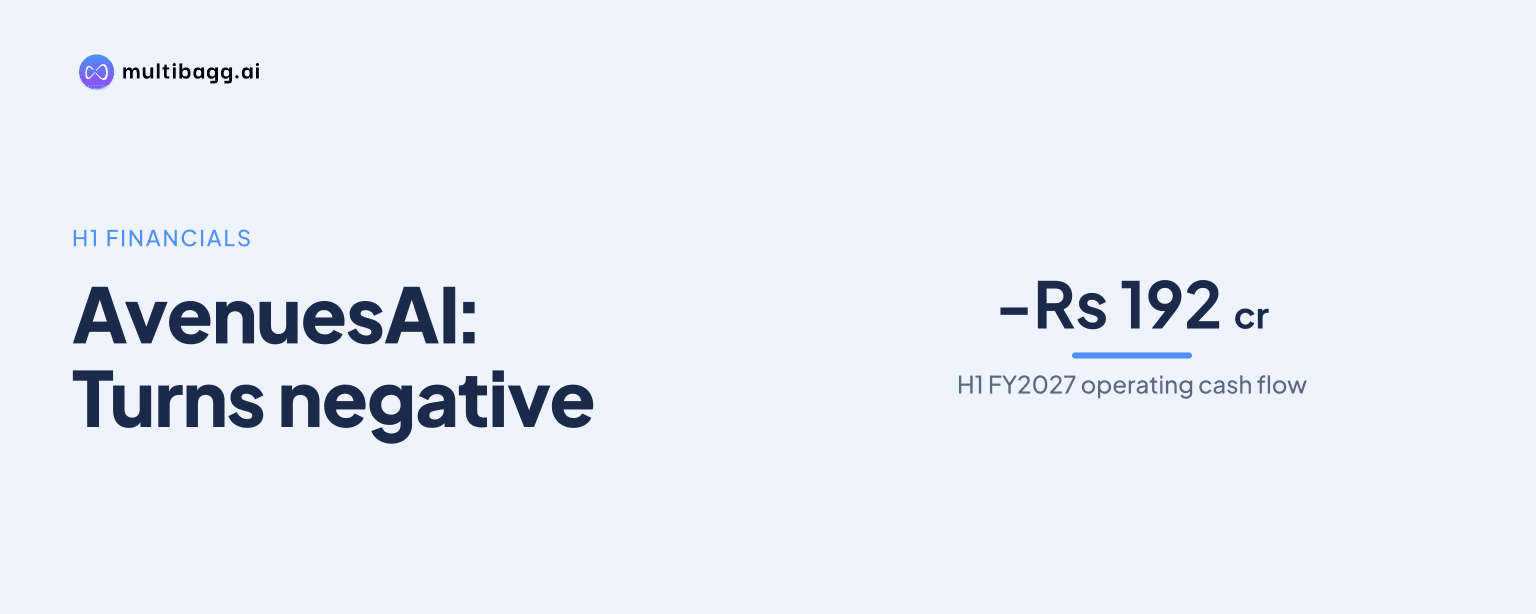
AvenuesAI Limited reported a negative Rs 192 crore operating cash flow in H1 FY2027 despite revenue from operations rising 71% year on year to Rs 5,560 crore. Management attributed the outflow primarily to faster merchant settlements, which bring forward payouts to merchants and create timing-related working-capital requirements for AvenuesAI.
Know AvenuesAI inside out
Results, valuation, peers and who's buying, in one view.
Why did AvenuesAI report negative operating cash flow?
AvenuesAI reported negative H1 FY2027 operating cash flow of Rs 192 crore because of significant working-capital movements, primarily related to accelerated merchant settlements, management said. The company said faster settlement cycles allow merchants to receive funds sooner, but create timing-related cash outflows for AvenuesAI.
The cash-flow outcome differed from the income-statement results for the same six-month period. H1 FY2027 revenue from operations rose 71% year on year to Rs 5,560 crore, operating earnings before interest, tax, depreciation and amortisation (EBITDA), excluding other income, increased 19% to Rs 199 crore, and consolidated profit after tax increased 24% to Rs 156 crore. Reported revenue and profit therefore increased while operating cash flow was negative.
Management said the faster-settlement approach is intended to improve merchant experience, support merchant liquidity and strengthen its competitive position. AvenuesAI also said it is focused on optimising working capital, maintaining adequate liquidity and improving cash conversion as the business scales; it reported Rs 546.5 crore of cash and cash equivalents at September 30, 2026.
How are faster merchant settlements affecting AvenuesAI’s working capital?
Faster merchant settlements are increasing AvenuesAI’s working-capital requirement because they require earlier payouts to merchants, according to management’s explanation for the negative Rs 192 crore H1 FY2027 operating cash flow. Management said the policy lets merchants access funds sooner and can improve their liquidity and performance on the platform.
AvenuesAI did not disclose the number of settlement days reduced, the specific working-capital components involved, or the amount of the Rs 192 crore outflow attributable to settlements. It described the cash effect as timing-related and said it would seek to balance settlement efficiency with prudent liquidity management and better cash conversion.
The settlement policy coincided with a volume-led payments strategy in Q2 FY2027. Payments transaction processing volume (TPV) rose 19% sequentially to Rs 1.77 lakh crore, while the net take rate was 5.06 basis points. Management said the rate declined about 4% sequentially because it consciously prioritised transaction volumes, including ahead of the festival period.
Management’s stated rationale is that competitive pricing, reliable payment infrastructure and efficient settlements can support more durable merchant relationships. AvenuesAI did not provide a target for operating cash flow to return positive, but said it would assess investments and initiatives against commercial potential, capital requirements and expected returns.
Did AvenuesAI’s revenue growth translate into proportional profit growth?
Revenue growth did not translate into proportional operating-profit growth in H1 FY2027: revenue increased 71% to Rs 5,560 crore, while operating EBITDA excluding other income rose 19% to Rs 199 crore. Consolidated profit after tax increased 24% to Rs 156 crore, also below the first-half revenue growth rate.
The pattern was also visible in Q2 FY2027. Revenue from operations increased 47% year on year to Rs 2,879 crore from Rs 1,965 crore in Q2 FY2026, while operating EBITDA excluding other income was Rs 98.9 crore compared with Rs 96.2 crore a year earlier. Q2 profit after tax was Rs 71.70 crore, compared with Rs 67.6 crore in the corresponding prior-year quarter.
Management linked its pricing approach to building transaction scale and future data-led opportunities rather than immediate take-rate expansion. It said that additional services could potentially be developed around enterprise technology, merchant intelligence, digital services and artificial-intelligence-enabled financial workflows, but did not report any H1 FY2027 revenue contribution from those initiatives.
Got a follow-up? Ask IRIS
What is AvenuesAI doing beyond its payments business?
AvenuesAI is pursuing Rediff integration, selective international payments expansion and TISco, its transaction-intelligence initiative, alongside the payments business that processed Rs 1.77 lakh crore of TPV in Q2 FY2027. Management said its immediate priorities include Rediff commercial execution and integration, as well as developing TISco responsibly.
Rediff is intended to connect enterprise communications, commerce, payments and technology services through products including RediffOne and RediffPay. Management said Rediff had an annualised revenue run rate above Rs 200 crore and generated about Rs 100 crore of annual profit, describing both as ballpark figures. It added that revenue synergies could take a few quarters to emerge, without setting a quantified target.
CCAvenue already has an international presence in the United Arab Emirates, Saudi Arabia and Oman, management said. The company identified the United States as an important priority but said it would pursue additional markets selectively, given market-specific regulatory requirements, competition and commercial considerations.
TISco is being conceptualised and developed for potential applications including merchant intelligence, risk management, fraud prevention and financial-services workflows. Management said the initiative could use permitted transaction-related information with appropriate governance and regulatory safeguards, but it remains under development and has no disclosed revenue stream in FY2027.
What does AvenuesAI’s FY2027 guidance indicate after H1?
AvenuesAI retained its previously communicated FY2027 consolidated revenue guidance of Rs 11,000 crore to Rs 13,000 crore after reporting H1 revenue from operations of Rs 5,560 crore. Management did not revise the range or provide a quarterly revenue target for the second half of FY2027.
Management also reiterated FY2027 earnings-per-share guidance of Rs 8.75 to Rs 9.50 after reporting about Rs 4.50 per share in the first half. It said it remained within that range, while its priorities for the rest of FY2027 include expanding transaction scale, strengthening merchant experience, advancing Rediff commercialisation, developing TISco and assessing selective international opportunities.
Cash conversion remains a separate disclosed issue from earnings guidance. AvenuesAI had Rs 546.5 crore of cash and cash equivalents and total equity of Rs 5,145 crore as of September 30, 2026, alongside the negative Rs 192 crore H1 operating cash flow. Management did not provide a cash-flow target or a timetable for reducing settlement-related working-capital pressure.
Conclusion
AvenuesAI’s H1 FY2027 figures show the cash consequence of its merchant-settlement strategy: revenue rose 71% to Rs 5,560 crore and profit after tax increased 24% to Rs 156 crore, but operating cash flow was negative Rs 192 crore. Management attributed the difference primarily to earlier merchant payouts, while lower take rates and higher TPV indicate that it is also prioritising scale.
The next disclosures to watch are progress toward the Rs 11,000 crore to Rs 13,000 crore FY2027 revenue range, cash-conversion trends and Rediff’s commercial contribution. Management said Rediff synergies may take a few quarters, while TISco remains in development and international expansion is being pursued selectively, leaving their timing and financial impact unresolved.