










AVG Logistics puts 30 EVs on five-year Assam contract
Key highlights
- AVG Logistics had 30 EVs live for Dalmia Cement in Assam in Q2 FY27.
- The Assam contract is disclosed as five years with “(+3)” and AVG Logistics-operated charging stations.
- AVG Logistics plans to add about 200 alternative-fuel vehicles during FY27.
- AVG Logistics reported standalone revenue of Rs 154 crore and PAT of Rs 7.3 crore in Q2 FY27.
powered by IRIS
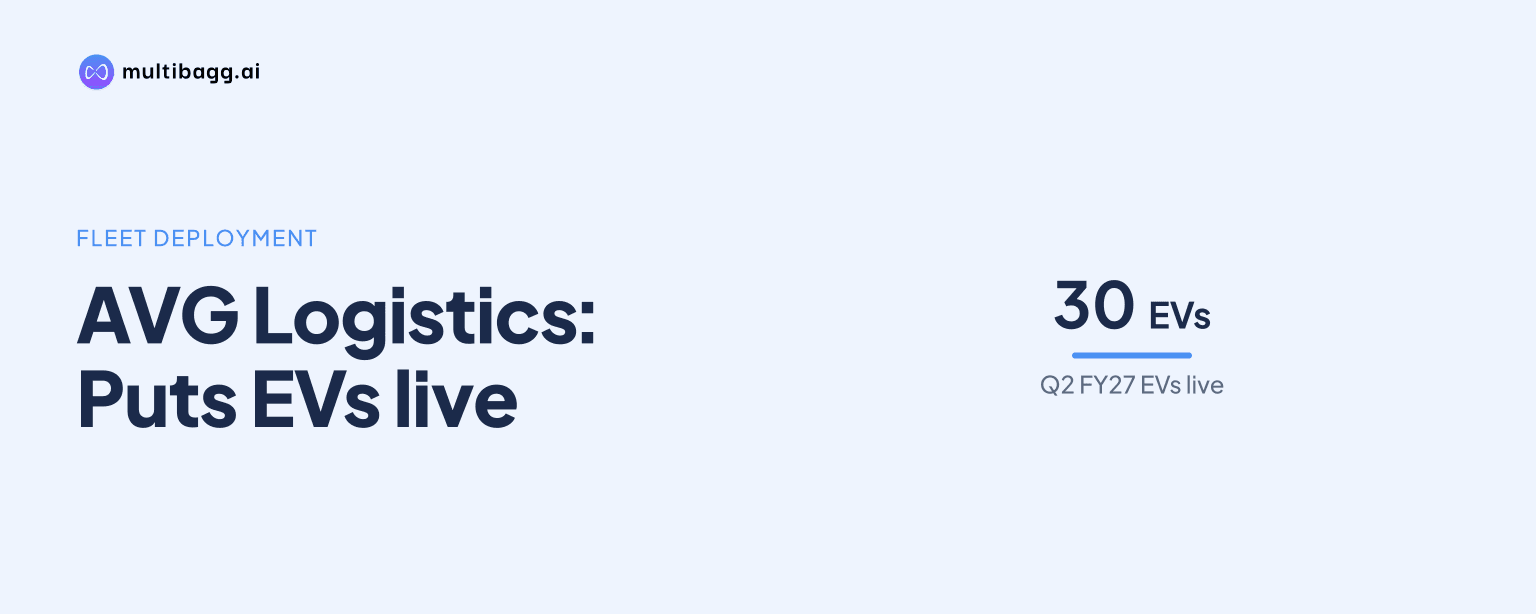
AVG Logistics had 30 electric vehicles live for Dalmia Cement in Assam in Q2 FY27 under a five-year contract marked “(+3)”, with AVG Logistics operating the charging stations. The arrangement combines dedicated electric transport and charging operations, while the presentation does not disclose its revenue, capital cost, routes or utilisation.
Know AVG Logistics inside out
Results, valuation, peers and who's buying, in one view.
What does AVG Logistics operate for Dalmia Cement in Assam?
AVG Logistics operates 30 electric vehicles for Dalmia Cement in Assam, with the fleet live in Q2 FY27 under a five-year contract carrying a “(+3)” notation. AVG Logistics also operates the charging stations, according to the company’s green-logistics presentation.
The contract therefore includes both vehicle operations and charging infrastructure rather than only a vehicle deployment. AVG Logistics does not explain the meaning of the “(+3)” notation or disclose the contract value, charging capacity, vehicle specifications, route distance, charging costs or fleet utilisation. It says customers choose its green-logistics offering for lower emissions that support environmental, social and governance, or ESG, goals under long-term dedicated contracts.
How does the Dalmia Cement assignment compare with AVG Logistics’ other green fleets?
AVG Logistics lists the Dalmia Cement deployment among electric vehicle, liquefied natural gas, or LNG, and compressed natural gas, or CNG, fleet initiatives. Its presentation identifies electric fleets for Tata Steel, Dalmia Cement and Nestlé; LNG operations for ITC; and a CNG programme for Nestlé with Ashok Leyland.
The 30-vehicle Dalmia Cement fleet exceeds the five heavy-duty electric trucks that AVG Logistics lists for Tata Steel routes. The company describes the Tata Steel operation as India’s first 55-tonne EV fleet, while it gives no comparable weight capacity for the Dalmia Cement vehicles. This prevents a like-for-like comparison of carrying capacity despite the higher vehicle count in Assam.
AVG Logistics says its first LNG fleet was launched in April 2024 for ITC in Pune with Blue Energy Motors. It also identifies Carbonlite Logistics, its joint venture with Baidyanath Group, as a vehicle for operating LNG, EV and CNG fleets at scale. The company plans to add about 200 alternative-fuel vehicles in FY27, but does not state how many will be EVs, LNG vehicles or CNG vehicles.
What were AVG Logistics’ Q2 FY27 revenue and profit results?
AVG Logistics reported standalone revenue of Rs 154 crore in Q2 FY27, up 16.3% from Rs 132.4 crore in Q1 FY27 and 6.6% from Rs 144.5 crore in Q2 FY26. Standalone profit before tax, or PBT, reached Rs 10.3 crore and profit after tax, or PAT, was Rs 7.3 crore in the quarter.
Standalone PBT margin rose to 6.7% in Q2 FY27 from 6.2% in Q1 FY27 and 4.5% in Q2 FY26. PAT margin was 4.8%, compared with 4.6% in the preceding quarter and 3.5% a year earlier. For H1 FY27, standalone revenue increased 6.2% year on year to Rs 286.5 crore, while PAT increased 33.0% to Rs 13.3 crore.
These figures cover the overall standalone business and cannot be assigned to the Assam contract. The presentation does not provide Dalmia Cement contract revenue, profit, asset ownership or a segment-level breakdown of green-fleet economics.
Got a follow-up? Ask IRIS
Did AVG Logistics’ cement revenue rise in Q2 FY27?
AVG Logistics’ reported cement revenue fell to Rs 4.68 crore in Q2 FY27 from Rs 5.89 crore in Q1 FY27, even as total revenue in its industry-mix disclosure rose to Rs 151.41 crore from Rs 130.78 crore. The newly live Dalmia Cement EV operation should not be treated as the cause of either movement because the company provides no customer-level revenue allocation.
Fast-moving consumer goods, or FMCG, revenue increased by Rs 14.13 crore quarter on quarter to Rs 80.25 crore. PTL revenue rose by Rs 6.84 crore to Rs 22.33 crore, while cement declined by Rs 1.21 crore. AVG Logistics does not define PTL in this presentation, and it does not reconcile the industry-mix table with the Rs 154 crore standalone revenue reported for Q2 FY27.
How does AVG Logistics’ green strategy extend beyond electric fleets?
AVG Logistics combines alternative-fuel fleets with rail freight and vehicle-allocation measures in its green-logistics strategy. It says one train carries about 35 to 40 truckloads, moves more than 2.25 lakh tonnes by rail annually and uses 96 International Organization for Standardization, or ISO, tanks for chemical transport.
The company also says its command centre assigns the nearest truck to each load to cut empty trips, and that it is ISO 14001 certified. These mechanisms are distinct from the Dalmia Cement charging-station operation: rail freight changes the transport mode, while the command centre addresses truck allocation. The presentation does not quantify emissions reductions from the Assam fleet, rail movement or reduced empty trips.
AVG Logistics places its green fleet joint venture among the margin levers in its Vision 2.0 plan. Management’s plan links LNG, EV and CNG fleets with India’s stated 2030 target of a 45% rail freight share, but the presentation does not quantify the joint venture’s current revenue, margin or fleet count.
How does the Assam contract fit AVG Logistics’ FY30 plan?
AVG Logistics includes steel, cement, coal and heavy commodities in its industrial-logistics growth plan, which targets more than Rs 100 crore of revenue against a stated Rs 12 crore starting point. The Dalmia Cement contract serves a sector named in that plan, but the company does not say whether its revenue is included in either figure.
Management’s Vision 2.0 plan targets revenue of Rs 1,250 crore and PAT of Rs 120 crore by FY30E, compared with Rs 582 crore and Rs 26 crore respectively in FY26. The company characterises this as 2.1 times revenue growth and 4.6 times PAT growth. These are management targets, not reported results.
The plan also specifies Rs 100 crore of capacity capital expenditure in FY25-26 followed by about Rs 50 crore annually. It includes more than 2 lakh square feet of added warehousing and clearing-and-forwarding capacity, with land identified in Himachal Pradesh and Odisha. AVG Logistics does not allocate this planned spending between charging stations, alternative-fuel vehicles, rail logistics and warehousing.
Conclusion
The Dalmia Cement assignment shows AVG Logistics operating a 30-vehicle electric fleet and its charging stations in Assam, expanding the disclosed role beyond transport alone. It sits within a wider mix of EV, LNG, CNG, rail and truck-allocation initiatives, while the reported Q2 FY27 cement revenue of Rs 4.68 crore was lower than Rs 5.89 crore in Q1 FY27 and cannot be linked directly to the contract.
The next disclosed operating milestone is management’s plan to add about 200 alternative-fuel vehicles in FY27. What remains unresolved is the Dalmia Cement contract’s value, the meaning of the “(+3)” notation, charging economics and the portion of future vehicle additions assigned to EV, LNG or CNG operations.