










AVG LOGISTICS liquor contracts target Rs 100 crore from FY28
Key highlights
- AVG expects two liquor logistics contracts to generate about Rs 25 crore in FY27.
- AVG expects liquor-contract revenue to scale to about Rs 100 crore annually from FY28.
- AVG reported consolidated Q2 FY27 total income of Rs 154.2 crore, up 6.3% year on year.
- AVG had 68 of 100 Haldiram’s vehicles deployed and 30 Dalmia electric trucks in service in Q2 FY27.
powered by IRIS
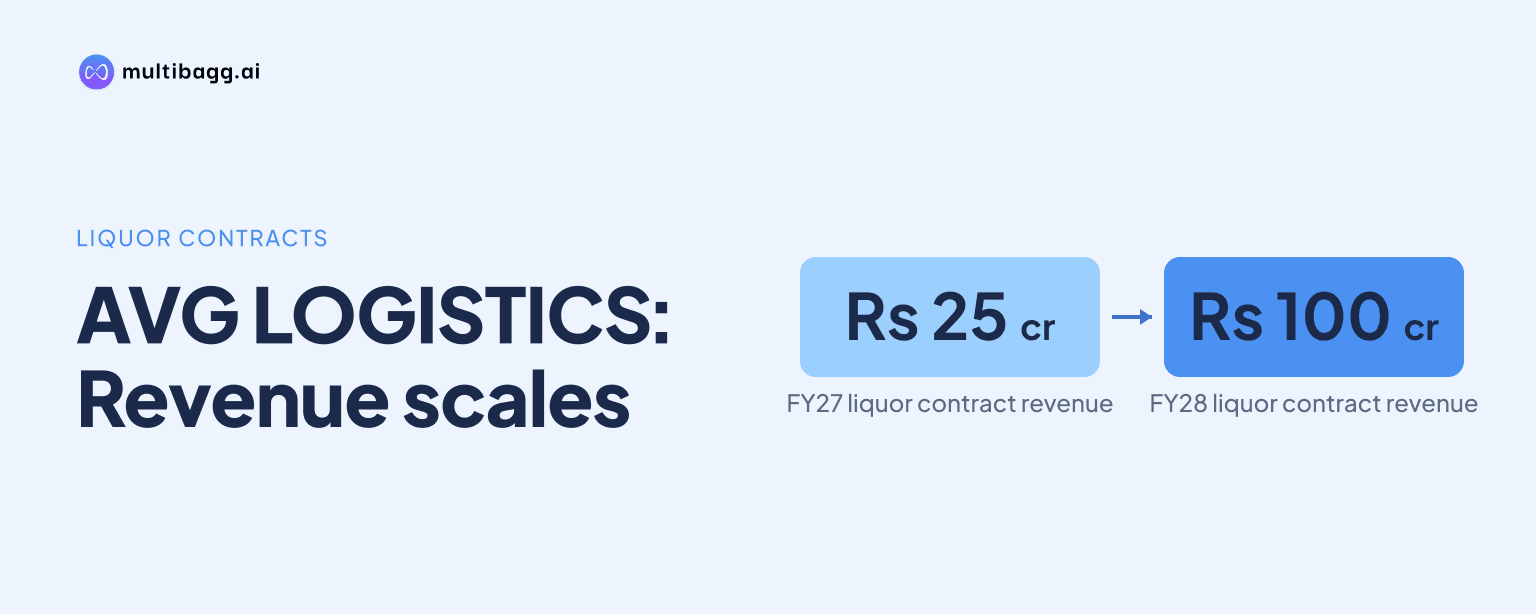
AVG LOGISTICS expects two long-term liquor logistics contracts to generate about Rs 25 crore in FY27 and scale to about Rs 100 crore annually from FY28. The new business update identifies liquor logistics as a tightly regulated segment requiring strict compliance, secure handling and trained drivers, and AVG says margins in this segment are better.
Know AVG Logistics inside out
Results, valuation, peers and who's buying, in one view.
What will AVG’s liquor contracts contribute?
AVG expects the two liquor contracts to contribute about Rs 25 crore in FY27 before scaling to about Rs 100 crore a year from FY28. The presentation describes the arrangements as long-term contracts with two well-known liquor companies, but does not name the customers or disclose individual contract lengths and start dates.
The stated FY28 annual run rate is four times the FY27 expectation, representing a difference of about Rs 75 crore. This is an expectation stated in the business update rather than reported liquor-segment revenue, and AVG does not split the FY27 estimate between the two contracts or disclose the operating cost of delivering them.
The forecast is framed in financial years. AVG reported consolidated revenue from operations of Rs 284.1 crore in H1 FY27, meaning the Rs 25 crore liquor-logistics expectation is a newly disclosed revenue stream rather than a historical segment result.
Why is AVG entering liquor logistics?
AVG says liquor logistics is tightly regulated and requires strict compliance, secure handling and trained drivers. The company identifies these operating requirements as the basis on which it can serve the segment, while stating that margins are better without providing a liquor-specific margin percentage.
Delivery of the about Rs 25 crore FY27 expectation and about Rs 100 crore FY28 annual figure will depend on meeting those specialised handling requirements. The presentation does not disclose the licences, compliance procedures, fleet size, routes, insurance arrangements or customer-level economics for the two liquor assignments.
AVG distinguishes liquor logistics through regulation and handling rather than a disclosed asset plan. In comparison, the Dalmia Cement North East contract specifies 30 heavy-duty electric vehicles, a net load of 38 to 41 tonnes per trip, and dedicated charging-station setup, operation and maintenance.
How do AVG’s liquor contracts compare with other new wins?
AVG’s liquor contracts have the largest disclosed annual revenue measure in the business update, at about Rs 100 crore a year from FY28. The multinational beverage company contract uses a different measure, at about Rs 60 crore over five years, so the figures are not directly comparable on the same time basis.
The Dalmia Cement assignment has a stated initial five-year term plus a further three years, while the liquor contracts are only described as long-term. AVG says it will establish, operate and maintain dedicated charging stations for Dalmia, a scope not disclosed for the liquor business.
The multinational beverage company award is a five-year transportation contract from a global company that AVG values at about Rs 60 crore over its term. The liquor business involves two companies and an expected annual figure of about Rs 100 crore from FY28, but the presentation does not say whether either liquor customer is multinational.
Got a follow-up? Ask IRIS
What dedicated fleets were deployed in Q2 FY27?
AVG had deployed 68 of 100 dedicated vehicles for Haldiram’s in Nagpur in Q2 FY27, while 30 heavy-duty electric trucks were in service for Dalmia Cement in Assam. The remaining 32 Haldiram’s vehicles were expected to follow as that contract rolled out.
The Haldiram’s fleet serves western and southern India, Odisha, Bihar and Jharkhand. The 30 Dalmia trucks move cement across plant locations under the long-term contract, whereas the liquor update provides no vehicle count or route network despite its about Rs 25 crore FY27 revenue expectation.
These deployments show AVG operating dedicated fleets in food and cement while adding liquor logistics. For Dalmia, the disclosed service includes electric trucks and charging infrastructure; for liquor, AVG identifies compliance, secure handling and trained drivers as the service mechanisms.
What do AVG’s latest financial results show?
AVG reported consolidated total income of Rs 154.2 crore in Q2 FY27, up 6.3% year on year from Rs 145 crore in Q2 FY26 and 15.0% quarter on quarter from Rs 134.1 crore in Q1 FY27. Revenue from operations was Rs 151.6 crore, compared with Rs 143 crore a year earlier.
Profit before tax, or PBT, rose to Rs 10.1 crore in Q2 FY27 from Rs 6.6 crore in Q2 FY26, while profit after tax, or PAT, increased to Rs 7.1 crore from Rs 5.1 crore. PBT margin rose to 6.6% from 4.6%, while PAT margin increased to 4.8% from 3.6%.
EBITDA moved differently from PBT: Q2 FY27 EBITDA was Rs 23.6 crore, down from Rs 26.3 crore, and the EBITDA margin was 15.6% against 18.4%. AVG notes that EBITDA in FY27 Q1 and Q2 was reduced by the Indian Accounting Standards, or Ind AS, effect on depreciation and finance cost of about Rs 7.99 crore in Q1 and Rs 8.03 crore in Q2.
For H1 FY27, total income increased 6.5% year on year to Rs 288.4 crore, PBT rose 39.0% to Rs 18.9 crore and PAT rose 33.7% to Rs 13.5 crore. EBITDA declined 11.5% to Rs 44.7 crore, while its margin declined to 15.7% from 18.9% in H1 FY26.
Conclusion
AVG’s liquor contracts add a disclosed revenue opportunity of about Rs 25 crore in FY27, with the company expecting about Rs 100 crore annually from FY28. That plan sits alongside a about Rs 60 crore five-year beverage transportation contract and a Dalmia Cement assignment involving 30 heavy-duty electric trucks and charging infrastructure.
The next disclosure to watch is progress against the FY27 liquor estimate and the FY28 annual run-rate expectation. AVG has not disclosed the customers, contract durations, fleet requirements or contract-level margins, while 32 of the 100 Haldiram’s dedicated vehicles remained to be deployed in Q2 FY27.