










Avon Mercantile Limited posts Rs 99.49 lakh September loss
Key highlights
- Avon Mercantile reported a Rs 99.49 lakh loss for the quarter ended September 30, 2026.
- Total expenses of Rs 2.27 crore exceeded total income of Rs 1.27 crore in the September 2026 quarter.
- Loans and advances rose by Rs 66.22 lakh to Rs 41.40 crore at September 30, 2026.
- Borrowings increased by Rs 56 lakh to Rs 36.56 crore from March 31, 2026.
powered by IRIS
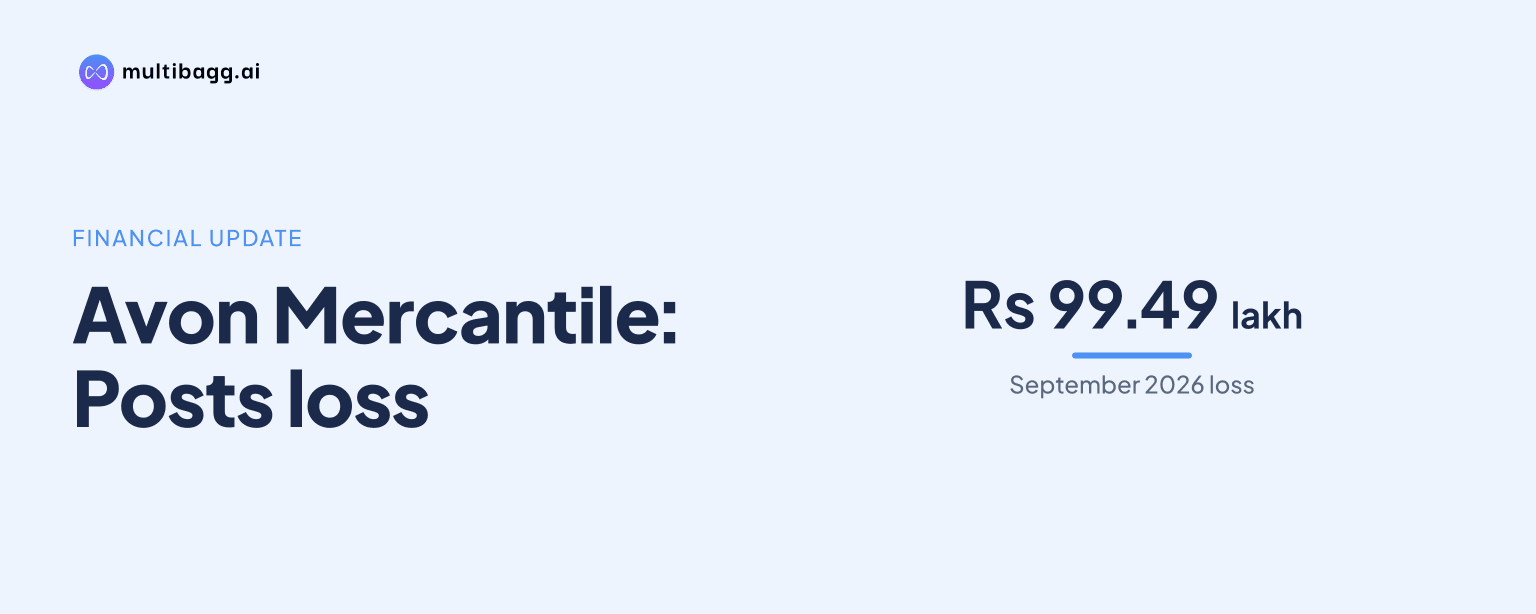
Avon Mercantile Limited reported a Rs 99.49 lakh loss for the quarter ended September 30, 2026, as total expenses of Rs 2.27 crore exceeded total income of Rs 1.27 crore. The unaudited result reversed a Rs 26.10 lakh profit in the preceding June 2026 quarter and compared with a Rs 18.95 lakh loss a year earlier.
Know Avon Mercantile inside out
Results, valuation, peers and who's buying, in one view.
What caused Avon Mercantile’s September 2026 quarter loss?
Avon Mercantile’s Rs 99.49 lakh loss in the three months ended September 30, 2026 resulted from expenses exceeding income by the same amount. Interest income, which was the company’s revenue from operations, was Rs 1.27 crore, while the filing shows no other income for the quarter.
Total expenses were Rs 2.27 crore in the September 2026 quarter. Finance costs were Rs 57.30 lakh, employee-benefit expense was Rs 1.14 crore, depreciation, amortisation and impairment expense was Rs 13,000, and other expenses were Rs 54.84 lakh.
The quarterly outcome changed from a Rs 26.10 lakh profit in the preceding three months ended June 30, 2026 to a Rs 99.49 lakh loss. Total income rose by Rs 6.85 lakh from Rs 1.20 crore in the June quarter, but total expenses increased by Rs 1.32 crore from Rs 94.33 lakh.
Against the corresponding quarter ended September 30, 2025, the loss increased by Rs 80.54 lakh from Rs 18.95 lakh. For the six months ended September 30, 2026, Avon Mercantile reported a Rs 73.39 lakh loss, compared with a Rs 36.93 lakh profit in the corresponding six-month period of 2025.
How did Avon Mercantile’s loans and funding change?
Avon Mercantile’s loans and advances increased to Rs 41.40 crore at September 30, 2026 from Rs 40.74 crore at March 31, 2026. The Rs 66.22 lakh increase was within the company’s single reported operating segment, identified in the results as the loan company segment.
Borrowings rose to Rs 36.56 crore at September 30, 2026 from Rs 36.00 crore at March 31, 2026, an increase of Rs 56 lakh. Other financial liabilities increased by Rs 30.40 lakh to Rs 3.79 crore, while provisions stayed at Rs 18.80 lakh at both reporting dates.
Total assets were Rs 45.84 crore at September 30, 2026, compared with Rs 45.71 crore at March 31, 2026. Financial assets declined to Rs 45.08 crore from Rs 45.21 crore because other financial assets fell to Rs 3.61 crore from Rs 4.36 crore, more than offsetting the growth in loans and advances.
Equity declined to Rs 5.31 crore at September 30, 2026 from Rs 6.04 crore at March 31, 2026. Equity share capital was unchanged at Rs 7.48 crore, while other equity moved to negative Rs 2.17 crore from negative Rs 1.44 crore, alongside the Rs 73.39 lakh first-half loss.
Got a follow-up? Ask IRIS
What did Avon Mercantile’s cash flow show?
Avon Mercantile ended the September 2026 quarter with cash and cash equivalents of Rs 7.23 lakh, up from Rs 2.77 lakh at the start of the quarter. The quarterly cash-flow statement reported a Rs 4.46 lakh net increase, with the balance held in current accounts with banks.
Operating activities generated Rs 6.08 lakh of cash in the September 2026 quarter despite the Rs 99.49 lakh reported loss before tax. The cash-flow statement recorded a Rs 2.33 crore increase in borrowings and a Rs 48.98 lakh increase in other financial and non-financial liabilities, while loans, advances and other financial and non-financial assets increased by Rs 1.77 crore.
Investing activities used Rs 1.63 lakh in the quarter ended September 30, 2026. This comprised Rs 1.76 lakh spent on property, plant and equipment or capital advances, partly offset by Rs 13,000 of proceeds from the sale or exchange of property, plant and equipment.
For the six months ended September 30, 2026, cash and cash equivalents declined to Rs 7.23 lakh from Rs 10.75 lakh at the start of the financial year. Operating cash flow was negative Rs 1.90 lakh and investing cash outflow was Rs 1.63 lakh, producing a Rs 3.53 lakh net reduction in cash over the half year.
What governance and review disclosures accompanied the results?
Avon Mercantile’s board approved the unaudited results on November 13, 2026. Gupta Garg & Agarwal reviewed the statement under Standard on Review Engagement 2410 and stated that nothing had come to its attention to indicate that the results omitted required disclosures or contained a material misstatement.
The review report dated November 13, 2026 said a review is narrower than an audit and therefore did not express an audit opinion. The results were prepared under Indian Accounting Standard 34, Interim Financial Reporting, according to the reviewer’s report.
On November 13, 2026, the board appointed Pooja Chugh as an additional and independent director with effect from that date. The filing says Chugh has more than 13 years of experience in legal advisory, financial management and compliance, including non-banking financial company compliance.
Himani Aneja ceased to be an independent director on November 13, 2026 for personal reasons, after which the board approved a reconstitution of certain committees. Avon Mercantile also reported zero investor complaints received during the period and zero complaints pending at the beginning and end of the period.
Conclusion
Avon Mercantile’s September 2026 quarter combined a Rs 99.49 lakh loss with a rise in loans and advances to Rs 41.40 crore and borrowings to Rs 36.56 crore. Income of Rs 1.27 crore did not cover Rs 2.27 crore of expenses, and the quarterly result turned the Rs 26.10 lakh June-quarter profit into a Rs 73.39 lakh first-half loss.
The next results will show whether the September-quarter increase in expenses persists alongside lending growth and higher borrowings. The filing discloses no numerical business target or operating plan, leaving the relationship between loan advances, funding and operating costs as the unresolved matter to monitor.