








Avro India recycling contributes Rs 11.6 crore in H1 FY27
MAX Plan at ₹4,999/yr

Find your next multibaggerBe a Pro Investor
Research stocks and track your picks on the go. Download the app.
Key highlights
- Avro India generated Rs 11.6 crore of recycling revenue in H1 FY27.
- Furniture revenue rose by Rs 70 lakh to Rs 43.3 crore in H1 FY27.
- Total H1 FY27 revenue increased 28.9% year on year to Rs 54.9 crore.
- H1 FY27 EBITDA was Rs 5.7 crore, while the presentation reported EBITDA margins of 10.4% and 9.7%.
powered by IRIS
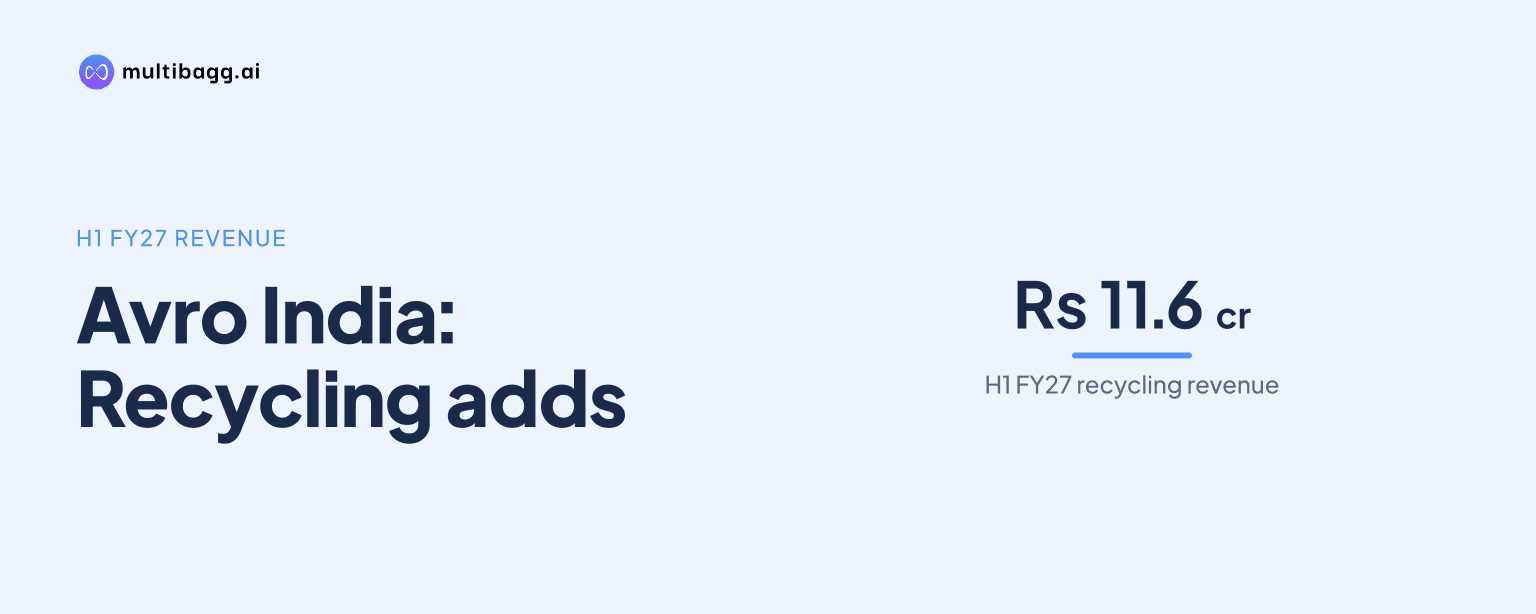
Avro India Limited generated Rs 11.6 crore from recycling in H1 FY27, lifting revenue from operations 28.9% year on year to Rs 54.9 crore, while its furniture business rose only Rs 70 lakh to Rs 43.3 crore. Recycling therefore supplied nearly all of the Rs 12.3 crore increase in the half year ended September 30, 2026.
Know Avro India inside out
Results, valuation, peers and who's buying, in one view.
How did recycling change Avro India’s H1 FY27 revenue mix?
Recycling changed Avro India’s revenue mix by contributing Rs 11.6 crore in H1 FY27, whereas the segment had no reported revenue in H1 FY26. Total revenue rose to Rs 54.9 crore from Rs 42.6 crore, but furniture, the established operation, increased to Rs 43.3 crore from Rs 42.6 crore. The Rs 70 lakh furniture increase accounted for a small part of the total Rs 12.3 crore year-on-year rise.
The half-year figures show a business mix shift rather than broad-based expansion across both segments at the same pace. Furniture represented Rs 43.3 crore of H1 FY27 revenue and recycling represented Rs 11.6 crore, together matching the reported Rs 54.9 crore total. Recycling’s contribution was roughly 21% of total reported revenue based on those disclosed figures.
Avro India describes plastic moulded furniture as its established business, with manufacturing since 2002 and more than 200 stock-keeping units, or SKUs, across categories. The newer recycling operation collects and processes plastic waste into reusable recycled granules, while also offering industrial and commercial waste-management solutions through its Operation Shuddhi initiative.
Did recycling accelerate in the second quarter?
Recycling accelerated in Q2 FY27, generating Rs 7.7 crore compared with Rs 3.8 crore in Q1 FY27. The Rs 3.9 crore sequential increase meant recycling supplied most of the Rs 4.2 crore rise in total quarterly revenue, which reached Rs 29.5 crore in Q2 from Rs 25.3 crore in Q1.
Furniture revenue rose from Rs 21.5 crore in Q1 FY27 to Rs 21.8 crore in Q2 FY27, an increase of Rs 30 lakh. Against Q2 FY26, furniture revenue rose by Rs 90 lakh from Rs 20.9 crore, while total revenue increased by Rs 8.6 crore to Rs 29.5 crore. The presentation reported no recycling revenue in Q2 FY26.
The Q2 total represented 41.2% year-on-year revenue growth, according to the presentation. Sales volume for the quarter was 2,160 metric tonnes, or MT, and pieces sold were 6,98,457. These group-level operating measures are not split between furniture and recycling, so the presentation does not disclose segment-specific volumes or realisations.
What happened to Avro India’s H1 FY27 profitability?
Avro India reported H1 FY27 earnings before interest, tax, depreciation and amortisation, or EBITDA, of Rs 5.7 crore, unchanged from H1 FY26. The detailed half-year table shows an EBITDA margin of 10.4%, down from 13.4%, while the presentation’s performance-summary page shows a 9.7% H1 FY27 margin for the same Rs 5.7 crore EBITDA and Rs 54.9 crore revenue.
Gross profit rose to Rs 18.7 crore from Rs 14.9 crore, although the gross-profit margin fell to 34.1% from 35.0%. Profit after tax, or PAT, decreased to Rs 2.1 crore from Rs 2.3 crore, and the PAT margin declined to 3.7% from 5.3%. The presentation notes that EBITDA excludes other income.
The quarterly data showed an improvement from Q1 FY27 but lower margins than the prior-year quarter. Q2 FY27 EBITDA was Rs 3.5 crore, compared with Rs 2.2 crore in Q1 FY27 and Rs 2.8 crore in Q2 FY26; its margin was 11.3%, versus 7.9% and 12.4%, respectively. Q2 PAT reached Rs 1.4 crore, compared with Rs 70 lakh in Q1 FY27 and Rs 1.2 crore in Q2 FY26.
Got a follow-up? Ask IRIS
What supports Avro India’s recycling expansion?
Avro India’s recycling expansion is supported by a disclosed Rs 39.8 crore investment, a 6,000-plus metric-tonne-per-annum recycling capacity and a digital scrap-collection system. Management said the business uses collection partners, sorting, washing, contamination control and polymer-specific grades to produce flakes, granules and pellets for external industrial and packaging customers.
The regulatory backdrop disclosed in the presentation is the Plastic Waste Management Amendment Rules, 2026, which set minimum recycled-content targets for plastic packaging in FY27. The targets are 40% for rigid packaging, 10% for flexible single-layer packaging and 5% for multi-layered packaging; these apply to producers, importers and brand owners under the extended producer responsibility, or EPR, framework.
Management said the recycling business could also support group operations through potential internal sourcing, cost resilience and circular credentials. That is a stated opportunity rather than a quantified benefit: the presentation does not provide recycling segment profit, internal procurement volumes, customer contracts or a target date for any group-wide sourcing arrangement.
What balance-sheet and operating factors should be tracked?
Avro India reported Rs 18.8 crore of total debt and Rs 2.8 crore of cash and cash equivalents at H1 FY27, resulting in net debt of Rs 15.9 crore. This compares with net cash of Rs 12.2 crore at FY26, when total debt was Rs 17.7 crore and cash and cash equivalents were Rs 29.9 crore.
Working-capital days rose to 167 in H1 FY27 from 155 in FY26. Inventory days increased to 107 from 77, receivable days moved to 108 from 110 and payable days increased to 49 from 31. The cash-flow bridge reported Rs 5.1 crore of operating cash flow and a Rs 13.81 crore change in working capital for H1 FY27.
Furniture retains substantial production infrastructure, with installed capacity of 13,800 metric tonnes per annum across two Ghaziabad units and reported overall utilisation of 78%. Unit 1, producing cabinets, has 3,000 metric tonnes per annum capacity and 90% utilisation, while Unit 2, producing chairs, stools and tables, has 10,800 metric tonnes per annum capacity and 75% utilisation.
Conclusion
Avro India’s H1 FY27 revenue growth was chiefly a recycling-led development: Rs 11.6 crore of new segment revenue drove total revenue to Rs 54.9 crore, while furniture rose only Rs 70 lakh to Rs 43.3 crore. Despite the revenue increase, EBITDA remained at Rs 5.7 crore and PAT fell to Rs 2.1 crore, while the presentation reported two different H1 EBITDA-margin figures of 10.4% and 9.7%.
The next disclosures should show whether recycling can sustain the Q2 FY27 increase to Rs 7.7 crore and whether it can improve group earnings as it scales. Investors can also track management’s stated plan to expand furniture products and distribution, the Rs 39.8 crore recycling investment, working-capital days of 167, and demand shaped by FY27 recycled-content requirements under the 2026 packaging rules.

