








Avro India Limited Recycling Revenue Rises 102.6% in Q2 FY27
MAX Plan at ₹4,999/yr

Find your next multibaggerBe a Pro Investor
Research stocks and track your picks on the go. Download the app.
Key highlights
- Avro India reported Rs 7.7 crore of recycling-business revenue in Q2 FY27, up 102.6% quarter on quarter.
- Avro India disclosed Rs 39.8 crore invested in recycling through Avro Recycling Limited.
- Q2 FY27 revenue from operations was Rs 29.5 crore, up 41.2% year on year.
- H1 FY27 EBITDA margin was 9.7%, compared with 12.3% in H1 FY26.
powered by IRIS
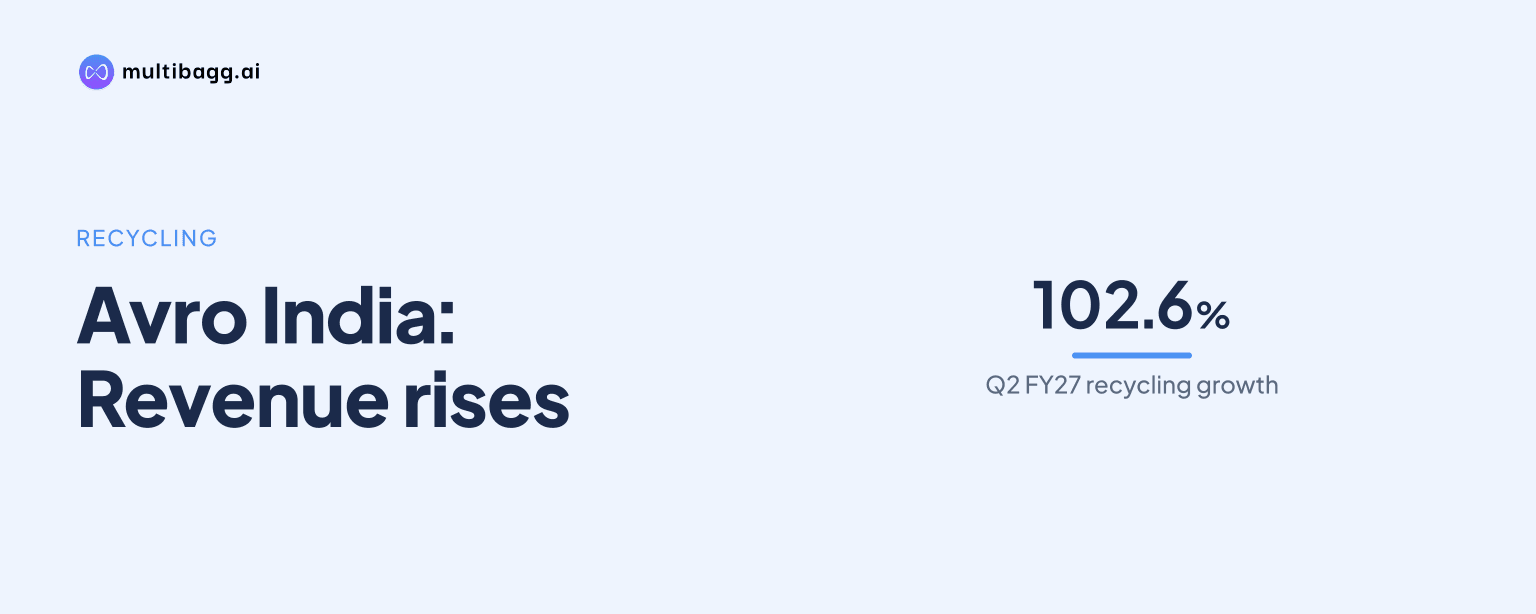
Avro India Limited reported Rs 7.7 crore in recycling-business revenue in Q2 FY27, up 102.6% quarter on quarter, while disclosing Rs 39.8 crore invested in its recycling business. The September 30, 2026 quarter therefore showed recycling generating revenue alongside company-wide revenue from operations of Rs 29.5 crore.
Know Avro India inside out
Results, valuation, peers and who's buying, in one view.
How fast did Avro India’s recycling revenue grow?
Avro India’s recycling-business revenue rose 102.6% quarter on quarter to Rs 7.7 crore in Q2 FY27. The company reported the figure in its earnings release for the quarter and half year ended September 30, 2026, but did not provide the underlying Q1 FY27 recycling revenue amount, a year-on-year comparison, or a separate recycling revenue target.
The recycling result came during a quarter in which Avro India’s total revenue from operations increased 16.5% sequentially to Rs 29.5 crore from Rs 25.3 crore in Q1 FY27. Total revenue was also 41.2% higher than Rs 20.9 crore in Q2 FY26, although the release does not state whether the Rs 7.7 crore recycling figure is included in the company-wide revenue-from-operations number.
Avro India reported company-wide earnings before interest, tax, depreciation and amortisation, or EBITDA, of Rs 3.5 crore in Q2 FY27, against Rs 2.2 crore in Q1 FY27. Profit after tax, or PAT, was Rs 1.4 crore, compared with Rs 0.7 crore in the preceding quarter, but these consolidated company figures do not identify recycling’s separate profit, margin, processing volume or customer contribution.
What has Avro India invested in recycling?
Avro India said it had invested Rs 39.8 crore in recycling through Avro Recycling Limited, an entity established in 2025. Management said the investment supports advanced polymer-sorting technologies and a customised digital scrap-collection platform intended to create an integrated system for material recovery, quality consistency and waste management.
The company describes Avro Recycling Limited as having one of India’s largest washing lines and associates the business with its “Operation Shuddhi” recycling mission. However, the release does not disclose the recycling operation’s annual capacity, utilisation, plant location, source of funding, remaining capital expenditure or expected project-return period.
Management said recycled-content requirements under the Extended Producer Responsibility framework represent a long-term opportunity for Avro Recycling Limited. It also said the recycling platform could create operational synergies with furniture manufacturing, but disclosed no quantified internal recycled-material use, cost saving, transfer volume, recycling margin or timing for such synergies.
Got a follow-up? Ask IRIS
How does Avro India’s furniture business provide the operating base?
Avro India operates 13,800 metric tonnes per annum, or MTPA, of installed furniture capacity at 78% utilisation. Its Ghaziabad platform includes a cabinets unit with 3,000 MTPA capacity and 90% utilisation, and a chairs, stools and tables unit with 10,800 MTPA capacity and 75% utilisation.
In H1 FY27, chairs accounted for 50.0% of Avro India’s product revenue contribution, followed by tables and others at 40.0% and cabinets at 10.0%. The company disclosed more than 200 stock-keeping units, or SKUs, more than 250 distributors, over 30,000 retail points and an average realisation of Rs 293 per piece, alongside sales through Amazon, Flipkart and Government e-Marketplace.
Avro India reported FY26 revenue of Rs 94.6 crore, EBITDA of Rs 12.4 crore and PAT of Rs 4.6 crore for the business overview it presented. The recycling investment of Rs 39.8 crore is therefore being developed alongside an established furniture network, although the release does not give separate furniture and recycling revenue, cost or profit statements.
What did Avro India report for Q2 and H1 FY27?
Avro India reported Q2 FY27 revenue from operations of Rs 29.5 crore, EBITDA of Rs 3.5 crore and PAT of Rs 1.4 crore. Revenue rose 41.2% year on year, while EBITDA increased 25.0% and PAT rose 12.6%; sequentially, EBITDA increased 63.3% and PAT increased 96.3% from Q1 FY27.
Avro India’s Q2 FY27 EBITDA margin was 11.3%, up from 7.9% in Q1 FY27 but below 12.4% in Q2 FY26. PAT margin followed the same comparison, rising from 2.5% sequentially to 4.3% but remaining below 5.3% a year earlier; the company did not attribute the year-on-year margin changes to a particular business, input cost or operating factor.
For H1 FY27, Avro India reported revenue from operations of Rs 54.9 crore, 28.9% higher than Rs 42.6 crore in H1 FY26. EBITDA was Rs 5.7 crore in both periods, while EBITDA margin declined to 9.7% from 12.3%; PAT fell 9.2% to Rs 2.1 crore from Rs 2.3 crore and PAT margin declined to 3.7% from 5.3%.
Conclusion
Avro India’s Q2 FY27 disclosure establishes that recycling was generating Rs 7.7 crore of quarterly revenue while the company was building the activity through Rs 39.8 crore of investment. The 102.6% sequential revenue increase coincided with higher company-wide quarterly revenue, EBITDA and PAT, but the release does not separate recycling profitability or confirm how recycling revenue is reflected within total revenue from operations.
The next disclosed items to watch are management’s plans to scale the recycling ecosystem, pursue operating synergies and expand the furniture portfolio, distribution reach and digital sales channels. Avro India has not set a future recycling revenue, margin, capacity, investment-completion or synergy target, leaving subsequent results disclosures to show the pace and economics of the planned expansion.

