










Axel Polymers leaves Rs 86.63 crore GST amounts unprovided
Key highlights
- Axel Polymers made no provision for a Rs 31.57 crore GST input tax credit demand at September 30, 2026.
- The November 5, 2026 GST order also imposed a Rs 55.06 crore penalty, before applicable interest.
- The stated GST demand and penalty total Rs 86.63 crore before unquantified interest.
- Income Tax, Vadodara had initiated an investigation, with no amount ascertained as of November 13, 2026.
powered by IRIS
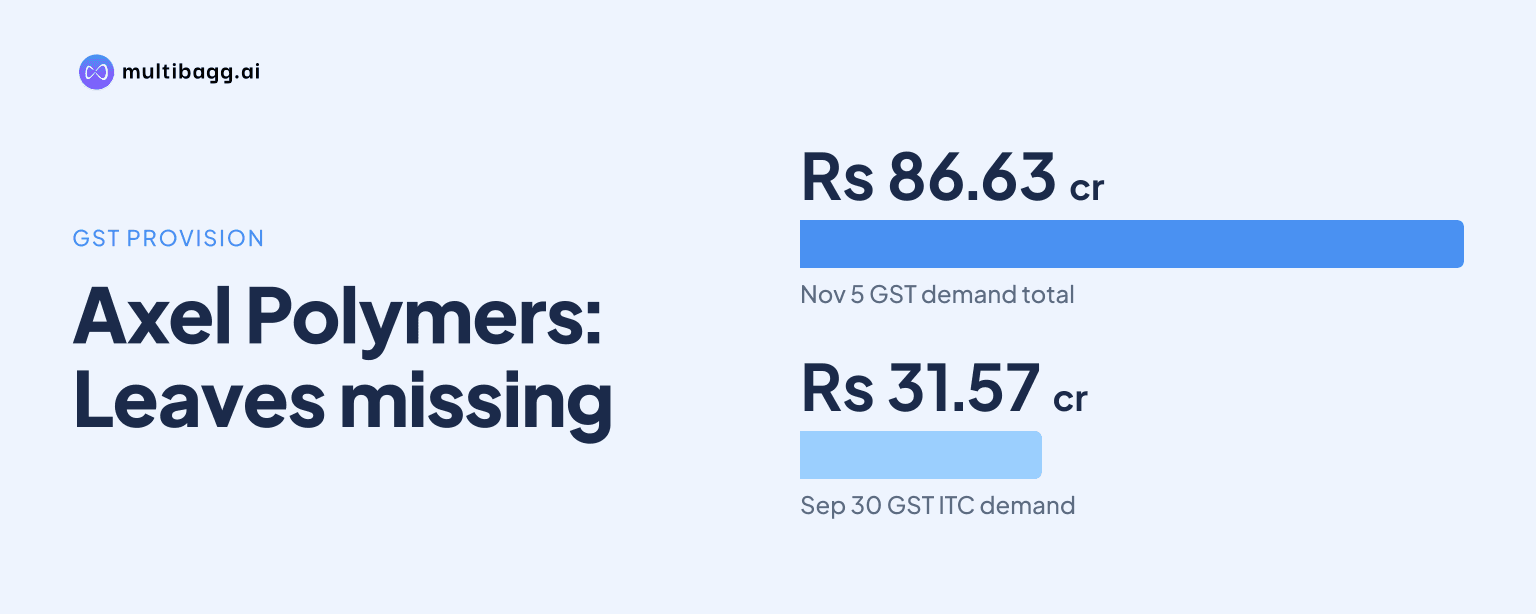
Axel Polymers Limited had made no provision at September 30, 2026 for a Rs 31.57 crore input tax credit demand and Rs 55.06 crore penalty confirmed in a November 5, 2026 GST order, with applicable interest also unprovided and unquantified. The specified demand and penalty total Rs 86.63 crore before interest.
Know Axel Polymers inside out
Results, valuation, peers and who's buying, in one view.
What GST order did Axel Polymers receive?
Axel Polymers received Order No. GEXCOM/ADJN/GST/ADC/749/2026 dated November 5, 2026, confirming a Rs 31.57 crore input tax credit demand for FY 2021-22 to FY 2024-25. The Additional Commissioner, Central GST and Central Excise, Vadodara-II Commissionerate issued the order, which also requires applicable interest.
The order splits the demand into Rs 0.25 crore of integrated GST, Rs 15.66 crore of central GST and Rs 15.66 crore of state GST. The reported demand therefore relates to four financial years ending March 31, 2025, rather than solely to the quarter and six months ended September 30, 2026.
How much has Axel Polymers provided for the GST demand?
Axel Polymers made no provision in its books for the Rs 31.57 crore demand, applicable interest or the Rs 55.06 crore penalty as at the September 30, 2026 reporting date, according to the limited review report. Interest is part of the order, but the filing does not quantify it.
The Rs 55.06 crore penalty is Rs 23.49 crore higher than the Rs 31.57 crore input tax credit demand. The Rs 86.63 crore combined figure covers only the stated demand and penalty, so it does not represent the full potential amount including applicable interest.
The GST order is dated November 5, 2026, after the September 30, 2026 reporting date, while the board approved the unaudited quarterly and half-yearly results on November 13, 2026. The disclosure identifies no payment, appeal, settlement or later accounting provision related to the order.
What investigations has Axel Polymers disclosed?
Axel Polymers disclosed that regulatory authorities initiated an investigation connected with the ongoing GST matter. The auditors said a show-cause notice had been issued by the Enquiries and Adjudication Department-3 to the company, its managing director and its former chief financial officer, who is also a non-executive director.
The Investigation Wing of Income Tax, Vadodara also initiated an investigation following the GST department proceedings, and it was ongoing as of November 13, 2026. No amount had been ascertained in that income-tax proceeding as of that date, so the filing gives no quantified tax exposure from it.
These are separate matters from the November 5, 2026 GST order for FY 2021-22 to FY 2024-25. The filing does not state the outcome, potential monetary amount or completion date for either the regulatory inquiry or the Income Tax investigation.
Got a follow-up? Ask IRIS
What did the limited review report say?
Mukund & Rohit conducted a limited review under Standard on Review Engagement 2410, covering the quarter and six months ended September 30, 2026. The firm said such a review consists primarily of inquiries and analytical procedures, provides moderate assurance and provides less assurance than an audit.
Based on its review, the firm said nothing had come to its attention that caused it to believe the unaudited results did not disclose information required under Regulation 33 of the Listing Obligations and Disclosure Requirements Regulations, 2015. That statement was accompanied by the specific disclosure that no provision had been made for the Rs 31.57 crore GST demand, interest and Rs 55.06 crore penalty.
The auditors also said they had not audited or reviewed certain financial results and other information for the quarter and six months ended September 30, 2026 that were presented solely on management-compiled financial information. Axel Polymers’ board considered and approved the unaudited results on November 13, 2026 after the audit committee’s review and recommendation.
How did Axel Polymers' balance sheet change by September 2026?
Axel Polymers reported total assets of Rs 74.12 crore at September 30, 2026, compared with Rs 70.25 crore at March 31, 2026. Current assets increased to Rs 58.41 crore from Rs 55.06 crore over that period, while the company said its operations were limited to one segment.
Inventories declined by Rs 0.31 crore to Rs 40.66 crore at September 30, 2026. However, the auditors said management had assessed inventory ageing and obsolete items while carrying them at the same amount, with no provision for obsolete or slow-moving inventories because the exact value was unavailable to the auditors.
Axel Polymers separately disclosed a vendor's legal proceeding under Section 138 of the Negotiable Instruments Act involving Rs 18 crore, pending before the competent court at Tirupati, Andhra Pradesh. Management believes crystallisation of that liability is not probable based on its stated legal position, and no provision has been made; the case is distinct from the GST order and investigations.
Conclusion
The November 5, 2026 GST order confirmed Rs 31.57 crore of input tax credit demand and imposed a Rs 55.06 crore penalty, neither of which had been provided for at September 30, 2026. Together they total Rs 86.63 crore before applicable interest, while separate regulatory and Income Tax inquiries remained unresolved.
The next disclosed matter to watch is the Income Tax investigation, for which no amount had been ascertained as of November 13, 2026. Updates on the GST order, including any appeal, payment, settlement or accounting provision, and the outcome of the regulatory inquiry would address the unresolved issues identified in the limited review report.