










Azad sees energy mix at 55%-60% as aerospace grows further
Key highlights
- Azad expects energy and oil and gas to represent 55%-60% of revenue by FY2030-31.
- Management said Rolls-Royce-related production revenue is expected to start from FY2028.
- Azad delivered Rs 100 crore of aerospace revenue last year, according to management.
- Azad described more than Rs 6,500 crore as rolling customer contracts spanning five to seven years, not an order backlog.
powered by IRIS
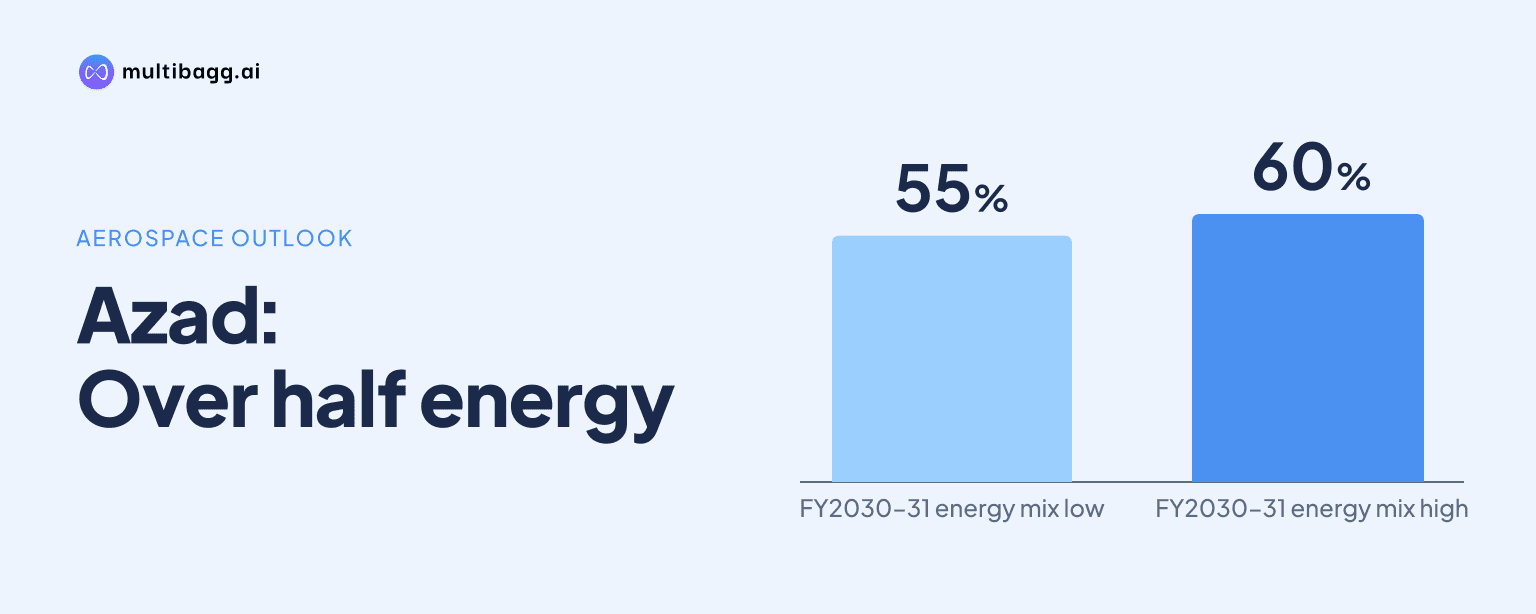
In FY2030-31, Azad expects energy and oil and gas to account for 55%-60% of revenue, with aerospace and defence taking the balance as production programmes advance. Management said production revenue from Rolls-Royce-related work would begin from FY2028, followed by Pratt & Whitney and Safran qualification and production activity.
Know Azad Engineering inside out
Results, valuation, peers and who's buying, in one view.
What revenue mix does Azad expect by FY2030-31?
Azad expects energy and oil and gas to contribute 55%-60% of revenue by FY2030-31, leaving the remaining 40%-45% for aerospace and defence. Management said this is a change in revenue composition rather than an expectation that energy and oil-and-gas revenue will fall in absolute terms.
The planned mix shift rests on a larger aerospace production base. Azad said Rolls-Royce is the first programme expected to add production revenue, followed by Pratt & Whitney and Safran. At the time of the call, Azad had revenue associated with Rolls-Royce but no production revenue from that customer, making serial production the main incremental development.
Management said its five-year plan is supported by revenue visibility on parts already qualified with existing customers and now ramping up. The 55%-60% range therefore assumes continued activity in energy and oil and gas alongside faster expansion in aerospace and defence from newer qualified programmes.
When will Azad begin aerospace production revenue?
Azad expects some aerospace production revenue to flow from FY2028 after Rolls-Royce-related qualification work is completed. Management identified Rolls-Royce as the first aerospace production ramp, with Pratt & Whitney and Safran following as their qualification processes progress.
The initial Rolls-Royce capital expenditure covered two engine programmes that were visible when Azad made the investment in 2024. Management said that, once those two lines complete qualification and enter production, further engine programmes may be released for qualification. This would allow production on qualified lines and qualification work on subsequent lines to proceed together.
Azad described qualification as a continuous process rather than a single event. Management said the aerospace business delivered Rs 100 crore last year, compared with an earlier stage when its aerospace work was more heavily weighted towards qualification. It compared this with the energy business seven or eight years ago, when that segment also had more qualification work before becoming largely production-led.
How is Azad preparing capacity for aerospace production?
Azad said capital expenditure for the commercial aero-engine airfoil production line has been completed and the capacity is production-ready. Management said the qualification batch was in its final stage, and successful delivery of that batch would show that the relevant parts had moved into production.
Capacity is being built against customer schedules rather than as unrestricted output. Azad said its contracts provide demand visibility by product and customer for the next five to seven years, and described the more than Rs 6,500 crore figure as rolling customer contracts rather than an order backlog. Annual demand is consumed as parts are manufactured and can be renewed or supplemented with new contracts.
Management said the next phase of capital expenditure from FY2029 onward would depend on customers releasing further programmes after current qualifications are completed. It said a qualified institutional placement, or QIP, could be considered if funding is needed. Azad also said Phase I at Tuniki Bollaram was complete and the Mangampet site was ready for a Phase II capacity build-out.
Got a follow-up? Ask IRIS
What supports Azad's growth in both aerospace and energy?
Azad said its customer wallet share is under 2%, which management cited as scope to add parts and programmes with existing customers. Management also described wallet share as single digit and said it intends to move towards a two-digit level, without disclosing a timetable or a specific percentage target.
In energy and oil and gas, management said customer projections remained intact and it was not seeing a slowdown in the visibility shared with Azad. It linked that view to the segment's development since 2010 through 2014, when the company was undertaking both qualifications and production. The stated outlook allows energy revenue to grow while its share of total revenue moves to 55%-60% by FY2030-31.
The ramp requires skilled employees to be hired before capacity produces its full revenue throughput. Management said manpower costs had increased because newly installed capacity needed trained workers before associated production revenue had activated. It expects manpower cost to decline in the next-to-next quarter as revenue rises, although similar hiring cycles may recur over four to six quarters as further capacity is installed.
What could affect Azad's aerospace mix timetable?
Azad's aerospace timetable depends on qualification completion and customer releases of subsequent programmes. Management said Rolls-Royce initially provided two engine programmes for qualification, while additional engine programmes may be opened after the first two complete qualification and production performance is established. Pratt & Whitney and Safran remain behind Rolls-Royce in the stated sequence.
Facility changes can also require delta qualification. Management defined this as revalidation after machinery or processes move to a new location, rather than a full qualification process. It said major energy and oil-and-gas qualifications were almost complete, while delta qualification was continuing for relevant facilities and equipment.
A separate engine programme discussed during the call also remained subject to testing. Management said testing was ongoing and Azad was preparing to deliver a second engine, but it did not disclose a production date. Management said production would be closer once an engine flies on the weapon platform, a milestone separate from the Rolls-Royce, Pratt & Whitney and Safran commercial aerospace ramps.
Conclusion
Azad's FY2030-31 outlook points to a broader revenue base rather than a retreat from energy and oil and gas. Management expects that segment to remain the majority at 55%-60% of revenue while aerospace and defence takes a larger share through qualified parts, completed production-line capital expenditure and sequential customer ramps.
The next developments to watch are delivery of the Rolls-Royce qualification batch, the FY2028 start of related production revenue and customer decisions on additional engine programmes. Management said FY2029-onward capital expenditure would depend on qualification progress and programme releases, while Mangampet land is available for a later Phase II expansion.