










Azad secures 50% OEM advance for working-capital funding
Key highlights
- Azad expects about US$45 lakh from one OEM that agreed to advance 50% on each purchase order.
- Inventory increased Rs 98 crore in H1 FY27 to Rs 425 crore, including Rs 72 crore of work in progress.
- Operating cash flow after tax improved to negative Rs 45.8 crore in H1 FY27 from negative Rs 76.5 crore in H1 FY26.
- Azad expects revenue to ramp from Q4 FY27 and all plants to be fully ramped in H1 FY28.
powered by IRIS
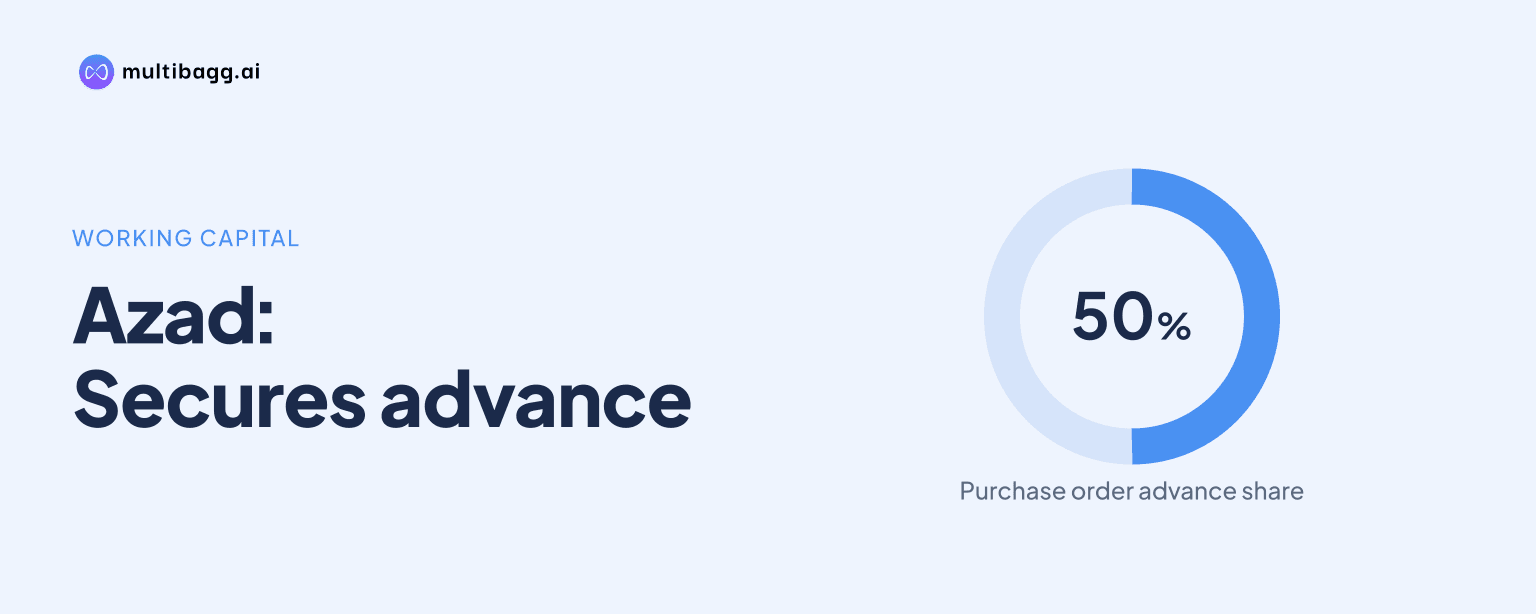
Azad Engineering disclosed for Q2 FY27 that one original equipment manufacturer, or OEM, will provide a 50% advance on each purchase order, with receipts expected at about US$45 lakh, as inventory rose Rs 98 crore in the first half to Rs 425 crore at September 30, 2026.
Know Azad Engineering inside out
Results, valuation, peers and who's buying, in one view.
How will Azad's 50% OEM advance support working capital?
Azad said the 50% purchase-order advance will provide customer cash before production is completed and directly fund its ramp-up requirements. Management expects to receive about US$45 lakh under the arrangement with one unnamed OEM. The company is using this structure as a template in discussions with other OEMs, although it did not disclose any further agreed advance-payment arrangements.
The arrangement matters because Azad has commissioned six customer-dedicated facilities in Tuniki Bollaram, covering 44,800 square metres for Mitsubishi Heavy Industries, GE Vernova, Siemens Energy and Baker Hughes. Parts produced at newly commissioned lines must pass customer delta qualifications before they can be invoiced. Management said the advance helps fund this interval between raw-material procurement, production and customer acceptance.
Azad said the agreement did not require a material price concession. In response to an analyst question, Chief Financial Officer Ronak Jajoo said the discount was “hardly 1% or so,” rather than a large reduction in margins. The company presented the advance as customer support for the capital expenditure and working-capital investment required to maintain production for committed delivery programmes.
Why did Azad's inventory and receivables increase in H1 FY27?
Azad's inventory increased Rs 98 crore during H1 FY27 to Rs 425 crore, with Rs 72 crore of that movement attributed to work in progress on new lines. These components include parts at the delta-qualification or ramp-up stage, which cannot be invoiced until a customer approves the production process. The company said 72% of its ageable inventory was less than six months old.
Trade receivables increased Rs 92 crore to Rs 402 crore as revenue expanded in the half year ended September 30, 2026. Azad said 69% of regular receivables were not yet due, while receivables more than one year old stood at Rs 7 crore. The inventory and receivables movements show that the main cash requirement arose alongside a 29.3% increase in standalone H1 revenue to Rs 358.3 crore.
Operating profit before working-capital changes rose 29% to Rs 130.6 crore in H1 FY27, but operating cash flow after tax remained negative Rs 45.8 crore. That was an improvement from negative Rs 76.5 crore in H1 FY26, despite a business that was 29% larger. Azad attributed the cash outflow to the production-readiness build-up and said inventory should move to finished goods, receivables and then cash as qualified parts are accepted.
When does Azad expect cash conversion to improve?
Azad expects throughput to improve in H2 FY27 and revenue to begin ramping from Q4 FY27 as parts clear customer acceptance. Management said supplies should start from the end of Q3 FY27 and continue through Q4 FY27. In response to an analyst question, it said cash inflow could become visible in Q4 FY27 and should be more established in Q1 of the following financial year.
The OEM advance is the second of three disclosed working-capital measures. The first is the conversion of raw materials already procured into work in progress, finished goods, receivables and cash. The third is the planned use of bill-discounting lines with ICICI Bank and DP World from Q4 FY27, which management said would reduce debtor days while adding a modest finance cost.
Azad had not previously used bill discounting aggressively because it held surplus treasury funds and expected additional financing costs from drawing those lines. Its cash and bank deposits stood at Rs 112.6 crore at September 30, 2026, after the company deployed funds in new plants and machinery. Management said the new advance-payment arrangement and bill discounting should help stabilise the cycle as revenue from the commissioned capacity rises.
Got a follow-up? Ask IRIS
What financial costs is Azad carrying during the ramp-up?
Azad reported standalone Q2 FY27 revenue of Rs 187.8 crore, up 31.6% year on year from Rs 142.7 crore and up 10.1% sequentially from Rs 170.5 crore in Q1 FY27. Earnings before interest, tax, depreciation and amortisation, or EBITDA, increased 37.1% year on year to Rs 70.4 crore. EBITDA margin rose 150 basis points to 37.5% from 36.0% in Q2 FY26.
The higher operating result did not fully translate into profit after tax because costs below EBITDA increased and treasury income declined. Depreciation doubled year on year to Rs 21.8 crore in Q2 FY27 from Rs 10.9 crore, while finance cost increased to Rs 12.2 crore from Rs 6.4 crore. Other income fell to Rs 4.7 crore from Rs 12.7 crore as Azad put initial public offering and qualified institutional placement funds into facilities and machines.
Azad capitalised Rs 251 crore of new assets during H1 FY27 and said Q3 FY27 and Q4 FY27 would include a full quarter of depreciation from the GE Vernova facility inaugurated in September. Standalone Q2 profit after tax was Rs 30.8 crore, equal to a 16.4% margin. Management said these costs reflect the investment phase and that the installed cost base is largely in place.
What capacity milestones underpin Azad's cash plan?
Azad said all six dedicated facilities are commissioned and production-ready, while multiple customer delta qualifications are under way. Management expects all plants to be fully ramped in H1 FY28. It reiterated that the present installed capacity could support an annual revenue run rate, or ARR, of more than Rs 1,300 crore by the end of FY28, more than twice its FY26 revenue.
The business remains export-led: exports contributed 88% of Q2 FY27 revenue, and management expects exports to remain about 85% of sales. In H1 FY27, energy and oil and gas revenue grew 28.5% to Rs 290.5 crore, while aerospace and defence revenue increased 28.3% to Rs 60.4 crore. The segment comparison shows that both main businesses expanded at broadly similar rates during the facility ramp-up.
Azad also disclosed a two-year rate contract with BHEL for gas-turbine blades worth about Rs 52.68 crore, while its supply agreement with Baker Hughes through Nuovo Pignone was extended to 2030. Management expects the dedicated Baker Hughes oil-and-gas facility to add a growth lever from Q4 FY27. These contracts and qualifications, rather than speculative capacity, are the basis management gave for its ramp-up timetable.
Conclusion
Azad's 50% OEM purchase-order advance changes the timing of funding for production that is currently absorbing inventory and receivables. The expected US$45 lakh receipt is limited to one disclosed OEM, but it complements Rs 425 crore of inventory moving through qualification and planned bill discounting from Q4 FY27. Revenue and EBITDA rose faster than profit after tax in Q2 FY27 as depreciation and finance costs increased.
The next disclosure to watch is whether Q4 FY27 brings the revenue ramp, cash inflow and bill-discounting use management has outlined. Azad expects all plants to be fully ramped in H1 FY28 and has maintained its target of more than Rs 1,300 crore of ARR by the end of FY28. Progress depends on customer acceptance of delta-qualified lines and on whether other OEM discussions produce comparable advance-payment arrangements.