










Baba Food Processing (India) Limited Reports ₹5.16 Crore H1 FY27 Loss
Key highlights
- Baba Food Processing reported a consolidated net loss of ₹5.16 crore in H1 FY27, versus a ₹1.31 crore profit in H1 FY26.
- Consolidated revenue from operations rose 0.8% year on year to ₹101.50 crore in H1 FY27.
- Raw material costs were ₹94.45 crore and the consolidated operating margin was negative 3.8% in H1 FY27.
- Consolidated operating cash flow was negative ₹7.84 crore, while borrowings stood at ₹85.87 crore.
powered by IRIS
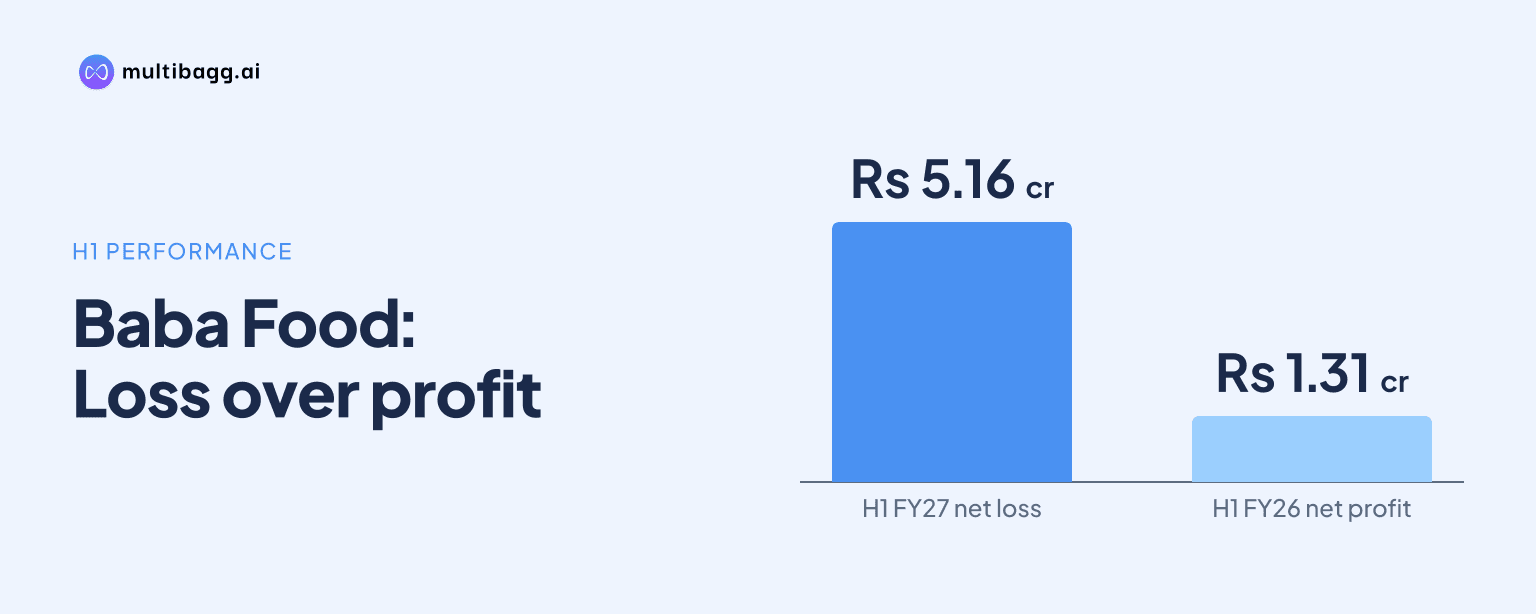
Baba Food Processing (India) Limited reported a consolidated net loss of ₹5.16 crore for H1 FY27, compared with a ₹1.31 crore profit a year earlier, even as revenue from operations increased 0.8% to ₹101.50 crore. The result shows that a modest rise in sales did not offset higher input costs and losses at its subsidiary.
Know Baba Food Processing India inside out
Results, valuation, peers and who's buying, in one view.
What did Baba Food Processing report for H1 FY27?
Baba Food Processing filed its April-September 2026 financial results with the NSE on November 13, 2026, following a board meeting held on the same date. The company released both standalone and consolidated results for the quarter and half-year ended September 30, 2026.
On a consolidated basis, revenue from operations stood at ₹101.50 crore, against ₹100.69 crore in H1 FY26. Total income was also ₹101.50 crore, as the filing showed no other income for the period. The company moved to a net loss of ₹5.16 crore from a net profit of ₹1.31 crore in the corresponding six months of the previous financial year.
The filing was made 44 days after the end of the September half year. The company had filed its April-September results on November 14, 2025, and November 12, 2024, indicating that the latest filing was broadly within its reported historical timing range of 43 to 60 days after a half-year close.
Why did consolidated profitability turn negative?
Consolidated profitability turned negative as material costs, depreciation and deferred tax expenses weighed on earnings despite broadly stable revenue. Raw material costs were reported at ₹94.45 crore, while depreciation was ₹2.75 crore and deferred tax expense was ₹1.26 crore.
The company reported a loss before exceptional items and tax of ₹3.90 crore, compared with a profit of ₹1.70 crore in H1 FY26. Its operating margin was negative 3.8%, against a positive 1.7% in the year-earlier period. The reported figures indicate that the cost base increased faster than the limited revenue growth.
The disclosed assessment also identified operating losses at subsidiary Panchakanya Foods Private Limited as a factor affecting the consolidated outcome. Baba Food Processing remained marginally profitable on a standalone basis, but that did not offset the subsidiary-related impact at the consolidated level.
How did standalone results compare with consolidated results?
Standalone operations reported revenue of ₹101.49 crore and a net profit of ₹2.18 lakh in H1 FY27. This compared with standalone net profit of ₹1.32 crore in H1 FY26, showing a substantial reduction in profitability even though the standalone business remained marginally in profit.
The difference between standalone and consolidated earnings points to the impact of group-level costs and subsidiary performance. Consolidated revenue was only slightly higher than standalone revenue, while the consolidated net loss was materially larger because the group result included the losses of Panchakanya Foods Private Limited.
For investors, the contrast is important because consolidated results reflect the financial position of the company and its subsidiaries together. The filing therefore indicates that pressure was not limited to the core standalone business, where profit also fell sharply from the prior-year period.
Got a follow-up? Ask IRIS
What do the results show about cash flow and leverage?
The results show negative operating cash flow and borrowings exceeding reported equity at the end of the half year. Consolidated operating cash flow was negative ₹7.84 crore, while borrowings were ₹85.87 crore and equity was ₹56.69 crore.
These figures place attention on working-capital requirements and funding capacity, particularly when earnings are negative. The source also noted that raw materials consumed more than 93% of revenue, underlining the sensitivity of the business to wheat and other commodity procurement costs.
Baba Food Processing operates in a segment where input prices can directly affect margins. The reported loss does not establish how costs or cash flow will develop in later periods, but it provides a clear measure of the pressure faced during the first half of FY27.
How could the H1 FY27 result affect investors and operations?
The H1 FY27 result gives investors a weaker consolidated earnings comparison, with a ₹5.16 crore loss replacing a ₹1.31 crore profit in the prior-year period. Revenue growth of 0.8% was insufficient to protect margins, and the negative operating margin reflects the extent of cost pressure in the half year.
For operations, the main disclosed areas to monitor are raw material costs, the performance of Panchakanya Foods Private Limited, and cash generation. The company also has Ranchi expansion projects under watch, with the available information identifying their eventual contribution to operations as a relevant factor.
The company held its 11th Annual General Meeting on September 25, 2026, where shareholders adopted financial statements and considered director appointments. No forecast, turnaround timetable, or financial target was disclosed in the provided results information.
Conclusion
Baba Food Processing's H1 FY27 filing records a significant deterioration in consolidated earnings: revenue rose marginally to ₹101.50 crore, but higher costs and subsidiary losses resulted in a ₹5.16 crore net loss. The standalone business remained profitable, although its profit also declined sharply from the previous year.
The next areas to watch are wheat procurement and other material costs, operating cash flow, and the performance of Panchakanya Foods Private Limited. Investors can also track whether the disclosed Ranchi expansion projects add to operations, while awaiting the company's next financial disclosure for evidence of any change in margins or consolidated profitability.