










Basilic Fly Studio Limited Revenue Rises 13% as Margins Fall
Key highlights
- Basilic Fly Studio's Q2 FY27 consolidated revenue rose 12.8% year-on-year to ₹107.4 crore.
- Basilic Fly Studio's Q2 FY27 net profit fell 49.7% year-on-year to ₹7.3 crore.
- Basilic Fly Studio's EBITDA margin declined to about 21% from 27% a year earlier.
- Basilic Fly Studio had a ₹186 crore order book, with 80% expected to convert over the next two quarters.
powered by IRIS
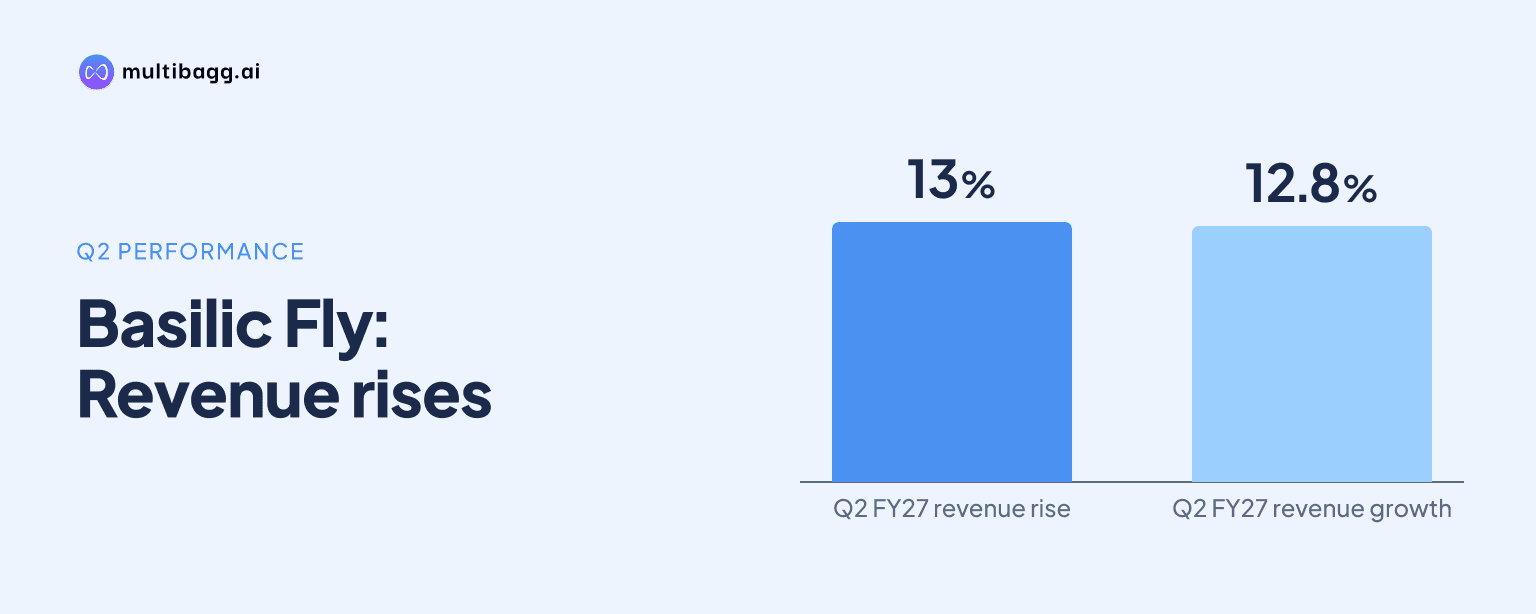
Basilic Fly Studio Limited reported Q2 FY27 consolidated revenue growth of 12.8% to ₹107.4 crore, while net profit fell 49.7% to ₹7.3 crore. The results show that higher project volumes and a ₹186 crore order book supported revenue growth, but a changing overseas revenue mix, depreciation and transition costs reduced profitability.
Know Basilic Fly Studio inside out
Results, valuation, peers and who's buying, in one view.
Why did Basilic Fly Studio's Q2 FY27 profit decline?
Basilic Fly Studio's Q2 FY27 profit declined because operating margins narrowed and depreciation increased despite higher consolidated revenue. Revenue from operations rose 12.8% year-on-year and 4% sequentially to ₹107.4 crore. EBITDA was ₹23 crore, translating into a margin of about 21%, compared with 27% in the corresponding quarter of the previous year.
Net profit was ₹7.3 crore, down 49.7% year-on-year, and the PAT margin fell to 7% from 15%. Management linked the consolidated margin decline to a greater contribution from overseas business, which has a different margin profile from the India operations, as well as higher depreciation and amortisation. The company also described the quarter as a transition period involving integration of its UK and Paris operations, severance costs and investment in AI and automation.
The standalone India business presented a different picture. Its Q2 revenue was ₹30 crore, down 13% year-on-year on a high prior-year commercial base, while its EBITDA margin improved to 55% from 42%. However, its PAT margin fell to 19% because of higher depreciation, underscoring the effect of non-operating cost structure changes on reported profit.
What were Basilic Fly Studio's key Q2 FY27 operating figures?
Basilic Fly Studio completed 81 projects for 52 clients globally during Q2 FY27 and ended the period with an order book of ₹186 crore. Management said 80% of this order book is expected to convert into revenue over the next two quarters, providing visibility for near-term delivery activity.
The company reported work on projects including Jailer 2 and The Witcher Season 5. These projects reflect the company's international visual-effects delivery base, while the growth in overseas volume was also a key reason why the consolidated revenue mix changed during the quarter.
How is Basilic Fly Studio addressing margin pressure?
Basilic Fly Studio is shifting high-cost UK and European roles to India and investing in automation to improve its operating structure. Management said the EBITDA percentage of the overseas and standalone businesses remained intact, and that the lower consolidated margin was primarily a result of a higher overseas revenue mix rather than a deterioration in the underlying profitability of those operations.
The company expects its full-year EBITDA margin to be broadly in line with the previous year, subject to minor timing-related variation. This guidance is important because the Q2 margin of about 21% was lower than the 27% recorded a year earlier. The company has also indicated an overall growth guidance of 30%.
Its Bangalore studio is scheduled to open in January 2027. The facility is planned to increase the local team from about 50 employees to about 100 employees over six to eight months. The planned capacity expansion is intended to support project execution in India as the company moves work from higher-cost overseas locations.
Got a follow-up? Ask IRIS
What does the order book mean for Basilic Fly Studio investors?
Basilic Fly Studio's ₹186 crore order book gives visibility on planned production work, with management expecting ₹148.8 crore, or 80%, to be covered over the next two quarters. The order book is significant relative to Q2 revenue of ₹107.4 crore because it indicates that a substantial amount of contracted work is scheduled for near-term execution.
But revenue visibility does not by itself resolve the margin issue. Investors will be tracking whether the movement of roles to India, the Bangalore capacity addition and the integration of overseas operations improve consolidated profitability. The key comparison will be between revenue growth and the EBITDA margin, since the latest quarter showed that higher revenue did not translate into higher net profit.
The company also reported that receivables had stretched, with debtors outstanding for more than 180 days above plan. This is relevant to cash conversion and working-capital management. No amount for these overdue receivables was disclosed in the supplied call summary, but the issue adds an execution and collection factor alongside the revenue and margin trends.
How do overseas operations shape Basilic Fly Studio's outlook?
Basilic Fly Studio's overseas operations are central to its client delivery model and were a major contributor to Q2 revenue growth. At the same time, management said the increased overseas contribution reduced the consolidated EBITDA margin because of the mix effect. The company's stated response is to integrate those operations and relocate selected high-cost roles to India.
The transition also includes investment in AI and automation. Management presented these initiatives as part of improving operational efficiency rather than as an immediate solution to the Q2 profit decline. The reported quarter therefore combined stronger delivery volumes and a larger order book with costs associated with building a more India-led production platform.
Conclusion
Basilic Fly Studio delivered double-digit Q2 FY27 revenue growth, supported by 81 projects and a ₹186 crore order book, but profit declined sharply as consolidated EBITDA and PAT margins compressed. The results make the revenue mix, depreciation burden, overseas integration costs and collection cycle central considerations alongside top-line growth.
The next disclosures to watch are the conversion of 80% of the order book over the next two quarters, progress on the Bangalore studio opening in January 2027, and whether the shift of overseas roles to India supports management's expectation of a full-year EBITDA margin broadly in line with the previous year.