










Basilic targets 4%-5% employee-cost reduction through offshoring
Key highlights
- Basilic expects its employee-cost measure to decline by close to 4% to 5% over time through greater offshore delivery.
- Bengaluru staffing rose from zero to about 50 in eight to nine months and is expected to double within six to eight months.
- An investor cited H1 FY'27 employee costs of Rs 137 crore, equal to about 65% of revenue.
- Basilic reported 11% year-on-year growth, which management said was primarily driven by AI efficiencies shared with clients.
powered by IRIS
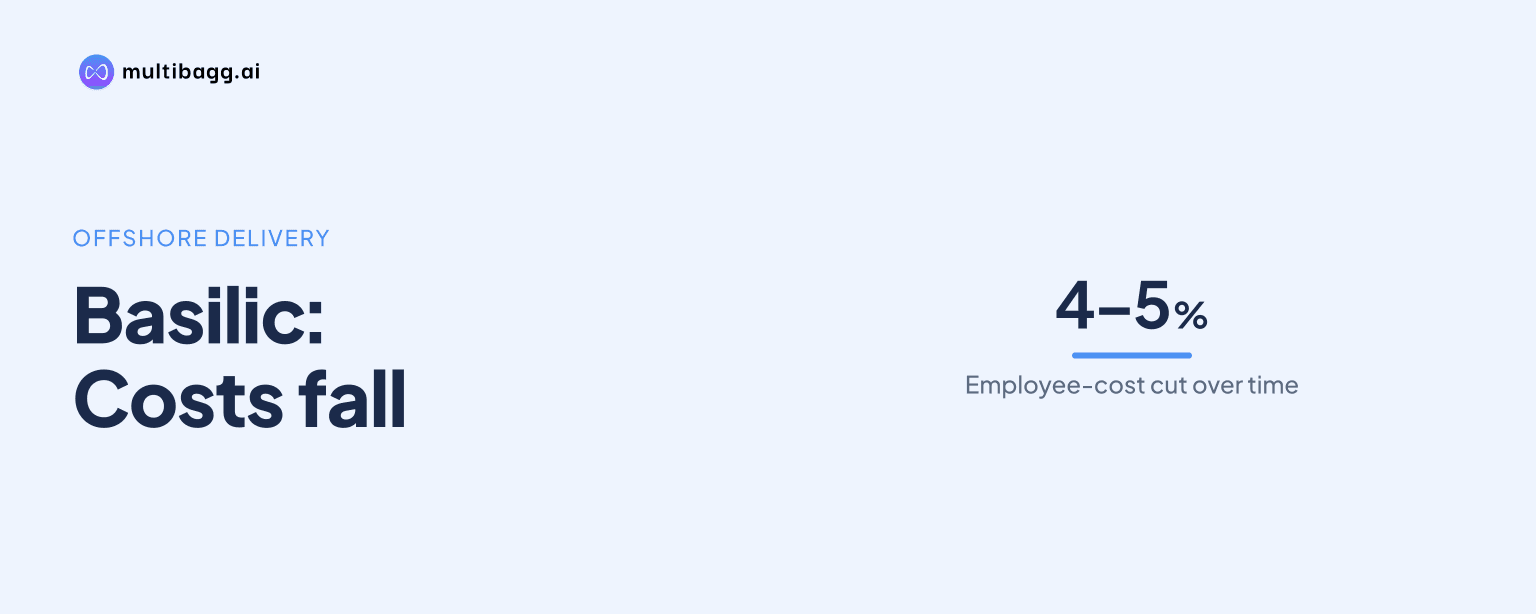
Basilic Fly Studio Limited expects its employee-cost measure to fall by close to 4% to 5% over time as Bengaluru VFX staffing doubles from about 50 within six to eight months, management said. The plan relies on lower offshore delivery costs, expanded capacity and technology enablement.
Know Basilic Fly Studio inside out
Results, valuation, peers and who's buying, in one view.
How much does Basilic expect employee costs to decline?
Basilic expects the overall employee-cost measure to decline by close to 4% to 5% over time, Gaurav Mehra said in response to a question on H1 FY'27 costs. An investor cited employee costs of Rs 137 crore in H1 FY'27, equal to about 65% of revenue, and management did not dispute the figures or give a deadline for the expected decline.
The company linked the projected change to a greater share of offshore delivery rather than to an announced absolute payroll reduction. Mehra cited the difference between on-site and offshore employee costs, alongside the expansion of the Bengaluru centre and existing Chennai and Pune teams. He also said severance costs incurred while moving work offshore contributed to recent employee-cost pressure.
How quickly is Basilic expanding the Bengaluru centre?
Basilic expanded its Bengaluru team from zero to about 50 people in the previous eight to nine months and expects it to double in the next six to eight months. Management described the new centre as a location for high-end work, while Chennai was already delivering another stream of VFX work.
Mehra said the company has an opportunity to add another 50 to 60 full-time equivalent, or FTE, roles during the same six-to-eight-month period. He said those FTEs would equal more than about 12% to 15% of Basilic’s current total FTE base and could make a significant contribution to revenue because they would handle high-end work. Management did not disclose a Bengaluru revenue target.
The additional capacity is intended to reduce a delivery constraint that emerged during a spike in overseas demand. Management said some work had to be completed on site because it could not immediately be moved offshore while meeting committed timelines. Once Bengaluru is fully operational, Basilic expects greater offshore capacity for projects with short as well as longer deadlines.
Why should offshore delivery reduce Basilic’s costs?
Basilic says the cost difference between on-site and offshore employees is the mechanism behind its expected 4% to 5% reduction. Management said increased Bengaluru, Chennai and Pune capacity, together with employee technical upskilling and technology enablement, should allow more work to be delivered from India.
The company does not expect every overseas project to be transferable. Balakrishnan said tax incentives generally permit 10% to 15% of project spend to be non-rebatable, although the terms differ by project and country. He said only a small number of projects may need a larger share of work in the United Kingdom, or UK, while India’s lower costs can allow the permitted non-rebatable spend to cover 50% to 70% of overseas-location spending in some cases.
Management illustrated the trade-off with examples rather than a formal offshore-mix target. It said 85% of spending could represent 40% to 50% of work in the UK, while the permitted 15% could support 50% to 60% of work in India and sometimes up to 70% because of the cost difference. These examples show that tax-credit conditions, client requirements and delivery costs will determine the work split project by project.
Got a follow-up? Ask IRIS
What has increased Basilic’s employee costs recently?
Basilic attributed recent employee-cost pressure to severance spending linked to offshoring and to on-site delivery needed during overseas-demand spikes. The Rs 137 crore H1 FY'27 employee-cost figure was raised by an investor, and management’s response was that Bengaluru capacity should reduce the need for higher-cost on-site work when schedules are tight.
Technology investment has also increased non-cash expense. Management said Rs 22 crore of assets were created between March and September, primarily as intangible assets for artificial intelligence, or AI, tools rather than property, plant and equipment. It said this capitalisation was the main cause of higher depreciation, with the larger investment occurring in the current H1 after a smaller first-quarter investment in the previous year.
Basilic said AI-related savings are not retained entirely by the company because lower operating costs can support more competitive client pricing. Management reported 11% year-on-year growth and said the growth was primarily driven by AI efficiencies shared with clients. That makes project volume, pricing and the pace of offshore delivery relevant to the eventual employee-cost outcome.
How does offshoring fit Basilic’s broader operating plan?
Basilic reported an order book of Rs 186 crore and said it expects H2 to be better than H1 because production is generally scheduled in the third and fourth quarters. Management did not provide a numerical revenue or earnings before interest, tax, depreciation and amortisation, or EBITDA, target, but said it expected growth in both top line and EBITDA.
The company is also considering a second mergers and acquisitions, or M&A, transaction involving a potential North American partner with intellectual-property, immersive-experience and commercial capabilities. Management said the final partner and due diligence are still pending, so the transaction is not immediate. It does not foresee near-term severance from that possible M&A, contrasting it with severance related to an acquisition completed two years earlier.
Conclusion
Basilic’s expected 4% to 5% employee-cost reduction depends on shifting more high-end VFX work to India as Bengaluru grows from about 50 employees toward twice that level within six to eight months. The plan also relies on Chennai and Pune capacity, employee upskilling and technology enablement, while tax-credit requirements and short project timelines may limit offshoring on some jobs.
The next indicators are Bengaluru becoming fully operational, the completion of the second technology phase and the extent to which overseas projects can be delivered offshore without on-site support. Management also expects H2 to exceed H1 seasonally, while its proposed North American M&A remains subject to partner selection and due diligence.