










Bagmane says job cuts have not reduced Bengaluru office demand
Key highlights
- Bagmane leased 1.2 million square feet in the quarter, four times the preceding quarter’s volume.
- Management said Bengaluru RFP activity has not declined over the past 6 to 7 quarters.
- Some AI-focused tenants allocate 250 sq ft per employee, compared with an 80 to 90 sq ft India average.
- Bagmane plans 2 million sq ft of development across three buildings, starting one in the March quarter.
powered by IRIS
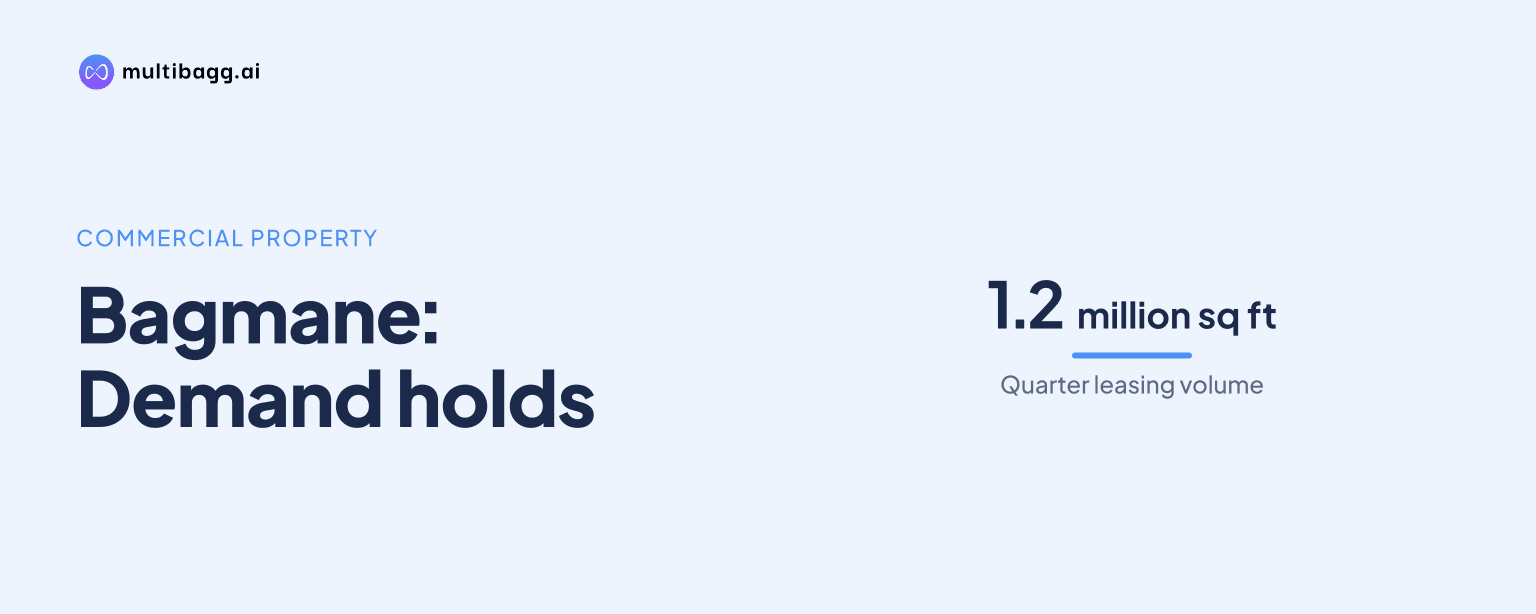
In the quarter, Bagmane said global job-cut announcements had not reduced Bengaluru office demand, citing 1.2 million square feet of leasing, four times the preceding quarter, and request-for-proposal activity that management said had remained unchanged for six or seven quarters despite AI-related employment concerns.
Know Bagmane Prime Office REIT inside out
Results, valuation, peers and who's buying, in one view.
Have job cuts reduced Bagmane’s Bengaluru office demand?
No. Bagmane said it had not seen a decline in Bengaluru demand or quarterly request-for-proposal, or RFP, rates during the past six or seven quarters, even as Qualcomm, Microsoft and Barclays announced headcount reductions. Hugh Andrew said this period included increased discussion about artificial intelligence, or AI, and its possible effect on employment.
Management said headline job-cut figures do not capture graduate programmes, new projects or outsourcing work. Andrew said a global organisation may reduce about 5% of staff annually through performance-related decisions, while outsourcing providers can add workers when client work shifts. This was management’s interpretation of tenant activity rather than a forecast of Bengaluru employment.
Bagmane also said India could be lower on the list for broad workforce cuts because of its talent pool and relatively low real-estate costs. Andrew qualified that statement by saying India would not be entirely unaffected. The company’s disclosed operating evidence was sustained RFP activity and quarterly leasing, not tenant-by-tenant hiring data.
What leasing evidence supports Bagmane’s demand view?
Bagmane’s main evidence is 1.2 million square feet of leasing in the quarter, which it said was four times the preceding quarter’s volume. Management said the leasing was almost entirely to global capability centres, or GCCs, at rents above market, with half signed as pre-leasing commitments before the relevant space was ready for occupation.
The quarter’s 1.2 million square feet also included activity linked to upcoming supply: Bagmane said 60% of its under-construction space was already committed ahead of completion. The call did not disclose how much of the quarterly leasing was specifically for AI or semiconductor operations, nor did it identify the tenants that had announced job cuts.
At Cosmos, Bagmane said two pre-leases totalling almost 600,000 square feet were agreed at Rs 158 to Rs 172 per square foot. That compares with a valuer’s estimated Cosmos market rent of about Rs 157 per square foot for the financial year, placing the disclosed lease range between Rs 1 and Rs 15 per square foot above that estimate.
An analyst referred to 99% committed occupancy across 16.7 million square feet, and Bagmane said it had maintained that level consistently for five years. Management said committed occupancy had never fallen below 94%, including during COVID, and argued that limited vacant space improves its position when leases are renewed or space is re-let.
Got a follow-up? Ask IRIS
Why does Bagmane think AI can raise office-space needs?
Bagmane said some AI-focused tenants are providing more space per worker to attract specialised talent. Andrew said the average Indian office occupation is 80 to 90 square feet per person, while some tenants using AI space are allocating 250 square feet per person to provide a better work environment.
The 250-square-foot allocation is about 2.8 to 3.1 times the 80-to-90-square-foot average management cited. Bagmane’s point is that lower headcount does not necessarily produce an equal reduction in office demand when employers change workplace design for specialised roles. It did not say 250 square feet is the average across its portfolio.
Management discussed AI and semiconductor development together as part of wider industry growth. Andrew said the company researches economic changes when considering the pace of construction, its right-of-first-offer pipeline and possible third-party acquisitions. Bagmane said it expects demand to exceed supply until 2028, while acknowledging that conditions beyond that year are difficult to predict.
What new Bengaluru supply is Bagmane planning?
Bagmane plans to begin construction on one of three future buildings in the March quarter. The programme covers 2 million square feet across Cosmos and Bagmane Tech Park, or BTP, which management said are in the same micro-market.
After the first start, Bagmane expects to launch another building every six to nine months. Management said a building would typically take 24 to 27 months to complete after construction starts, but did not disclose the size, development cost or pre-leasing level for each of the three buildings.
Future growth is also expected to come from lease renewals and re-leasing. Of the 0.7 million square feet due to expire in the second half, Bagmane said almost 40% was already leased, 15% was under renewal and 45% was expected to terminate but remained under discussion with clients.
Bagmane expects a 10% mark-to-market, or MTM, increase on those second-half expiries. Management said the current quarter’s overall MTM was 9%, including some second-half leasing, and that it had achieved MTM increases 2% to 4% above projected market trends in each of the past two quarters.
Conclusion
Bagmane’s position is that job cuts at global companies have not translated into weaker Bengaluru office demand in its portfolio. The company cited 1.2 million square feet of quarterly leasing, four times the prior quarter, unchanged RFP activity over six or seven quarters and workspace allocations of 250 square feet per employee at some AI-related tenants.
The next disclosures to watch are the March-quarter construction start for the first of three planned buildings, launches every six to nine months and the stated 24-to-27-month completion cycle. Bagmane’s ability to achieve its expected 10% MTM increase on 0.7 million square feet of second-half expiries will also provide evidence on rental conditions.