










Bagmane targets 16%-17% tax outgo after new tax regime shift
Key highlights
- Bagmane expects taxes of 16% to 17% of NOI in FY27 after adopting the new tax regime.
- Bagmane reported Q2 FY27 NOI of Rs 684.4 crore and an NOI margin of 89%.
- Bagmane declared a Q2 FY27 distribution of Rs 527 crore, or Rs 1.55 per unit, with 79% in dividends.
- Bagmane has 1 million square feet under development, of which 60% was pre-leased.
powered by IRIS
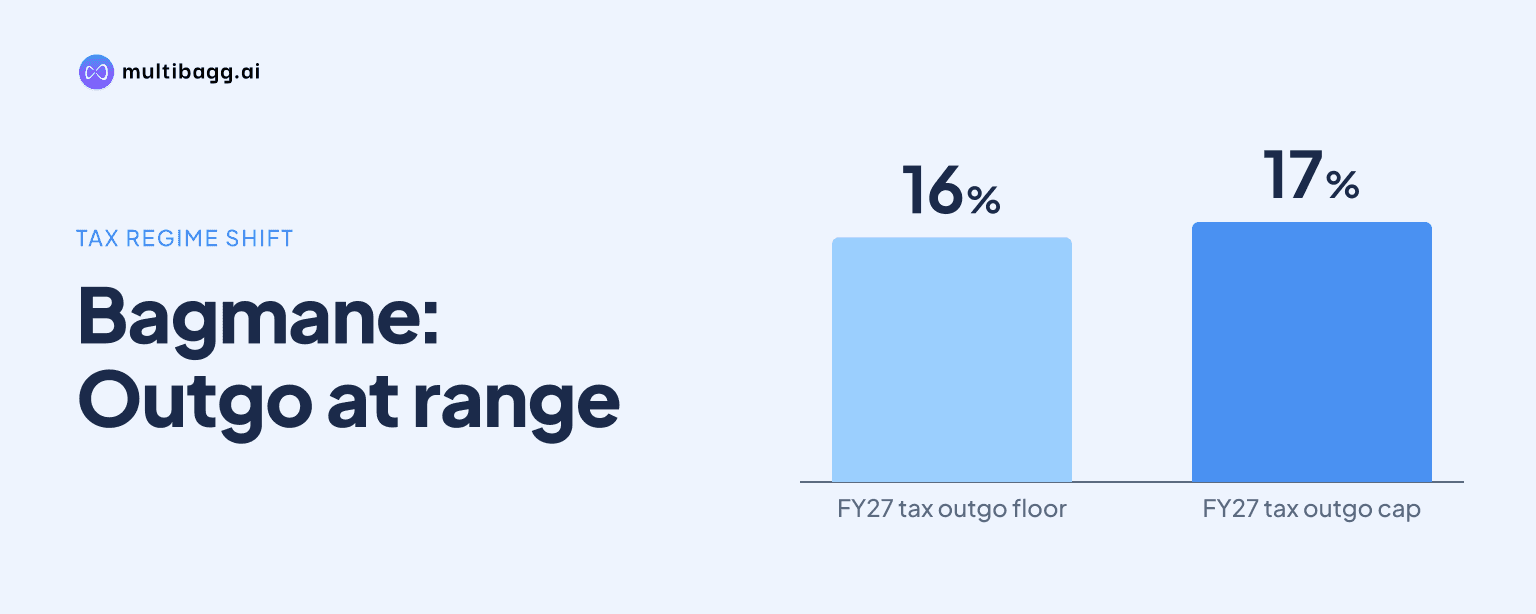
Bagmane expects taxes to fall to 16% to 17% of net operating income, or NOI, in FY27 after adopting the new tax regime, following a higher Q2 FY27 tax payment calculated under the old regime and paid as advance tax. Management said the range should remain similar thereafter under current circumstances.
Know Bagmane Prime Office REIT inside out
Results, valuation, peers and who's buying, in one view.
Why will Bagmane's tax outgo decline after Q2 FY27?
Bagmane expects tax outgo to decline because its Q2 FY27 advance-tax payment was made assuming the old tax regime before management decided to adopt the new regime. Ashay Shah said taxes in subsequent quarters should be 16% to 17% of NOI, and confirmed that this expectation applies to FY27.
The 16% to 17% range is management's recurring expectation rather than a one-quarter adjustment. When an analyst asked whether taxes would fall further from the next financial year because advance tax had already been paid, Shah said the level would remain similar under current circumstances.
The call did not quantify the Q2 FY27 tax amount in rupees or disclose the tax rate under either regime. The analyst described cash tax as almost 23% of earnings before interest, tax, depreciation and amortisation, or EBITDA, in the first full reported quarter, while management attributed the higher tax to the timing and basis of advance-tax payments.
What did Bagmane report in its first full listed quarter?
Bagmane reported Q2 FY27 revenue from operations of Rs 765 crore and NOI of Rs 684.4 crore, producing an NOI margin of 89%. This was its first full quarter of results as a listed real estate investment trust, or REIT, and it reported Rs 1,500 crore of revenue and Rs 1,340 crore of NOI for the first half of FY27.
The first-half NOI margin was 1 percentage point above the Q2 FY27 margin. Management attributed the 89% to 90% range to the scale of its parks, efficient operations and in-house facility management, and said it expects NOI margin to remain between 88% and 90% going forward.
The tax guidance uses NOI, whereas the analyst's Q2 FY27 observation used EBITDA, so the two percentages are not directly comparable. Shah said a 3.5% property-management fee at the special purpose vehicle, or SPV, level applies to facility rentals, excluding common-area-maintenance, or CAM, margin; minor corporate expenses and treasury income also affect the movement from NOI to EBITDA.
Got a follow-up? Ask IRIS
How could the new tax range affect Bagmane's distributions?
Bagmane did not provide a revised distribution forecast, but it said it aims to convert revenue growth into distributions and declared a Q2 FY27 distribution of Rs 527 crore, or Rs 1.55 per unit. A lower tax outgo as a share of NOI would reduce a tax item in the cash walk-down, although management did not quantify the effect on distributions.
The Q2 FY27 distribution was 79% dividends, which Bagmane said are tax-exempt in the hands of unitholders, and first-half distributions reached Rs 1,040 crore, or Rs 3.05 per unit. The dividend proportion describes the composition of the payout, while the tax-regime guidance concerns taxes paid within the operating and cash-distribution structure.
Bagmane's tax explanation is distinct from its property operating margin. It maintained an 89% NOI margin in Q2 FY27 and guided to an 88% to 90% range going forward despite the elevated tax payment, while management did not say that the tax-regime shift would change that NOI-margin range.
What income drivers support Bagmane's FY27 tax guidance?
Bagmane identified contractual escalations, mark-to-market gains on renewals and re-leasing, and development income as drivers of its NOI base. It achieved 9% mark-to-market on re-leasing in Q2 FY27, while in-place rents carry 18% mark-to-market potential and 26% of gross contracted rentals expire by FY30.
Of the 0.7 million square feet due to expire in the second half, management said almost 40% was already leased, 15% was under renewal and 45% was expected to terminate but remained under active client discussions. Shah said Bagmane expects to achieve a 10% mark-to-market on this expiring space, noting that it had achieved 2% to 4% above projected market trends in the past two quarters.
Development is another planned source of income. Bagmane is constructing 1 million square feet at Cosmos Business Park, of which 60% was pre-leased; Ceres was 54% pre-leased and on track for Q3 FY27 completion, while Aurora was 63% pre-leased and on track for Q4 FY27 completion.
Management said the balance cost to complete its office projects, solar asset and two hotels was about Rs 1,100 crore. Bagmane also reported gross debt of just over Rs 2,500 crore, net debt of Rs 1,700 crore and a 4% loan-to-value ratio as of September 30, 2026, alongside Rs 18,000 crore of debt headroom for developments, right-of-first-offer assets and potential third-party acquisitions.
Conclusion
Bagmane's central tax message is that Q2 FY27 tax was elevated by advance tax calculated under the old regime, while management expects taxes to settle at 16% to 17% of NOI after moving to the new regime. The guidance accompanies Q2 FY27 NOI of Rs 684.4 crore at an 89% margin and a Rs 1.55-per-unit distribution, separating property operating performance from the tax item discussed in the cash walk-down.
The next point to watch is whether subsequent FY27 tax disclosures align with the 16% to 17% of NOI range, alongside leasing and development milestones. Management expects Ceres to complete in Q3 FY27 and Aurora in Q4 FY27, while the 0.7 million square feet of second-half expiries carries a targeted 10% mark-to-market.