










Bagmane Prime Office REIT GCC share reaches 92.9% in Sep 2026
Key highlights
- Bagmane REIT’s GCC tenant-profile share rose from 88.6% in Mar-25 to 92.9% in Sep-26.
- Top-10 tenants contributed 61.6% of gross contracted rentals in Sep-26, down from 63.6% in Mar-25.
- Google accounted for 17% of Bagmane REIT’s gross contracted rentals, while Amazon accounted for 10%.
- Bagmane REIT reported 99.0% committed occupancy across 19.7 msf of leasable area at Sep-26.
powered by IRIS
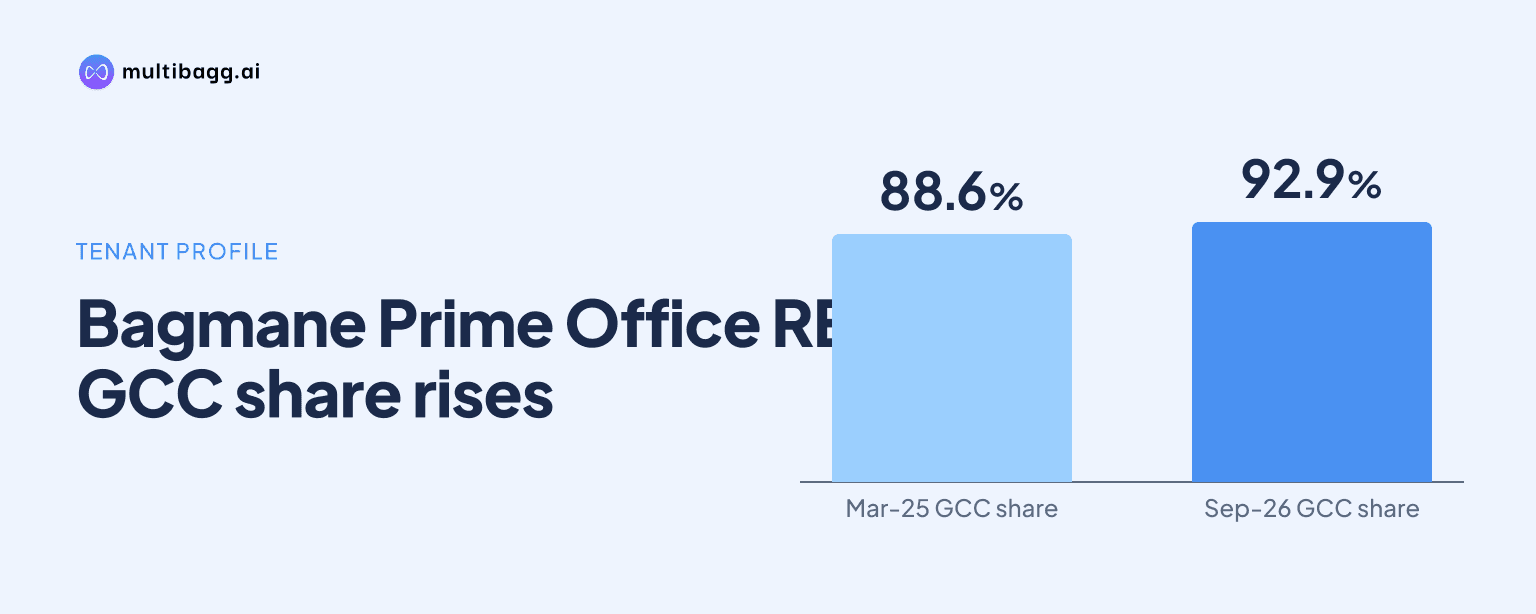
Bagmane Prime Office REIT reported that Global Capability Centers, or GCCs, represented 92.9% of its tenant profile at September 30, 2026, while its top 10 tenants accounted for 61.6% of gross contracted rentals, down from 63.6% in March 2025. The data shows a larger GCC weighting alongside a 2.0-percentage-point fall in disclosed rental concentration among the largest occupiers.
Know Bagmane Prime Office REIT inside out
Results, valuation, peers and who's buying, in one view.
How did Bagmane REIT’s GCC tenant share change?
Bagmane REIT’s GCC share increased by 4.3 percentage points from 88.6% in March 2025 to 92.9% in September 2026. The progression was limited through December 2025, when the share was 88.5%, before it rose to 89.5% in June 2026 and then increased by 3.4 percentage points during the September 2026 quarter.
The September 2026 figure is consistent with the presentation’s rounded portfolio overview, which describes 93% of the tenant profile as GCCs. The portfolio had 19.7 million square feet, or msf, of leasable area and 99.0% committed occupancy at September 2026.
Has Bagmane REIT reduced its largest-tenant concentration?
Bagmane REIT reduced top-10 tenant concentration to 61.6% of gross contracted rentals in September 2026 from 63.6% in March 2025. The 2.0-percentage-point reduction means the 10 largest occupiers still accounted for more than three-fifths of the gross contracted rentals measure.
The disclosed movement was consistent across interim periods: the top-10 contribution declined from 63.6% in March 2025 to 63.5% in June 2025, 63.0% in December 2025, 62.5% in June 2026 and 61.6% in September 2026. Historical top-10 figures were not provided for March 2022 through March 2024, so the available comparison begins in March 2025.
Gross contracted rentals comprise base rentals, fit-out income and car-park rentals from occupied area, excluding utility income, common-area maintenance income and other operating income. The lower 61.6% top-10 measure therefore reflects rental concentration, while the 92.9% GCC figure is reported as a tenant-profile metric rather than explicitly as a share of gross contracted rentals.
Which tenants account for Bagmane REIT’s rental concentration?
Bagmane REIT’s largest disclosed tenant was Google at 17% of gross contracted rentals, followed by Amazon at 10% and Texas Instruments at 7%, based on the September 2026 tenant roster. Samsung, an unnamed Fortune 500 semiconductor company and Qualcomm each represented 5%, while Volvo accounted for 4%.
The remaining disclosed top-10 positions were a leading PC manufacturer, Nvidia and opentext™, each at 3% of gross contracted rentals. These individually rounded percentages total 62%, compared with the databook’s 61.6% aggregate, which is consistent with the presentation’s statement that certain figures are rounded for presentation.
The sector mix lists technology at 34%, semiconductor at 22%, and electronics and e-commerce at 19%. Together, those three sectors represented 75% of the displayed tenant segmentation, compared with 12% for others, 8% for engineering and manufacturing, and 5% for banking, financial services and insurance.
Got a follow-up? Ask IRIS
How does Bagmane REIT’s portfolio support its GCC-led tenant profile?
Bagmane REIT’s six premium parks are located in Bengaluru’s Outer Ring Road and Secondary Business District City micro-markets, with 16.7 msf of completed area at September 2026. Bagmane Constellation Business Park and Bagmane Rio Business Park each reported 100% committed occupancy, while Bagmane World Technology Centre reported 96.4%.
The named campus relationships illustrate the occupier base: Bagmane Constellation Business Park is described as Amazon’s mini campus across five towers, Bagmane Rio Business Park as Google’s largest standalone facility outside the United States, and Bagmane Tech Park as Volvo’s largest research and development centre outside Sweden. Bagmane Cosmos is described as Texas Instruments’ largest centre in India.
Bagmane REIT’s weighted average lease expiry, or WALE, was 6.1 years at September 2026, compared with 7.5 years at March 2025 and 6.8 years at June 2026. The presentation defines WALE using an assumption that occupiers exercise all renewal options after their initial commitment period under the lease terms.
What leasing and expiry data matter for Bagmane REIT next?
Bagmane REIT has 0.7 msf of area expiring in the remaining six months of FY27, representing 6.0% of gross contracted rentals, followed by 1.0 msf in FY28 representing 7.8%. The next largest disclosed expiry by area is 1.4 msf in FY30, accounting for 7.7% of gross contracted rentals.
Management reported an average 15% re-leasing spread from FY23 through the first half of FY27, with 91% of gross leasing in that period leased to existing tenants. Gross leasing totalled 1.4 msf in the first half of FY27, comprising 0.6 msf of new area and 0.8 msf of existing area, compared with 1.9 msf in FY26.
The REIT also reported 18% average future mark-to-market potential for expiring rents through FY30. Its schedule identifies potential mark-to-market changes of 10% in the second half of FY27, 27% in FY28, 19% in FY29 and 17% in FY30; these are management estimates associated with future lease expiries rather than contracted rent increases.
Conclusion
The September 2026 data shows that Bagmane REIT became more concentrated in GCC occupiers, with the disclosed tenant-profile share rising to 92.9%, while the top-10 share of gross contracted rentals declined to 61.6%. Google’s 17% share and Amazon’s 10% share show that individual large occupiers remain material despite the lower aggregate top-10 concentration.
The next disclosed indicators are leasing outcomes on 0.7 msf expiring in the second half of FY27 and 1.0 msf in FY28, alongside the expected completion of Cosmos-Ceres in Q3 FY27 and Cosmos-Aurora in Q4 FY27. At September 30, 2026, those developments were 54% and 63% pre-leased, respectively, and their occupation could change the tenant profile and rental concentration.