










Bagmane REIT reports occupancy lead and 18% mark-to-market
Key highlights
- Bagmane REIT reported 99% committed occupancy in September 2026 versus 88% for the Bengaluru market.
- Bagmane REIT’s in-place rent index reached 137 in September 2026, compared with 128 for Bengaluru from a March 2021 base of 100.
- Bagmane REIT reported 18% average future MTM potential on 26% of gross contracted rentals expiring through FY30.
- Bagmane REIT averaged 2.1 msf of gross leasing from FY23 through H1 FY27, with 91% leased to existing tenants.
powered by IRIS
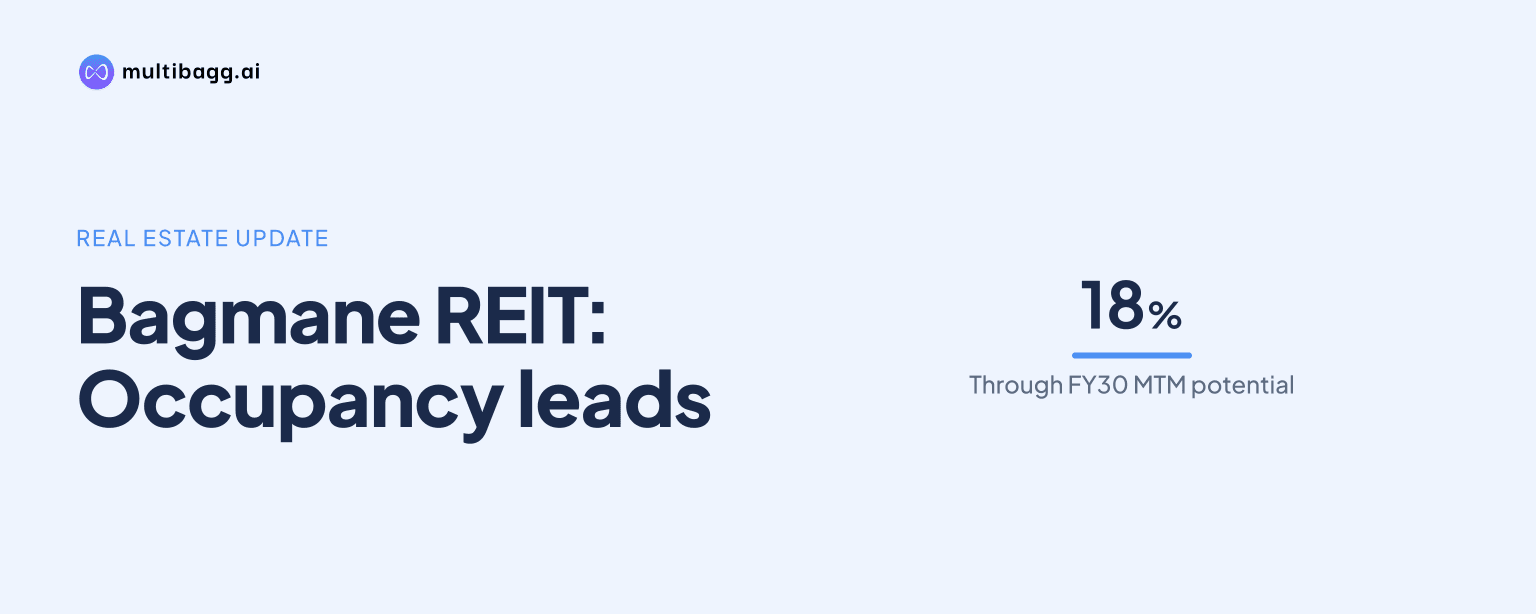
Bagmane REIT reported 99% committed occupancy in September 2026, 1,080 basis points above Bengaluru’s 88%, while its in-place rent index reached 137 against the market’s 128 and leases expiring through FY30 carried 18% average future mark-to-market potential.
Know Bagmane Prime Office REIT inside out
Results, valuation, peers and who's buying, in one view.
How did Bagmane REIT outperform Bengaluru occupancy?
Bagmane REIT maintained committed occupancy above the Bengaluru market at every reported point from March 2021 to September 2026. Its occupancy was 96% in March 2021 against Bengaluru’s 93%, and it reached 99% in September 2026 while the market was at 88%, producing the stated 1,080-basis-point lead.
The portfolio’s lowest reported committed occupancy was 94% in March 2022, compared with 89% for Bengaluru in that period. Bagmane REIT notes that the March 2022 figure would have been 97% excluding 0.7 million square feet, or msf, completed in December 2021 and subsequently leased in October 2022. From March 2024 to December 2025, occupancy increased from 97% to 99%, while Bengaluru increased from 87% to 90%.
How much faster did Bagmane REIT’s in-place rents grow?
Bagmane REIT’s in-place rent index rose by 37 points from its March 2021 base to 137 in September 2026, compared with a 28-point increase to 128 for the Bengaluru market. The presentation rebases both series to 100 in March 2021, allowing a like-for-like comparison of the change in portfolio and market rents.
The gap widened over the reported periods. Bagmane REIT’s index was 113 in March 2023 against 105 for Bengaluru, then reached 127 versus 116 in March 2025 and 132 versus 123 in December 2025. The presentation reports a 5.9% compound annual growth rate, or CAGR, for portfolio assets, compared with 4.6% for Bengaluru market rents, and labels the difference as 133 basis points. Bengaluru market data are attributed to JLL.
What does Bagmane REIT’s leasing record show?
Bagmane REIT reported average gross leasing of 2.1 msf from FY23 through H1 FY27, with 91% of leasing completed with existing tenants. Total gross leasing was 2.3 msf in FY23, 2.0 msf in FY24, 1.3 msf in FY25, 1.9 msf in FY26 and 1.4 msf in H1 FY27.
The FY25 total of 1.3 msf was the lowest in the five displayed periods, before leasing increased by 0.6 msf to 1.9 msf in FY26. Existing area represented 1.6 msf of FY23 leasing, 1.2 msf in FY24, 1.1 msf in FY25, 1.9 msf in FY26 and 0.8 msf in H1 FY27. Bagmane REIT reports an average re-leasing spread of 15% for FY23 through H1 FY27, including car-park rents.
Got a follow-up? Ask IRIS
How much lease expiry and mark-to-market potential does Bagmane REIT have?
Bagmane REIT reports 18% average future mark-to-market, or MTM, potential on leases expiring through FY30, while 26% of gross contracted rentals are scheduled to expire between H2 FY27 and FY30. The disclosed schedule includes car-park rents and covers 0.7 msf in H2 FY27, 1.0 msf in FY28, 0.8 msf in FY29 and 1.4 msf in FY30.
FY28 has the highest disclosed MTM at 27%, associated with 1.0 msf of expiring area and 8% of gross contracted rentals. FY30 has the largest expiring area at 1.4 msf, but its stated MTM is 17%, below FY28’s 27% and FY29’s 19%. H2 FY27 has 6% of gross rentals expiring and 10% MTM, while FY29 has 5% of gross rentals expiring.
What development milestones has Bagmane REIT disclosed?
Bagmane REIT disclosed 1.0 msf under development, 2.0 msf of future development and 0.6 msf pre-leased in its development pipeline. At Cosmos, Ceres was 54% pre-leased and expected to complete in Q3 FY27, while Aurora was 63% pre-leased and expected to complete in Q4 FY27.
Ceres had Rs 90 crore of balance cost and Aurora had Rs 140 crore of balance cost as of September 30, 2026. Bagmane REIT also disclosed a 72.5-megawatt direct-current solar project at Chitradurga with Rs 70 crore of balance cost and estimated completion by Q3 FY27. Its hospitality development has 607 keys, Rs 820 crore of balance cost and estimated completion by FY29; the presentation says the hospitality and renewable-energy developments are intended to support the office portfolio and drive net operating income.
Conclusion
Bagmane REIT’s reported occupancy premium over Bengaluru coincided with faster growth in its in-place rent index, which rose to 137 by September 2026 against 128 for the market. Gross leasing averaged 2.1 msf from FY23 through H1 FY27, and the portfolio has disclosed 18% average future MTM potential on lease expiries representing 26% of gross contracted rentals through FY30.
The next disclosed milestones are the expected Q3 FY27 completion of Cosmos Ceres and Q4 FY27 completion of Cosmos Aurora. The expiry schedule also points to FY28, when 1.0 msf and 8% of gross contracted rentals expire with stated 27% MTM, and FY30, when expiring area rises to 1.4 msf with stated 17% MTM.