










Balkrishna Paper Mills auditor cites Rs 175.3772 crore deficit
Key highlights
- Balkrishna Paper Mills had negative net worth of Rs 175.3772 crore as of September 30, 2026.
- Total assets fell to Rs 7.5137 crore from Rs 17.8544 crore at March 31, 2026.
- Paper and paperboard trading sales rose to Rs 3.2695 crore in the half year ended September 30, 2026, from Rs 2.1327 crore a year earlier.
- Operating cash flow remained negative at Rs 1.2025 crore, while cash and cash equivalents stood at Rs 0.6055 crore at September 30, 2026.
powered by IRIS
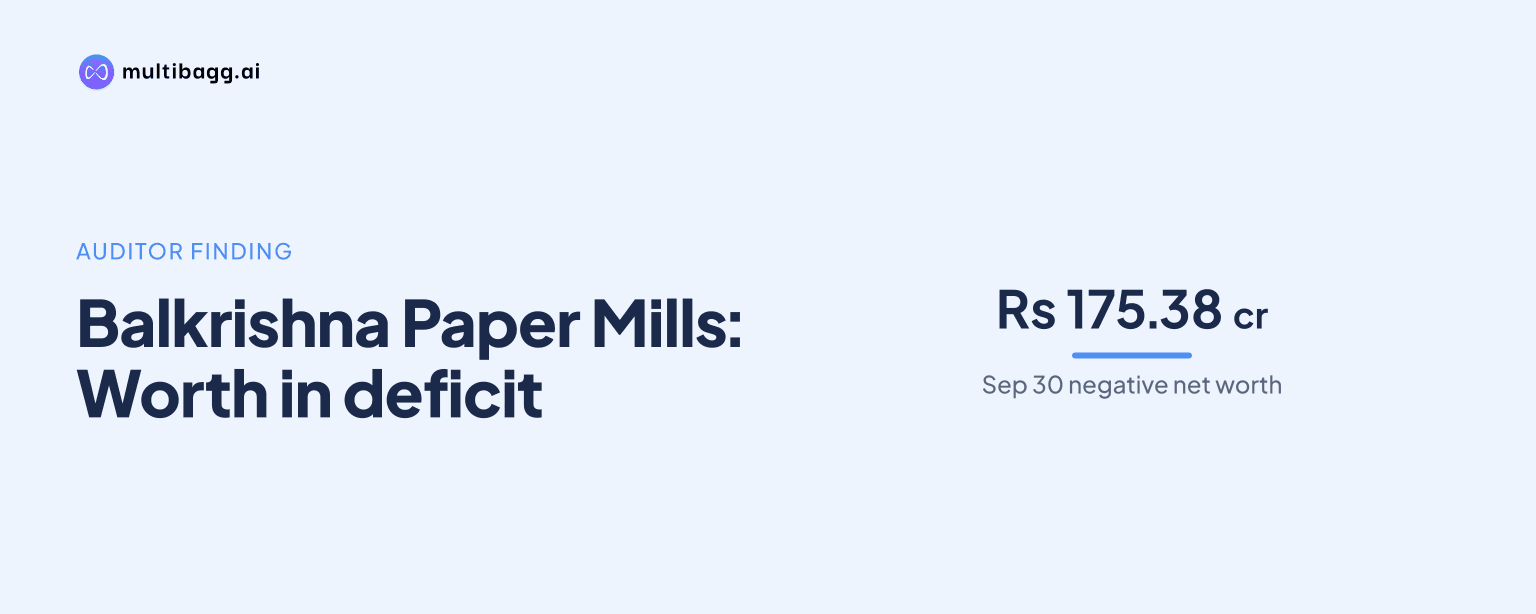
Balkrishna Paper Mills Limited faces a material going-concern uncertainty after its auditor issued a qualified limited-review conclusion for the half year ended September 30, 2026. The auditor cited net worth of negative Rs 175.3772 crore and discontinued manufacturing at Ambivali, while management’s going-concern basis depends on generating expected cash flows to meet obligations.
Know Balkrishna Paper Mills inside out
Results, valuation, peers and who's buying, in one view.
Why did Balkrishna Paper Mills receive a qualified conclusion?
Balkrishna Paper Mills received a qualified conclusion because its net worth was negative Rs 175.3772 crore on September 30, 2026, while paper and paperboard manufacturing at Ambivali had been discontinued. D S M R & Co said these circumstances created a material uncertainty that may cast significant doubt on the company’s ability to continue as a going concern. The firm issued its limited-review report on October 30, 2026.
The auditor did not say the interim results contained a material misstatement beyond the stated matter. Its conclusion said that, except for the effects of the going-concern issue described in the basis for qualification, nothing had come to its attention indicating that the statement did not make required disclosures under Securities and Exchange Board of India listing regulations. The review was conducted under the Standard on Review Engagements and provides moderate assurance, with a scope narrower than an audit under Standards on Auditing.
How did Balkrishna Paper Mills’ financial position change?
Balkrishna Paper Mills’ negative equity narrowed marginally to Rs 175.3772 crore at September 30, 2026 from Rs 175.4416 crore at March 31, 2026. Equity share capital was unchanged at Rs 32.2195 crore, while the other-equity deficit moved to Rs 207.5967 crore from Rs 207.6611 crore. The Rs 0.0644 crore movement did not remove the negative-net-worth position cited in the qualified conclusion.
Total liabilities fell to Rs 182.8909 crore from Rs 193.296 crore over the six-month period ended September 30, 2026. Non-current borrowings declined by Rs 10 crore to Rs 132.50 crore, while current liabilities rose to Rs 29.1705 crore from Rs 26.8152 crore. Total assets declined to Rs 7.5137 crore from Rs 17.8544 crore, and assets held for disposal fell to Rs 4.9639 crore from Rs 15.2681 crore.
What business does Balkrishna Paper Mills operate after manufacturing stopped?
Balkrishna Paper Mills operates in trading of paper and paperboards after its board decided on November 13, 2024 to discontinue paper and paperboard manufacturing at Ambivali. The company disclosed the former manufacturing activity as a discontinued operation under Indian Accounting Standard 105. It also said trading in plastic and packaging materials ceased from April 1, 2026, leaving paper and paperboard trading as its single operating segment.
The continuing trading business reported sales turnover of Rs 3.2695 crore in the half year ended September 30, 2026, compared with Rs 2.1327 crore in the corresponding prior-year period. That was an increase of Rs 1.1368 crore. Management said it was optimistic about improving operations and intended to explore available resources and business opportunities to support future operations and cash-flow generation.
The discontinued paper and paperboard operation recorded no revenue from operations in the half year ended September 30, 2026, as in the comparative period. It reported profit before tax of Rs 2.9314 crore, compared with a loss before tax of Rs 0.819 crore a year earlier. The result included a Rs 3.3296 crore exceptional gain on the sale of an asset held for disposal; before that gain, the discontinued operation recorded a Rs 0.3982 crore loss before tax.
Got a follow-up? Ask IRIS
Can Balkrishna Paper Mills generate the cash flows it needs?
Balkrishna Paper Mills generated Rs 12.2513 crore of net cash from investing activities in the half year ended September 30, 2026, principally from Rs 10.8967 crore of property, plant and equipment sales and Rs 1.3546 crore from investment sales. These investing receipts coincided with cash and cash equivalents rising to Rs 0.6055 crore at September 30 from Rs 0.1939 crore at the beginning of the financial year.
Operating cash flow remained negative at Rs 1.2025 crore for the half year, although the outflow improved from Rs 3.538 crore in the corresponding period of 2025. Cash used in financing activities was Rs 10.6372 crore, including repayment of Rs 10 crore of long-term borrowings and Rs 4.4303 crore of finance costs paid. The auditor specifically said continuation as a going concern depends on expected cash flows being sufficient to meet obligations as they arise.
What did management say about the going-concern assumption?
Balkrishna Paper Mills’ management said the September 30, 2026 financial statements were prepared on a going-concern basis because it expects business operations to improve and plans to use available resources and opportunities to support cash generation. This is management’s assessment, rather than an auditor confirmation that future cash flows will be achieved. The financial results were reviewed by the audit committee and approved by the board on October 30, 2026.
The accompanying statement on audit qualifications said the financial impact of the qualification was unascertainable and could not be quantified for the quarter and half year ended September 30, 2026. The statement did not provide an adjusted figure for turnover, expenditure, net profit or loss, earnings per share, total assets, total liabilities or net worth. The qualification instead identifies uncertainty in the assumption underpinning the accounts rather than calculating a separate adjustment.
Conclusion
Balkrishna Paper Mills’ September 2026 filing shows a company that has exited manufacturing, is pursuing paper and paperboard trading, and reduced non-current borrowings by Rs 10 crore. Yet the fall in total liabilities and the smaller operating cash outflow have not resolved the auditor’s concern: negative net worth of Rs 175.3772 crore, alongside the Ambivali manufacturing closure, creates material uncertainty over continued operations.
The next issue to watch is whether management’s plan to improve trading operations and use available resources produces the expected cash flows needed to meet obligations when due. Subsequent results will show whether turnover builds on the Rs 3.2695 crore reported for the half year ended September 30, 2026 and whether recurring operating cash generation can replace proceeds from asset and investment sales.