










Balmer Lawrie operating cash outflow widens to Rs 101.9504 crore
Key highlights
- Balmer Lawrie reported net cash used in operating activities of Rs 101.9504 crore for the six months ended September 30, 2026.
- Balmer Lawrie’s profit before tax increased to Rs 172.7502 crore from Rs 140.8753 crore a year earlier.
- Trade receivables, inventories and other short-term financial assets used Rs 320.0006 crore of cash combined.
- Balmer Lawrie’s cash and cash equivalents closed at Rs 25.2290 crore on September 30, 2026, down Rs 8.1660 crore during the period.
powered by IRIS
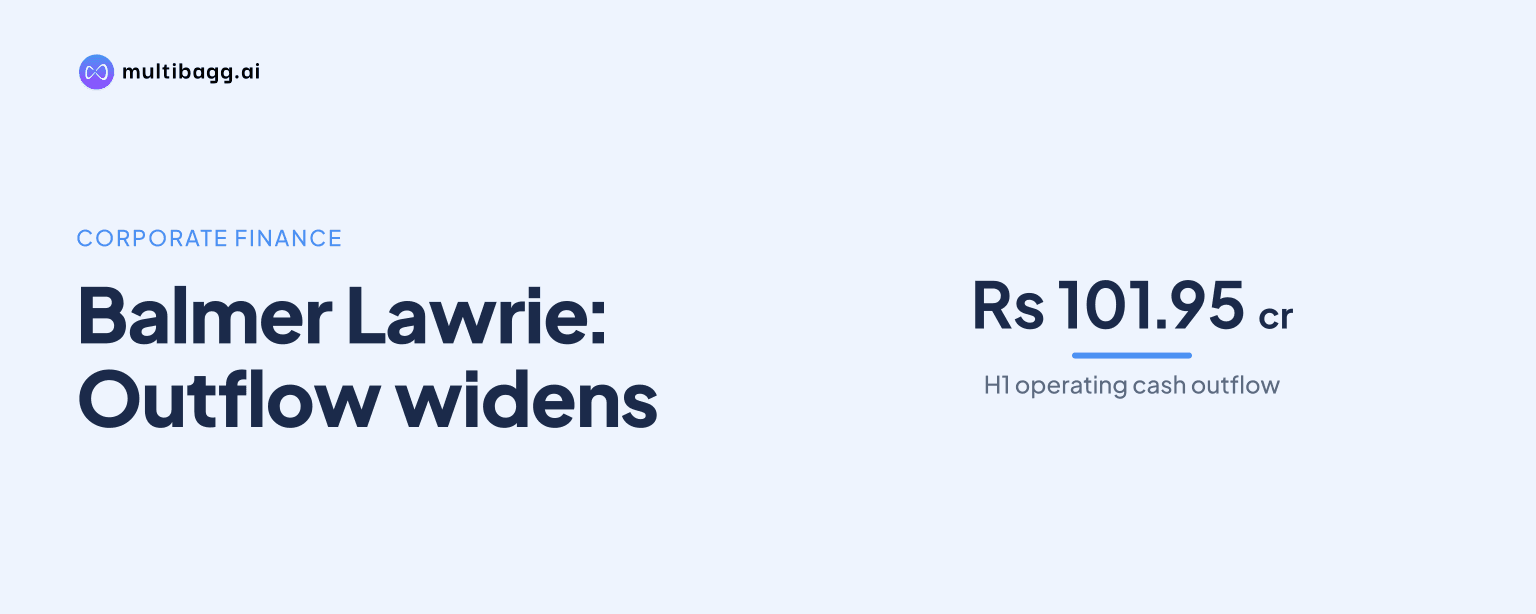
Balmer Lawrie & Co. Ltd. reported net cash used in operating activities of Rs 101.9504 crore for the six months ended September 30, 2026, versus Rs 72.7338 crore a year earlier, despite profit before tax rising to Rs 172.7502 crore from Rs 140.8753 crore. Higher receivables, inventories and other short-term financial assets absorbed cash.
Know Balmer Lawrie & Company inside out
Results, valuation, peers and who's buying, in one view.
Why did Balmer Lawrie report a wider operating cash outflow?
Balmer Lawrie reported a wider outflow because Rs 204.4426 crore of operating cash flow before working-capital changes was outweighed by cash absorbed in operating assets and liabilities. Cash generated from operations consequently stood at negative Rs 69.2288 crore, and net income taxes paid of Rs 32.7216 crore took net cash used in operating activities to Rs 101.9504 crore for the period ended September 30, 2026.
The outflow increased by Rs 29.2166 crore from negative Rs 72.7338 crore in the corresponding six months ended September 30, 2025. In that earlier period, cash generated from operations was negative Rs 36.9006 crore and taxes paid were Rs 35.8332 crore. The reduction in tax payments in 2026 therefore did not offset the larger operating cash use before tax.
The cash-flow statement separates profit-related cash generation from the movement in working-capital balances. Balmer Lawrie increased profit before tax by Rs 31.8749 crore year on year, while the increase in receivables, inventories and other financial assets reduced cash after those balances were accounted for. The filing does not give commercial reasons for the individual balance-sheet movements.
How did Balmer Lawrie’s profit compare with operating cash generation?
Balmer Lawrie increased revenue from operations to Rs 1,542.5098 crore in the six months ended September 30, 2026 from Rs 1,305.4250 crore a year earlier, while profit before tax rose to Rs 172.7502 crore from Rs 140.8753 crore. Profit after tax increased to Rs 125.3203 crore from Rs 104.4122 crore in the standalone unaudited results approved by the board on November 2, 2026.
Cash flow before working-capital changes rose to Rs 204.4426 crore from Rs 150.4006 crore. The calculation included depreciation and amortisation of Rs 33.5940 crore, compared with Rs 24.3312 crore a year earlier, and finance costs of Rs 20.4680 crore, compared with Rs 9.7016 crore. Interest income was adjusted by Rs 16.7412 crore, below the Rs 18.4124 crore adjustment in the prior-year period.
The comparison shows that the outflow did not result from lower reported revenue, profit or cash generation before working capital. Rather, cash conversion changed after movements in operating balances. Balmer Lawrie’s revenue increased by Rs 237.0848 crore, but the cash absorbed by the largest working-capital items exceeded the pre-working-capital cash flow.
Got a follow-up? Ask IRIS
Which working-capital movements used Balmer Lawrie’s cash?
Balmer Lawrie used Rs 134.2182 crore as trade receivables increased, Rs 128.5560 crore as other short-term financial assets increased, and Rs 57.2264 crore as inventories increased. These three movements together used Rs 320.0006 crore in the six months ended September 30, 2026, exceeding the Rs 204.4426 crore generated before working-capital changes.
Receivables used more cash than in the corresponding 2025 period, when they absorbed Rs 78.2439 crore, while inventory growth used Rs 21.7380 crore. Other short-term financial assets absorbed Rs 128.5560 crore, marginally below the Rs 131.3866 crore used a year earlier. Other current assets used Rs 16.6027 crore, compared with Rs 25.2753 crore in the previous period.
Liability movements partly offset the asset-related cash use. Other liabilities added Rs 30.0453 crore, other current liabilities added Rs 40.5932 crore, and short-term provisions added Rs 11.8863 crore. Trade payables, however, fell by Rs 14.1118 crore after providing Rs 19.2694 crore of cash in the prior-year period, while long-term provisions declined by Rs 6.2650 crore.
What offset Balmer Lawrie’s operating outflow and where did cash end?
Balmer Lawrie generated Rs 97.9304 crore from investing activities and used Rs 4.1460 crore in financing activities, limiting the overall fall in cash and cash equivalents to Rs 8.1660 crore. Cash and cash equivalents ended September 30, 2026 at Rs 25.2290 crore, down from Rs 33.3950 crore at the beginning of the period and below Rs 38.6893 crore at September 30, 2025.
Investing cash generation was lower than Rs 164.2154 crore in the corresponding 2025 period. Net movement in bank deposits with original maturities of more than three months contributed Rs 82.0504 crore, compared with Rs 163.0522 crore a year earlier. Balmer Lawrie also received Rs 30.3975 crore in dividends and Rs 11.1603 crore in interest, while purchase or construction of property, plant and equipment used Rs 26.9490 crore.
Financing activities moved to a smaller outflow of Rs 4.1460 crore from an outflow of Rs 93.1291 crore a year earlier. Borrowing proceeds were Rs 112.7706 crore, while dividends paid, lease-liability repayments and finance costs used Rs 80.0073 crore, Rs 16.4413 crore and Rs 20.4680 crore respectively. The filing records these movements but does not disclose the intended use or terms of the borrowings.
Conclusion
Balmer Lawrie’s first-half figures show revenue rising by Rs 237.0848 crore and profit before tax increasing by Rs 31.8749 crore, alongside a Rs 29.2166 crore wider operating cash outflow. The central factor was working-capital absorption, led by Rs 134.2182 crore in receivables, Rs 128.5560 crore in other short-term financial assets and Rs 57.2264 crore in inventories.
The next financial results will show whether the receivables, inventory and financial-asset movements reverse, stabilise or increase further after September 30, 2026. Investors can also track the closing cash balance of Rs 25.2290 crore, borrowing proceeds of Rs 112.7706 crore and the next disclosed movements in bank deposits, capital expenditure and dividends.