










BASF India operating cash outflow narrows to Rs 347.06 crore
Key highlights
- BASF India reported a Rs 347.06 crore operating cash outflow for the six months ended September 30, 2026, versus Rs 965.36 crore a year earlier.
- Trade receivables increased by Rs 756.70 crore and inventories increased by Rs 633.41 crore in BASF India’s six-month cash-flow statement.
- BASF India’s revenue from operations increased to Rs 9,669.63 crore from Rs 7,655.82 crore in the first half.
- Cash and cash equivalents fell to Rs 555.31 crore at September 30, 2026 from Rs 868.90 crore at March 31, 2026.
powered by IRIS
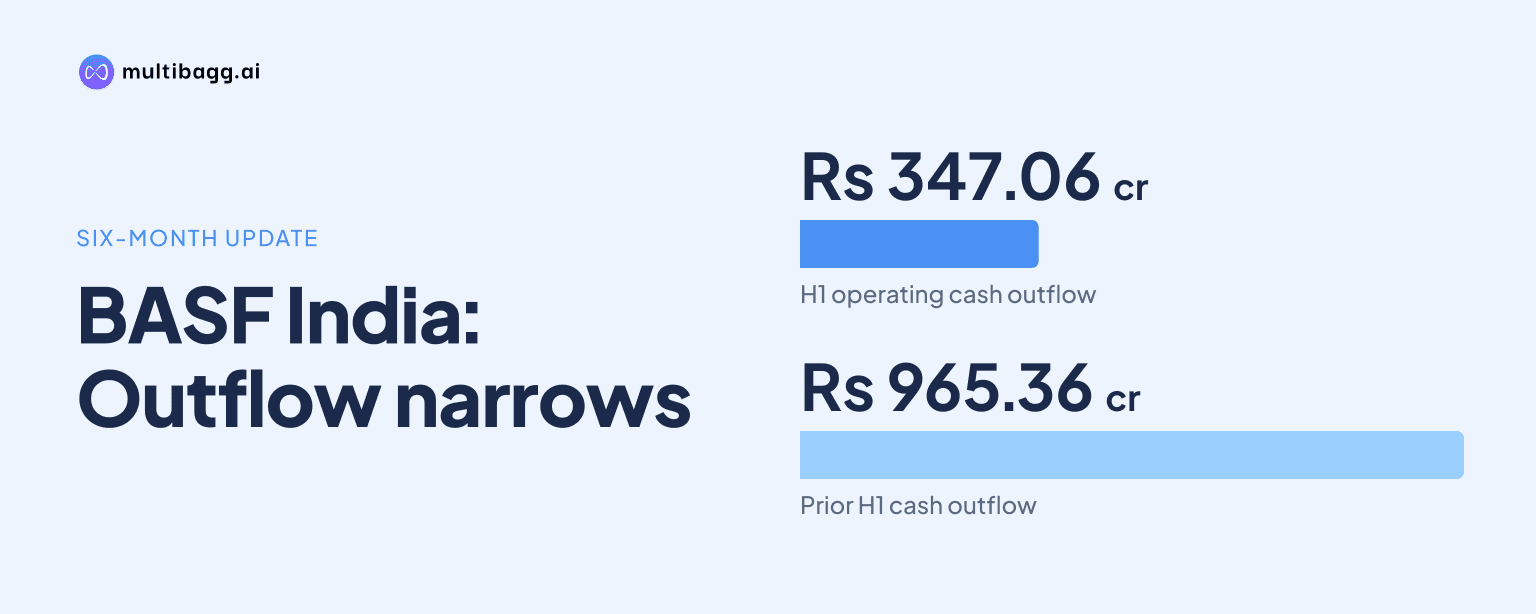
BASF India Limited reported a standalone operating cash outflow of Rs 347.06 crore for the six months ended September 30, 2026, compared with an outflow of Rs 965.36 crore a year earlier, as higher pre-tax profit and increased trade payables partly offset Rs 756.70 crore absorbed by receivables and Rs 633.41 crore by inventories.
Know BASF India inside out
Results, valuation, peers and who's buying, in one view.
Why did BASF India report an operating cash outflow?
BASF India reported an operating cash outflow because movements in working capital exceeded Rs 637.67 crore of cash flow generated before working-capital changes in the six months ended September 30, 2026. Profit before tax rose to Rs 582.33 crore from Rs 336.14 crore a year earlier, including a Rs 18.15 crore exceptional gain on the sale of a wholly owned subsidiary.
Trade receivables were the largest use of cash, increasing by Rs 756.70 crore in the cash-flow statement. Inventories used another Rs 633.41 crore and other current and non-current assets used Rs 68.91 crore. These movements resulted in Rs 229.76 crore of cash used in operations, while net income taxes paid of Rs 117.30 crore took the operating outflow to Rs 347.06 crore.
The outflow was Rs 618.30 crore lower than the Rs 965.36 crore reported in the corresponding 2025 period. In the earlier period, BASF India generated Rs 379.40 crore before working-capital changes, but trade payables fell by Rs 998.29 crore. In the latest half year, trade payables increased by Rs 592.41 crore, partly countering the higher receivables and inventory requirements.
How much did BASF India’s receivables and inventory increase?
BASF India’s trade receivables rose to Rs 3,498.15 crore at September 30, 2026 from Rs 2,747.05 crore at March 31, 2026, a balance-sheet increase of Rs 751.10 crore. Inventories increased to Rs 3,342.32 crore from Rs 2,708.91 crore, adding Rs 633.41 crore. The Rs 756.70 crore cash-flow increase in receivables differs slightly from the movement between the two reported closing balances.
Revenue from operations rose to Rs 9,669.63 crore in the first half from Rs 7,655.82 crore a year earlier. Product sales increased to Rs 9,596.52 crore from Rs 7,589.36 crore, while service revenue was Rs 63.42 crore compared with Rs 62.05 crore. The filing does not specify whether the receivables and inventory movements resulted from payment timing, product mix, sales terms or stocking policy.
Receivables and inventories together were Rs 6,840.47 crore at September 30, 2026, compared with Rs 5,455.96 crore at March 31, 2026. Their combined balance increased by Rs 1,384.51 crore, while cash and cash equivalents declined by Rs 313.59 crore to Rs 555.31 crore. Assets classified as held for sale, worth Rs 211.91 crore at March 31, were not reported at September 30 after the coatings transaction closed.
Got a follow-up? Ask IRIS
Which BASF India segments drove first-half revenue growth?
BASF India recorded higher first-half revenue in Materials, Industrial Solutions, Nutrition & Care and Chemicals, while Agricultural Solutions declined year on year. Chemicals added Rs 645.56 crore of revenue to Rs 1,579.56 crore, and Materials added Rs 636.83 crore to Rs 2,807.25 crore, the two largest absolute increases among the disclosed segments.
Agricultural Solutions revenue declined to Rs 1,173.11 crore from Rs 1,326.40 crore in the six months ended September 30, 2025. BASF India describes Agricultural Solutions, which consists of the Crop Protection division, as seasonal. Its segment result was Rs 48.86 crore, down from Rs 215.44 crore, while the Materials segment result increased to Rs 212.24 crore from Rs 24.79 crore.
Industrial Solutions revenue increased to Rs 1,894.46 crore from Rs 1,446.35 crore, and Nutrition & Care rose to Rs 2,161.37 crore from Rs 1,722.35 crore. The filing does not assign trade receivables or inventories to individual segments. It therefore shows which businesses contributed to revenue growth, but does not identify which segment generated the working-capital build-up.
How did the outflow affect BASF India’s cash and investing flows?
BASF India’s cash and cash equivalents fell to Rs 555.31 crore at September 30, 2026 from Rs 868.90 crore at March 31, 2026. The reported net decrease was Rs 313.59 crore, comprising the Rs 347.06 crore operating outflow, Rs 178.37 crore generated from investing activities and Rs 144.90 crore used in financing activities.
Investing activities included Rs 230.06 crore of net proceeds from the sale of equity shares in BASF India Coatings Private Limited. The transaction was completed on June 30, 2026, and the subsidiary ceased to be wholly owned by BASF India. Investing flows also included Rs 125 crore of inter-corporate deposits given, Rs 102 crore of inter-corporate deposits repaid and Rs 55.37 crore spent on property, plant and equipment and related assets.
Financing activities included Rs 108.21 crore of dividend paid, Rs 30.80 crore of lease-principal repayment and Rs 5.89 crore of interest paid, including lease interest. Short-term loan proceeds and repayments were both Rs 170 crore, resulting in no net cash contribution from those borrowings. Total current liabilities increased to Rs 4,584.51 crore from Rs 4,001.15 crore, while trade payables rose to Rs 4,182.49 crore from Rs 3,644.10 crore.
Conclusion
BASF India’s first-half operating cash deficit narrowed from Rs 965.36 crore to Rs 347.06 crore as cash flow before working capital increased and trade payables moved from a cash use to a cash source. Yet the higher revenue and Rs 423.76 crore profit for the period did not translate into positive operating cash flow because receivables and inventories absorbed Rs 1,390.11 crore in aggregate.
The next disclosed matter to watch is the proposed Scheme of Arrangement involving BASF India and BASF Agricultural Solutions India Limited. BASF India’s shareholders approved the scheme on June 24, 2026, but the filing says the transaction remains subject to requisite approvals. Subsequent disclosures can also show whether receivables, inventories and cash balances reverse or continue to increase.