










BASF India Revenue Rises 24% as Q2 Net Profit Falls 42.4%
Key highlights
- BASF India’s Q2 FY27 revenue from operations increased 24% year-on-year to ₹4,832.19 crore.
- BASF India’s Q2 FY27 consolidated net profit fell 42.4% to ₹61.71 crore.
- Total expenses rose to ₹4,782.37 crore in Q2 FY27 from ₹3,785.26 crore a year earlier.
- BASF India’s first-half FY27 net profit increased to ₹422 crore from ₹244.55 crore.
powered by IRIS
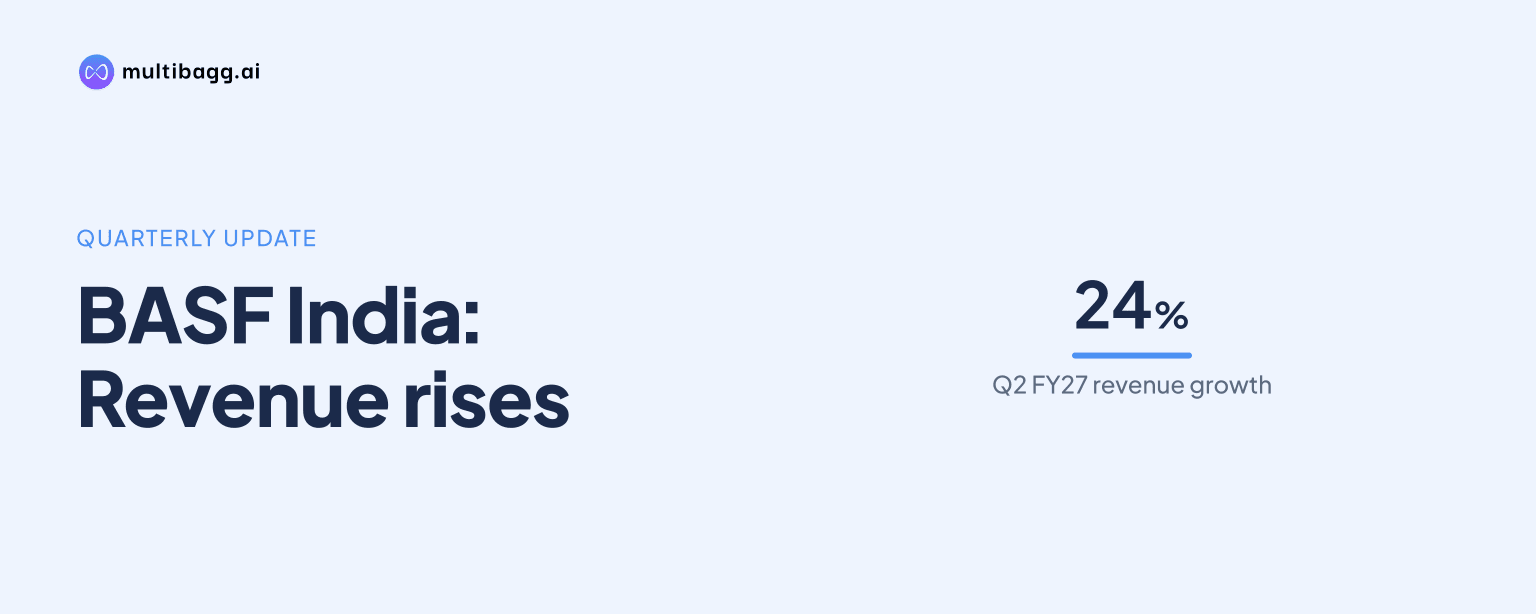
BASF India Limited reported consolidated revenue from operations of ₹4,832.19 crore in Q2 FY27, up 24% year-on-year, while net profit fell 42.4% to ₹61.71 crore from ₹107.15 crore in the September 2025 quarter. The results show that higher sales did not translate into higher quarterly profitability.
Know BASF India inside out
Results, valuation, peers and who's buying, in one view.
What did BASF India report for Q2 FY27?
BASF India reported a 24% year-on-year increase in consolidated revenue from operations for the quarter ended September 30, 2026. Revenue rose to ₹4,832.19 crore from ₹3,895.77 crore in the corresponding quarter of FY26. Total income increased to ₹4,865.44 crore, compared with ₹3,920.61 crore a year earlier.
The Board of Directors approved the unaudited standalone and consolidated financial results on November 4, 2026. Despite the increase in revenue and total income, consolidated net profit declined to ₹61.71 crore in Q2 FY27 from ₹107.15 crore in Q2 FY26. This represents a year-on-year reduction of 42.4%.
How did costs affect BASF India’s quarterly profitability?
BASF India’s reported expenses rose faster in absolute terms than total income during the quarter. Total expenses increased to ₹4,782.37 crore from ₹3,785.26 crore in the prior-year period, while total income rose to ₹4,865.44 crore. The gap between total income and expenses was therefore narrower than a year earlier.
Material and trading-related costs formed a substantial part of the quarterly expense base. The cost of materials consumed was ₹1,722.47 crore, while purchases of stock-in-trade stood at ₹2,521.76 crore. Profit before tax from continuing operations declined to ₹83.07 crore from ₹135.35 crore, before the company reported net profit of ₹61.71 crore.
The results do not provide a separate detailed explanation for each cost movement. However, the reported numbers establish that the revenue gain in the September quarter was accompanied by a higher expense base and lower profit before tax and net profit compared with the same quarter last year.
Which BASF India businesses contributed to quarterly revenue?
BASF India’s Materials segment was the largest contributor to quarterly revenue, reporting ₹1,464.34 crore in Q2 FY27. Nutrition & Care followed with revenue of ₹1,177.40 crore, while Industrial Solutions generated ₹894.57 crore during the quarter.
Chemicals reported quarterly revenue of ₹651.39 crore, and Agricultural Solutions recorded ₹616.08 crore. Together, the five reported segments accounted for the company’s diversified operating base across materials, chemicals, industrial applications, nutrition and care products, and agricultural solutions.
Segment profitability was uneven. Industrial Solutions reported segment profit before tax and interest of ₹83.58 crore, followed by Nutrition & Care at ₹65.51 crore. Agricultural Solutions recorded a segment loss of ₹28.63 crore, Chemicals reported a loss of ₹8.11 crore, and Materials posted a loss of ₹0.45 crore.
Got a follow-up? Ask IRIS
What do BASF India’s first-half FY27 results show?
BASF India’s first-half results show stronger revenue and profit compared with the corresponding six months of FY26. Revenue from operations for April to September FY27 increased to ₹9,656.45 crore from ₹7,637.09 crore in the year-earlier period.
Net profit for the first six months stood at ₹422 crore, compared with ₹244.55 crore in the corresponding period of the previous financial year. Profit before tax from continuing operations increased to ₹563.31 crore from ₹335.49 crore. These half-year figures contrast with the lower net profit reported for the September quarter alone.
The difference between the quarterly and half-year trend indicates that the first-quarter performance contributed materially to the six-month result. The company’s disclosures provide the reported half-year totals but do not separately explain the quarter-to-quarter factors behind the change in profitability.
What does the result mean for BASF India investors?
For investors, the result presents two distinct operating signals: revenue expanded by 24% in Q2 FY27, but quarterly net profit declined by 42.4%. The performance of Industrial Solutions and Nutrition & Care was positive at the segment profit level, while losses in Agricultural Solutions, Chemicals and Materials added to the mixed segment picture.
No share-price movement was provided in the company’s result disclosure, so the financial release alone does not establish the market’s immediate response. The company had earlier informed exchanges that its trading window would remain closed from October 1, 2026, and reopen on November 9, 2026, following the approval of the September-quarter and half-year results.
The figures are also relevant for assessing the balance between sales growth and cost management. With purchases of stock-in-trade at ₹2,521.76 crore and material consumption at ₹1,722.47 crore, changes in operating costs remain important context for evaluating future quarterly profitability.
Conclusion
BASF India delivered higher consolidated revenue in Q2 FY27, with sales rising to ₹4,832.19 crore, but its net profit fell to ₹61.71 crore as total expenses increased and profit before tax from continuing operations declined. The segment data showed that Industrial Solutions and Nutrition & Care remained profitable, while three other reported segments posted losses.
The next disclosed event for investors is the reopening of BASF India’s trading window on November 9, 2026. Future results will indicate whether the company can sustain revenue growth while improving quarterly profitability and reducing the divergence between income growth and expenses.