










Bharat Forge targets near-doubling after 50% acquired growth
Key highlights
- Bharat Forge said JSA and K-Drive combined quarterly revenue rose about 50% from roughly Rs 400 crore to more than Rs 600 crore.
- JSA reported Q2 FY27 revenue of Rs 220 crore, up 16% year on year, with a 14.2% EBITDA margin.
- Bharat Forge aims for K-Drive revenue growth of at least 20% annually and double-digit EBITDA within two years.
- Bharat Forge reported Q2 FY27 consolidated revenue of Rs 4,870 crore, up 21% year on year.
powered by IRIS
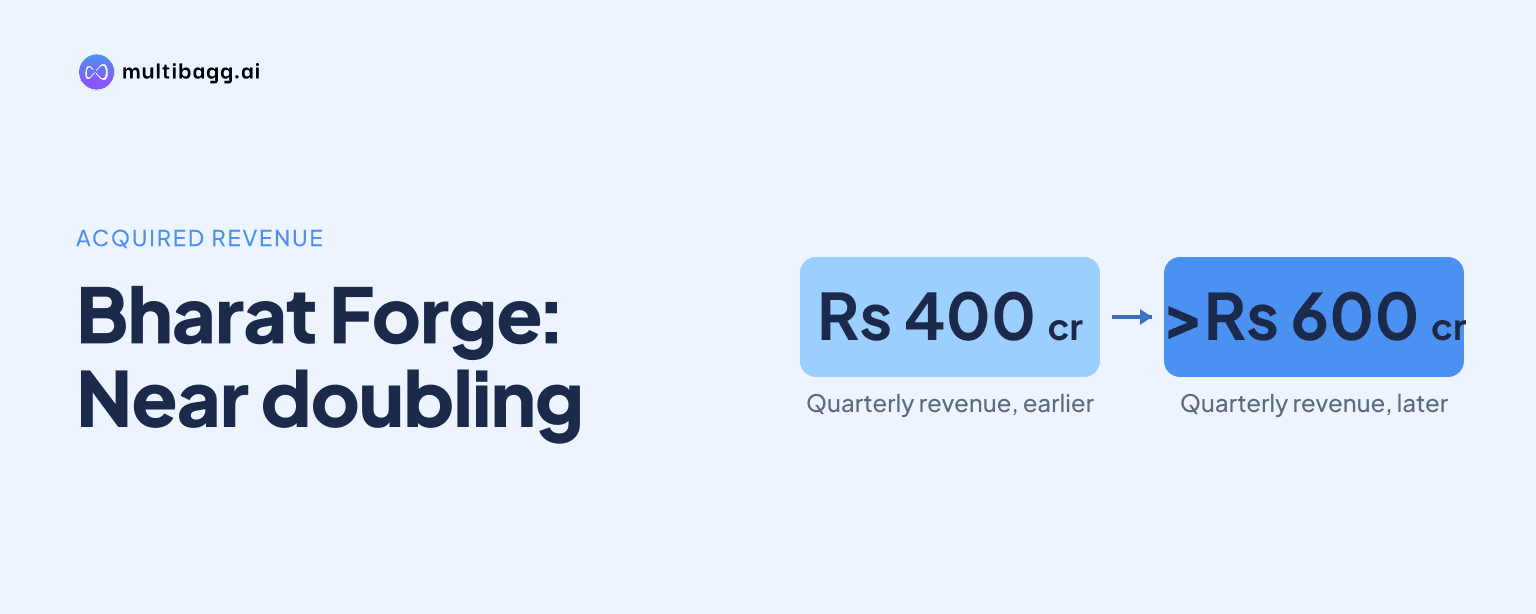
On November 5, 2026, Bharat Forge Limited said combined JSA and K-Drive quarterly revenue had risen about 50% from roughly Rs 400 crore at acquisition to more than Rs 600 crore, and management expects the businesses to grow to close to double that level through broader SUV, pickup and utility-vehicle participation.
Know Bharat Forge inside out
Results, valuation, peers and who's buying, in one view.
How much have JSA and K-Drive grown since acquisition?
Bharat Forge said JSA and K-Drive have grown combined quarterly revenue by about 50%, from roughly Rs 400 crore at acquisition to more than Rs 600 crore. Management also said the two businesses together should generate more than Rs 2,200 crore to Rs 2,300 crore for the year.
The acquired companies began at different scales. Bharat Forge said JS Auto Cast, or JSA, had annual business of about Rs 400 crore, equivalent to about Rs 100 crore quarterly, when it was bought. K-Drive had annual revenue of about Rs 1,220 crore to Rs 1,230 crore, or about Rs 300 crore per quarter, making the combined starting quarterly base about Rs 400 crore.
JSA recorded Rs 220 crore of revenue in Q2 FY27, the quarter ended September 30, 2026, up 16% year on year and its highest quarterly revenue to date, according to Bharat Forge. Its earnings before interest, tax, depreciation and amortisation, or EBITDA, grew 35% year on year, producing a 14.2% EBITDA margin.
What is Bharat Forge targeting for JSA and K-Drive?
Bharat Forge is targeting combined JSA and K-Drive revenue at close to double the current level of more than Rs 600 crore per quarter, alongside higher margins. Management did not give a date or financial-year target for that combined revenue objective.
For K-Drive, management set a goal of revenue growth of at least 20% annually, and potentially 25%, while taking EBITDA into double digits within the next two years. The plan relies on entry into passenger-vehicle applications, especially SUVs, pickups and utility vehicles, as well as hybrid and electric solutions for customers.
Bharat Forge distinguished this strategy from a capacity-only acquisition case. Management said the casting and driveline businesses provide access to passenger-car, utility-vehicle and pickup-truck segments in which Bharat Forge had not previously had a large presence. It said India’s automotive market is growing more through SUVs, pickup SUVs and multi-utility vehicles than through small cars.
Which vehicle markets could drive K-Drive growth?
Bharat Forge expects K-Drive growth to come from SUVs, pickup trucks, utility vehicles and hybrid and electric solutions. Management described the approach as a two-part strategy of expanding passenger-vehicle participation and developing products for changing powertrain requirements.
The export opportunity includes restrictions. Bharat Forge said it has a non-compete agreement with the company from which it bought K-Drive for certain sectors, but added that there are other sectors in which the seller did not operate. Management said those open sectors provide room for Bharat Forge to export and compete.
Off-highway is one such market. Bharat Forge said it is now supplying into off-highway applications and can export into that market globally. The November 5 call did not disclose K-Drive revenue by domestic versus export sales, or by passenger vehicles, off-highway, hybrid or electric products.
Got a follow-up? Ask IRIS
How do the acquisitions fit Bharat Forge's FY27 results?
Bharat Forge discussed the acquisitions alongside Q2 FY27 standalone revenue of Rs 2,526 crore, which was up nearly 30% year on year. Standalone EBITDA was Rs 655 crore, up 20% year on year, while the EBITDA margin was 25.9% for the quarter ended September 30, 2026.
At the consolidated level, Bharat Forge reported Q2 FY27 revenue of Rs 4,870 crore, up 21% year on year, and EBITDA of Rs 778 crore, up about 9% year on year. The consolidated EBITDA margin was about 16%, compared with the 25.9% standalone margin, reflecting a different operating mix across group businesses.
Management said freight, energy and other input costs affected profitability, with recovery from customers occurring with a lag. It also cited an optical inflation effect of about 0.4 percentage points on margins and an exceptional standalone item of about Rs 20 crore for legal and consultancy charges related to restructuring its European steel business, CDP.
Europe reported Q2 revenue of Rs 931 crore and EBITDA of Rs 29 crore, equating to a 3.1% margin, despite lower utilisation during holidays and a difficult operating environment. The United States business reported revenue of Rs 476 crore and negative EBITDA of Rs 6.7 crore, providing contrast with JSA's 14.2% EBITDA margin.
What could support the next stage of Bharat Forge growth?
Bharat Forge management expects H2 FY27 to be stronger than H1 FY27, supported by recovery of price and cost increases from customers and the ramp-up of new business. It specifically listed JSA and K-Drive among the operations expected to contribute, alongside aerospace, industrial exports, semiconductors, commercial vehicles, passenger-car exports and marine products.
The India manufacturing businesses received Rs 2,100 crore of new orders in H1 FY27, including a Rs 1,000 crore order for forgings. Bharat Forge did not quantify how much of those orders belongs to JSA or K-Drive, so the disclosed order intake cannot be used to calculate a separate backlog for the acquired businesses.
Beyond the acquisitions, Bharat Forge is implementing an about Rs 1,300 crore Baramati forging and machining expansion. Management said the project comprises four forging facilities and a large machining facility, adding about 100,000 tonnes of forging capacity and potentially more than doubling Baramati output over two to three years.
Production trials for the first two Baramati assets are expected in January, February and March, with the third planned around the middle of the following year and the final asset by that year-end. Management said the expansion should provide capacity for aerospace, semiconductor and industrial work after the existing facilities had operated close to full capacity for several quarters.
Conclusion
Bharat Forge has positioned JSA and K-Drive as routes into vehicle categories beyond its earlier core exposure, rather than as incremental manufacturing capacity alone. Combined quarterly revenue has increased from about Rs 400 crore at acquisition to more than Rs 600 crore, while JSA delivered Rs 220 crore of Q2 FY27 revenue and a 14.2% EBITDA margin.
The next measures to watch are management's target of at least 20% annual K-Drive revenue growth and double-digit EBITDA within two years, as well as progress toward the combined businesses' planned near-doubling. Investors can also monitor the Baramati trial schedule beginning in January through March and management's stated expectation that H2 FY27 will exceed H1 FY27.