










Bharat Forge plans 100,000-tonne Baramati capacity addition
Key highlights
- Bharat Forge is implementing an about Rs 1,300 crore brownfield expansion at Baramati.
- The Baramati project will add about 100,000 tonnes of forging capacity and four forging facilities.
- Management expects the project to more than double Baramati output over two to three years.
- Bharat Forge reported Q2 FY27 standalone revenue of Rs 2,526 crore, up nearly 30% year on year.
powered by IRIS
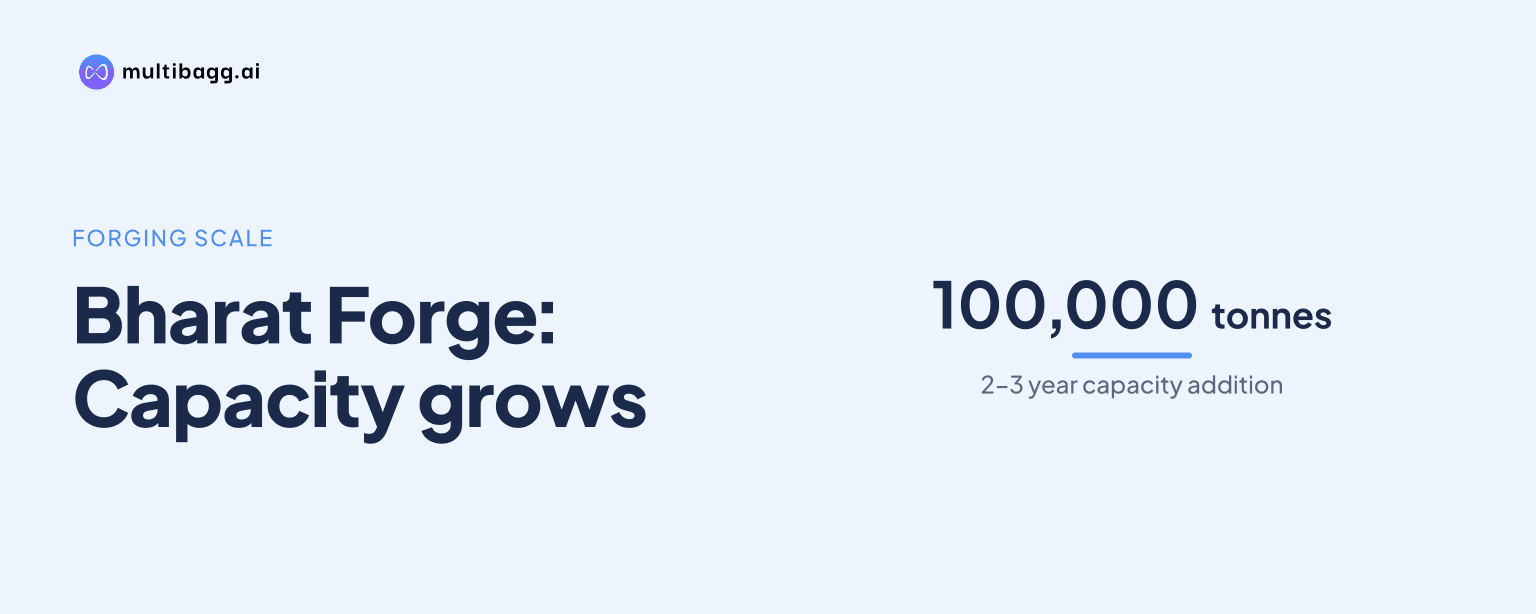
In Q2 FY27, Bharat Forge Limited said it was implementing an about Rs 1,300 crore brownfield expansion at Baramati that will add 100,000 tonnes of forging capacity and is intended to more than double the location's output in two to three years. Management said the first two assets should begin production trials in January, February and March.
Know Bharat Forge inside out
Results, valuation, peers and who's buying, in one view.
What is Bharat Forge adding at Baramati?
Bharat Forge is adding about 100,000 tonnes of forging capacity, four forging facilities and a large machining capacity at Baramati through an about Rs 1,300 crore brownfield project. Management said the programme has entered implementation, meaning the capacity is being developed at an existing location rather than through a new greenfield site.
The company expects the combined forging and machining investment to more than double Baramati output over two to three years. Management said the expansion would start contributing from the first quarter of the next year, with production trials for the first two assets planned across January, February and March, the third asset around the middle of the year and the last asset towards year-end.
The inclusion of machining capacity is central to the project rather than an addition to forging tonnes alone. Bharat Forge said it plans to undertake full machining on semiconductor products, a step management expects to raise value addition once the new machining facilities are online.
Why is Bharat Forge expanding Baramati capacity?
Bharat Forge is expanding Baramati because its existing facilities have operated close to full utilisation for the last few quarters, according to management. The 100,000-tonne addition is intended to create capacity headroom in non-automotive applications, particularly aerospace, semiconductor and industrial products.
Management said the company has been making some large, high-value parts for aerospace, semiconductors and industrial customers, but not at the scale it wanted. A new forging facility is planned to serve these three sectors, allowing parts to be produced more efficiently at greater scale over at least the next two to three years.
In semiconductors, management said Bharat Forge was already at a double-digit-million-dollar annual run rate and aims to grow that business by two to three times over the next two years. The company linked that target to a new forging facility and subsequent machining capacity, without disclosing a rupee revenue target or individual customer commitments.
The aerospace opportunity also supports the additional capacity. Management said it had won new engine-side and landing-gear business across multiple products and customers, while a separate manufacturing facility dedicated to aerospace was about 60% sold out and was expected to start from the middle of the next year.
Got a follow-up? Ask IRIS
How does the Baramati project fit Bharat Forge's current performance?
Bharat Forge began the Baramati implementation phase after reporting its highest quarterly domestic and export sales in Q2 FY27. Standalone revenue rose nearly 30% year on year to Rs 2,526 crore, while earnings before interest, tax, depreciation and amortisation, or EBITDA, rose 20% to Rs 655 crore, producing a 25.9% EBITDA margin.
Consolidated growth was lower than the standalone increase in Q2 FY27. Consolidated revenue increased 21% year on year to Rs 4,870 crore and EBITDA rose about 9% to Rs 778 crore, for a margin of about 16%, compared with standalone revenue of Rs 2,526 crore and EBITDA of Rs 655 crore.
The overseas businesses illustrate part of that difference. Europe reported Q2 FY27 revenue of Rs 931 crore and EBITDA of Rs 29 crore, or a 3.1% margin, while the US business reported revenue of Rs 476 crore and a negative EBITDA of Rs 6.7 crore.
Management said standalone profitability was affected by higher freight, energy and other input costs that are being recovered from customers with a lag. It also cited an approximately 0.4 percentage-point optical inflation effect on margins and an exceptional Rs 20 crore Q2 FY27 charge for legal and consultancy work related to restructuring the European steel business.
Bharat Forge reported about Rs 4,158 crore of consolidated cash following its qualified institutional placement fundraise and a net debt-to-equity ratio of 0.45 times. In H1 FY27, it received Rs 2,100 crore of new orders across India manufacturing businesses, including Rs 1,000 crore in forgings, while the unexecuted defence order book was Rs 10,950 crore at the end of September.
When will Bharat Forge commission the Baramati assets?
Bharat Forge expects trials for the first two Baramati assets in January, February and March, followed by a third asset around the middle of the year and the final asset towards year-end. This sequence is the disclosed timetable for bringing the Rs 1,300 crore project into operation, although management did not provide individual commissioning dates or production volumes for each asset.
Management expects the second half of FY27 to be stronger than the first half, citing aerospace, industrial exports, semiconductors, commercial vehicles, passenger-vehicle exports, marine products, JSA and K-Drive. Those businesses are separate from the Baramati timetable, but their ramp-up will influence demand for the new forging and machining capacity.
For India manufacturing, management said quarterly sales were running at about Rs 3,000 crore to Rs 3,400 crore and could exceed Rs 5,000 crore by the end of the next year. It also said margins could rise by at least 200 to 250 basis points depending on product mix, which is management's outlook rather than reported guidance.
Defence deliveries provide another scheduled programme to monitor. Management said Advanced Towed Artillery Gun System shipments should begin in Q1 FY28 after bulk production clearance, with 184 guns expected to be delivered over about four years as production moves from ramp-up to steadier output.
Conclusion
The Baramati project gives Bharat Forge an about Rs 1,300 crore route to add 100,000 tonnes of forging capacity and large-scale machining capability while addressing facilities that management said have been close to full for several quarters. The stated purpose is to support larger, higher-value aerospace, semiconductor and industrial components and to more than double Baramati output within two to three years.
The next points to watch are the January-to-March trials for the first two assets, the planned mid-year and year-end trials for the remaining assets, and the aerospace facility's expected start from the middle of the next year. Management's expectation of India manufacturing sales above Rs 5,000 crore by the end of the next year depends on those capacity additions, new-programme execution and product mix.