










Bharat Wire Ropes Q2 revenue rises 10% as margin falls 494 bps
Key highlights
- BWR Q2 FY27 revenue rose 10.0% year on year to Rs 181 crore.
- BWR Q2 FY27 EBITDA margin fell 494 basis points year on year to 18.51%.
- BWR Q2 FY27 volume increased 35% sequentially to 11,625 MT.
- BWR H1 FY27 PAT declined 21.2% year on year to Rs 29.7 crore.
powered by IRIS
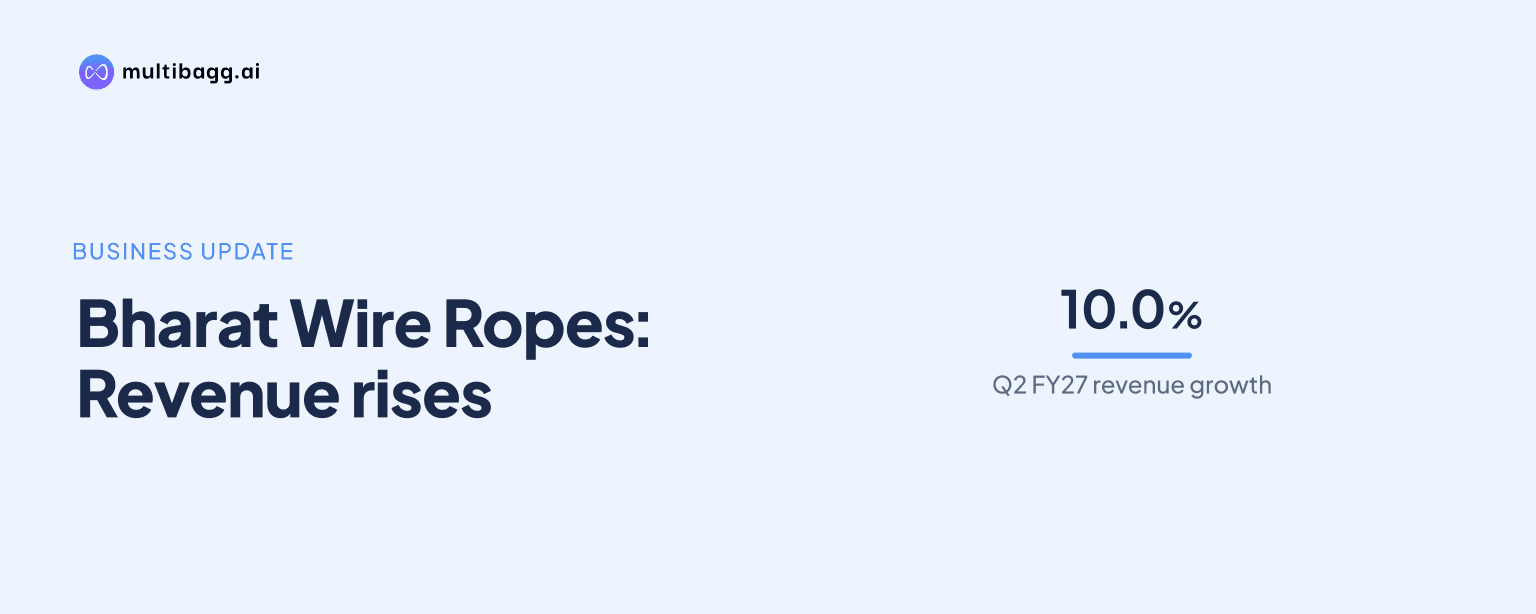
Bharat Wire Ropes Ltd. reported Q2 FY27 revenue from operations of Rs 181 crore, up 10.0% year on year, while EBITDA margin fell 494 basis points to 18.51% as higher zinc, steel and liquefied natural gas costs raised expenses. Sales volume increased 35% quarter on quarter, supporting a sequential recovery in revenue and profit.
Know Bharat Wire Ropes inside out
Results, valuation, peers and who's buying, in one view.
What did BWR report for Q2 FY27?
BWR reported higher Q2 FY27 sales but lower year-on-year earnings. Revenue from operations rose to Rs 181 crore from Rs 164.6 crore in Q2 FY26, while earnings before interest, tax, depreciation and amortisation (EBITDA) declined to Rs 33.5 crore from Rs 38.6 crore. Profit after tax (PAT) fell 21.3% to Rs 17.4 crore from Rs 22.1 crore.
The gap between revenue growth and cost growth drove the margin movement. Total expenses increased 17.1% year on year to Rs 147.5 crore, exceeding the 10.0% increase in revenue. EBITDA margin therefore declined to 18.51% from 23.45%, while PAT margin contracted to 9.61% from 13.43%, a reduction of 382 basis points.
BWR’s diluted earnings per share were Rs 1.88 in Q2 FY27, compared with Rs 2.41 a year earlier, a 22.0% decrease. Depreciation and amortisation increased 13.6% to Rs 6.7 crore, while finance costs decreased 6.7% to Rs 2.8 crore. Profit before tax was Rs 24.1 crore, down 19.4% from Rs 29.9 crore.
Why did BWR’s Q2 EBITDA margin fall?
BWR said higher prices for zinc and steel put profitability margins under pressure in Q2 FY27, while elevated liquefied natural gas, or LNG, prices increased operating costs. These input-cost pressures coincided with the 494-basis-point year-on-year reduction in EBITDA margin to 18.51%, despite Rs 16.4 crore of additional revenue.
The quarterly comparison also shows margin pressure versus the immediately preceding quarter. Revenue rose 38.8% from Rs 130.4 crore in Q1 FY27 to Rs 181 crore in Q2 FY27, and EBITDA increased 31.4% from Rs 25.5 crore to Rs 33.5 crore. However, expenses rose 40.6%, from Rs 104.9 crore to Rs 147.5 crore, and the EBITDA margin declined by 105 basis points from 19.56%.
The presentation attributes the higher sequential sales volume to a domestic-market focus and higher-value-added products, despite continued global supply-chain disruptions. It does not quantify the separate cost effects of zinc, steel or LNG, nor does it state whether price increases offset any portion of these costs during Q2 FY27.
Got a follow-up? Ask IRIS
Did higher volume improve BWR’s sequential results?
BWR’s 35% sequential volume increase improved Q2 FY27 revenue, EBITDA and PAT from Q1 FY27, although it did not restore the prior-year margin. Sales volume rose to 11,625 metric tonnes (MT) from 8,619 MT in Q1 FY27, while revenue increased by Rs 50.6 crore and PAT increased by Rs 5.2 crore.
Compared with Q2 FY26, volume was also higher, at 11,625 MT versus 11,322 MT, a gain of 303 MT. Yet EBITDA declined by Rs 5.1 crore and PAT by Rs 4.7 crore over that comparison. The additional Q2 FY27 volume and revenue therefore did not prevent the reported input-cost pressure from reducing absolute earnings year on year.
PAT margin improved 25 basis points sequentially, to 9.61% in Q2 FY27 from 9.36% in Q1 FY27. PAT rose 42.6% sequentially to Rs 17.4 crore from Rs 12.2 crore, and diluted earnings per share increased 36.2% from Rs 1.38. Those movements followed the higher volume base even as EBITDA margin continued to decline quarter on quarter.
How did BWR perform in the first half of FY27?
BWR’s H1 FY27 revenue increased 1.7% to Rs 311.4 crore, but EBITDA fell 14.2% to Rs 59 crore and PAT declined 21.2% to Rs 29.7 crore. The first-half EBITDA margin was 18.95%, down 352 basis points from 22.47% in H1 FY26, while PAT margin decreased 277 basis points to 9.54%.
First-half volume was slightly below the previous year despite the Q2 rebound. BWR reported H1 FY27 volume of 20,244 MT, compared with 20,583 MT in H1 FY26, a decline of 339 MT. Revenue nevertheless increased from Rs 306.2 crore, but total expenses rose 6.3% to Rs 252.4 crore, compared with a Rs 5.2 crore increase in revenue.
The H1 EBITDA margin was below BWR’s FY26 margin of 22.15%, FY25 margin of 21.36% and FY24 margin of 26.39%. H1 FY27 PAT margin of 9.54% was also below FY26’s 12.28%, FY25’s 11.69% and FY24’s 15.49%, placing the current half-year result below the margins reported in each of the three preceding full financial years.
BWR reported total debt of Rs 69.1 crore at H1 FY27, compared with Rs 74.3 crore at FY26, while net worth increased to Rs 842.7 crore from Rs 810.8 crore. On the asset side, inventories rose to Rs 129.1 crore from Rs 117.1 crore and trade receivables increased to Rs 120.6 crore from Rs 97.3 crore at FY26.
Conclusion
The combined result was a sequential volume-led recovery within a weaker first half: H1 FY27 EBITDA of Rs 59 crore was Rs 9.8 crore below H1 FY26, while PAT of Rs 29.7 crore was Rs 8 crore lower. Expenses increased faster than revenue in both the Q2 and H1 year-on-year comparisons, aligning with management’s stated zinc, steel and LNG cost pressures.
The next result will indicate whether BWR can sustain its Q2 FY27 volume of 11,625 MT through its disclosed domestic-market and higher-value-added-product focus. The presentation leaves the direction of zinc, steel and LNG costs unresolved, making their effect on margins a continuing item to watch after the H1 FY27 EBITDA margin of 18.95%.