










Tembo targets March 2027 Amravati arms production start
Key highlights
- Tembo targets March 2027 production at its Amravati arms and ammunition facility.
- Tembo's 51% JR UAV venture expects drone production at Vasai by December 2026-end and targets about Rs 100 crore in first-year revenue.
- The Vasai facility was commissioned in January 2026 after Rs 75 crore of capex, including Rs 50 crore funded by debt.
- Tembo reports capacity rising from 18,000 MTPA in Q2FY26 to 1,00,000 MTPA in Q4FY26.
powered by IRIS
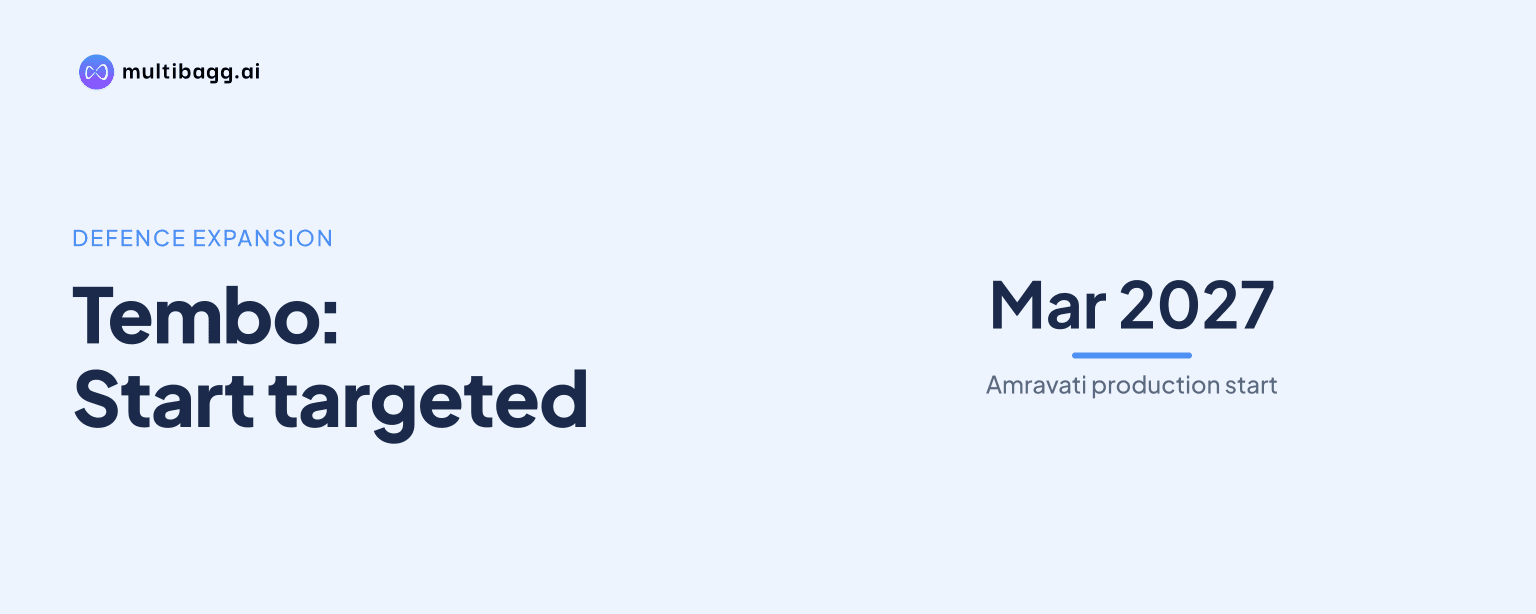
Tembo Global Industries Limited targets production at its Amravati arms and ammunition facility from March 2027 after land allocation, an arms licence and ammunition-manufacturing approval, while its 51% JR UAV joint venture expects Vasai drone production by December 2026-end and targets about Rs 100 crore of first-year revenue.
Know Tembo Global Industries inside out
Results, valuation, peers and who's buying, in one view.
When will Tembo begin arms and ammunition production?
Tembo is targeting March 2027 for production to begin at its Amravati arms and ammunition facility. The company says the bhoomi poojan, or ground-breaking ceremony, has been completed, marking a disclosed on-site milestone before the planned manufacturing start.
The March 2027 timetable applies to Tembo’s arms and ammunition project, rather than its unmanned aerial vehicle, or UAV, programme. JR UAV drone production at Tembo’s Vasai facility is expected to commence by December 2026-end, giving the UAV operation an earlier stated production timetable.
Tembo is pursuing the defence business through Tembo Classic Engineering (Defence), described in the presentation as an approximately 75% subsidiary. The company separately reports a 51% equity stake for Tembo Classic Engineering (Defence) in the JR UAV joint venture.
What approvals and arrangements support Tembo’s Amravati plan?
Tembo says the Government of Maharashtra has allocated land for the defence factory and issued an arms licence, while the Ministry of Home Affairs has approved ammunition manufacturing through its defence subsidiary. These disclosures cover land, arms manufacturing and ammunition manufacturing as separate regulatory and project steps.
In FY25, Tembo signed a memorandum of understanding, or MoU, with the Government of Maharashtra at the World Economic Forum in Davos to establish a defence-products manufacturing unit in Maharashtra. The presentation places the MoU’s proposed capital expenditure, or capex, at Rs 1,000 crore, without disclosing an expenditure schedule, financing plan or amount spent to date.
Tembo also reports a technology MoU with an unnamed leading European company to assist in establishing an arms and ammunition manufacturing plant in India. According to Tembo, the arrangement includes a strategic buy-back under which the European partner commits to purchase 100% of production output, although the presentation gives no product mix, price, contract period or conditions for those purchases.
How is Tembo developing UAV manufacturing?
Tembo’s JR UAV joint venture is expected to begin drone production at the Vasai facility by December 2026-end, and management targets about Rs 100 crore of revenue in its first year of operations. Tembo Classic Engineering (Defence) holds 51% equity in the venture.
The disclosed technology model divides roles among the venture’s partners. Tembo Classic Engineering provides Indian manufacturing infrastructure, quality systems and localisation capability; JR PROPO of Japan contributes radio-control technology, Xbus architecture, flight electronics, servo actuators, transmitters, receivers and telemetry solutions; and JR UAV Europe provides platform design, autonomous systems, mission integration and flight validation.
The programme also identifies specialist contributors for airframes and propulsion. AROLAB of Italy is listed for carbon-composite airframes, SAITO of Japan for electronic fuel injection engines, and Desert Aircraft of the United States for four-stroke heavy-UAV engines. Tembo presents technology transfer, localisation, secure supply and global markets as the framework for the venture.
Got a follow-up? Ask IRIS
What does the Vasai facility contribute to Tembo’s plans?
Tembo commissioned the Vasai facility in January 2026 after incurring Rs 75 crore of capex, funded by Rs 50 crore of debt and the balance from the company and promoters. Factory work is described as complete, and the site is the planned production location for JR UAV drones by December 2026-end.
Manufacturing capacity is reported to have increased from 18,000 metric tonnes per annum, or MTPA, in Q2FY26 to 1,00,000 MTPA in Q4FY26. That is an increase of 82,000 MTPA, alongside an FY26 product pipeline comprising 60,000 MTPA of electric-resistance-welded, or ERW, pipes and 30,000 MTPA of strut channels.
Tembo places Vasai’s revenue potential at Rs 700 crore at peak utilisation. That facility-level potential differs from the approximately Rs 100 crore first-year target for the UAV venture, which is a separate management target tied specifically to the new joint venture.
Engineering human capital increased from 122 in FY26 to 129 in H1FY27, a rise of seven people. Tembo links the Vasai model to in-house research and development, centralised operations, supply-chain logistics and lean manufacturing, but it does not disclose separate employment or output figures for the Amravati plant.
What defence opportunity is Tembo identifying?
Tembo reproduces industry-report estimates showing domestic small-calibre ammunition opportunity increasing from 811 in 2023 to 1,154 in 2032, while medium-calibre ammunition rises from 2,641 to 4,097. The presentation does not specify the units for these market-opportunity figures, so they cannot be treated as rupee estimates.
The domestic loitering-munition figure rises from 80 in 2023 to 960 in 2032 in Tembo’s table. Globally, the corresponding figure rises from 4,500 to 12,812, while the global heavy-calibre ammunition figure increases from 69,120 to 1,04,570 over the same 2023-to-2032 period.
Tembo states an ambition to manufacture small arms and ammunition using foreign technology and expertise, followed by technology absorption and innovation. The presentation does not yet disclose the Amravati facility’s product range, annual capacity, revenue target or commissioning cost within the Rs 1,000 crore Maharashtra MoU outlay.
Conclusion
Tembo has disclosed two distinct defence manufacturing schedules: Vasai UAV production is expected by December 2026-end through a 51% joint venture targeting about Rs 100 crore in first-year revenue, while Amravati arms and ammunition production is targeted from March 2027. Land allocation, an arms licence and ammunition approval are the disclosed project milestones, with a European technology MoU providing a proposed 100% output buy-back mechanism.
The next disclosed milestones are the expected December 2026-end UAV production start and the March 2027 Amravati production target. Further disclosures on spending and funding under the Rs 1,000 crore Maharashtra MoU, as well as the terms of the European buy-back arrangement and the Amravati plant’s capacity, would clarify execution of the plan.