










SA Technologies shifts toward GCC services targeting 30% margin
Key highlights
- SA Tech’s current delivery mix is 60% consulting and 40% offshore and GCC work.
- SA Tech presents a 30% gross-profit-margin expectation as it increases its GCC focus.
- H1 FY27 revenue rose 37.28% year on year to Rs 68.11 crore.
- SA Tech reported H1 FY27 profit after tax of Rs 26.99 lakh, versus a Rs 65.94 lakh loss a year earlier.
powered by IRIS
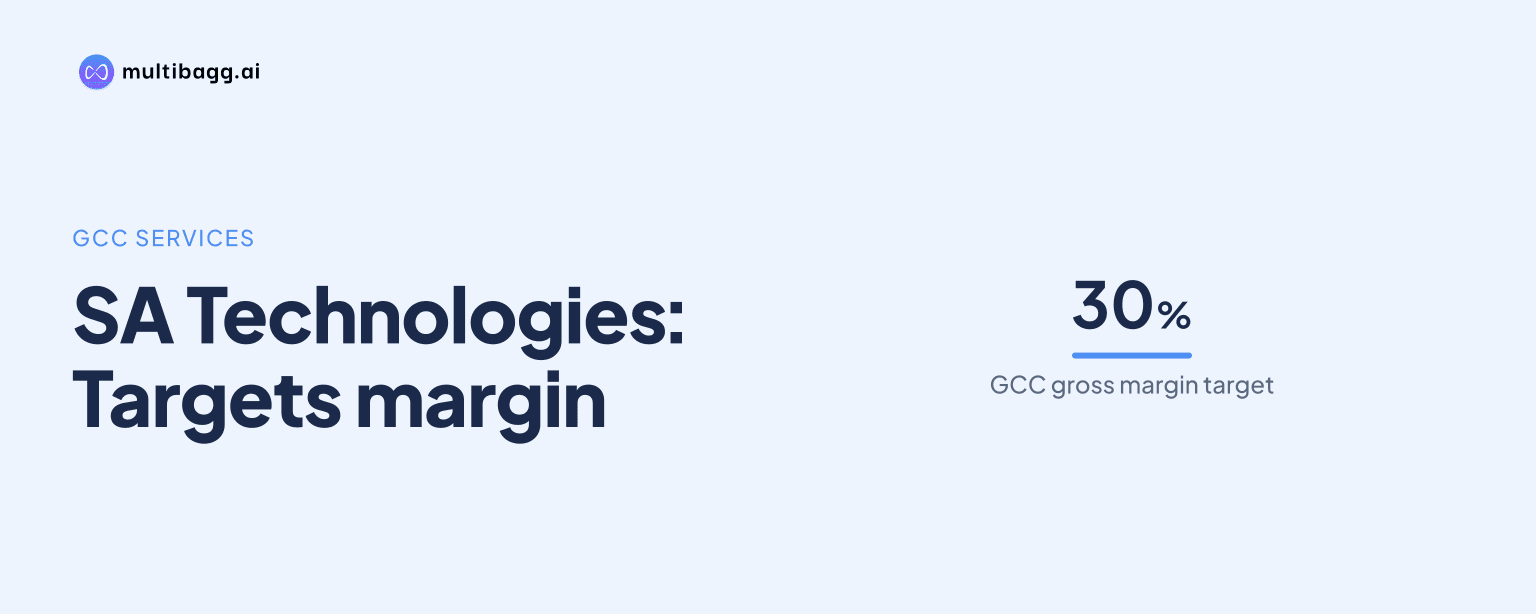
SA Technologies is shifting from a delivery mix of 60% consulting and 40% offshore and Global Capability Centre (GCC) work toward GCC services after enabling Axiado Corporation’s Bengaluru launch, with management presenting a 30% gross-profit-margin expectation and tax-related profitability benefits from the model.
Know S A Tech Software India inside out
Results, valuation, peers and who's buying, in one view.
Why is SA Tech moving toward GCC services?
SA Tech is moving toward GCC services because consulting accounts for 60% of its current model, while offshore and GCC work represents 40%. The expected model does not disclose a future revenue-share split, but it explicitly says the company is focusing more on GCCs and presents a 30% gross profit margin as the expected outcome.
SA Tech’s GCC offer extends beyond staffing or project delivery through a Build-Operate-Transfer (BOT) model. The model covers centre setup, talent acquisition, infrastructure and operations management for global enterprises establishing offshore centres in India, allowing SA Tech to provide services across several stages of a client’s India operation.
The 30% figure is a management expectation rather than a reported margin. SA Tech separately states in its FY27 outlook that it expects a gross-margin range of 27% to 30% and is targeting revenue of more than Rs 150 crore, linking the greater GCC emphasis to its broader FY27 operating plan.
What does the Axiado Bengaluru launch demonstrate?
SA Tech’s work enabling Axiado Corporation’s India GCC launch in Bengaluru is the presentation’s disclosed operating example of its GCC proposition. SA Tech says the centre will support next-generation technology innovation and engineering excellence while strengthening collaboration with global enterprises in semiconductor, artificial intelligence and cybersecurity domains.
The Axiado engagement reflects the setup functions within SA Tech’s GCC services, including location selection, infrastructure, legal compliance and talent acquisition. The presentation does not disclose the contract value, centre headcount, duration, ownership-transfer timetable or revenue contribution from Axiado, so the engagement’s financial scale cannot be measured from the disclosed information.
The Bengaluru launch comes alongside SA Tech’s strategic presence in New York City, which the company says improves on-ground engagement and real-time communication with international clients and partners. SA Tech also reports more than 100 clients, more than 640 employees and more than 14 years of technology consulting and outsourcing experience since its 2012 founding.
Got a follow-up? Ask IRIS
How does SA Tech intend to deliver GCC services?
SA Tech intends to deliver GCC services through five components: setup and establishment, talent acquisition and management, operational excellence, technology enablement and strategic advisory. Its operational role includes workflow management, best-practice adherence and local-regulation compliance, while technology enablement includes tools and infrastructure designed to support collaboration and performance.
SA Tech is adding delivery formats that can support this GCC proposition, including fully managed Forward Deployed Engineering (FDE) teams. These specialised pods cover engineering, revenue operations, marketing, finance, enterprise technology and legal functions, while its Salesforce practice provides customer relationship management teams and Agentforce artificial-intelligence specialists for enterprise clients in the United States and India.
Leadership additions are also tied to the operating direction. Founder and promoter Manoj Joshi said Chief Executive Officer Bharath Raj has experience setting up and leading GCCs, while Kamlesh Melwani leads client success and deployment of Intelligent Pods and FDEs. SA Tech also appointed Vinay Kumar Singh as Senior Director for AI Platform and Technology, citing more than 20 years of experience across Intuit, McAfee, AMD and Employ.
What financial evidence supports the planned shift?
SA Tech’s H1 FY27 results show revenue growth and a return to reported profitability, although they do not separately quantify GCC revenue or margins. Revenue rose 37.28% year on year to Rs 68.11 crore from Rs 49.61 crore in H1 FY26, while total income increased to Rs 69.25 crore from Rs 50.48 crore.
Earnings before interest, tax, depreciation and amortisation (EBITDA) more than tripled to Rs 2.71 crore in H1 FY27 from Rs 89.18 lakh a year earlier, a 204.35% increase. Profit before tax turned to Rs 50.51 lakh from a Rs 71.08 lakh loss, and profit after tax was Rs 26.99 lakh compared with a Rs 65.94 lakh loss in H1 FY26.
Management said H1 FY27 included a one-time, non-cash gratuity charge of Rs 83.77 lakh. According to Manoj Joshi, the charge resulted from the revised wage definition under the Code on Wages, 2019, which increased the salary base used to measure gratuity obligations; SA Tech recognised the past-service cost under Accounting Standard 15 and described it as a regulatory adjustment rather than a recurring cost.
The expense profile shows the costs accompanying growth. Employee-benefit expenses increased to Rs 49.72 crore from Rs 36.26 crore, and other expenses rose to Rs 16.82 crore from Rs 13.32 crore. Finance costs increased to Rs 1.40 crore from Rs 89.17 lakh, while depreciation rose to Rs 99.44 lakh from Rs 71.09 lakh.
Conclusion
SA Tech’s disclosed business-model change is a move from a 60%-consulting-led mix toward end-to-end GCC work, supported by the Axiado Bengaluru launch, BOT capabilities and managed FDE teams. Management presents a 30% gross-profit-margin expectation and tax-related profitability benefits from GCC services, while H1 FY27 revenue reached Rs 68.11 crore and profit after tax turned positive at Rs 26.99 lakh.
The next disclosed measures to watch are progress toward the FY27 revenue target of more than Rs 150 crore and the expected 27% to 30% gross-margin range. Further disclosures could clarify GCC revenue mix, the economics and duration of engagements such as Axiado’s, and progress on the merger petition involving SA Tech Software India and Mindpool Technologies before the National Company Law Tribunal.