










Chalet reports 45.6% FY26 EBITDA margin above large peers
Key highlights
- Chalet reported a 45.6% FY26 hospitality EBITDA margin, compared with a 34.4% ex-HMA average for four large peers.
- NOX at Westin Powai reported Rs 1.55 crore in monthly revenue after conversion from an executive lounge.
- Chalet added 2 banquet spaces at JW Marriott Sahar to support hotel inventory.
- Chalet says Athiva has potential to achieve approximately 1,200 or more keys by FY30+.
powered by IRIS
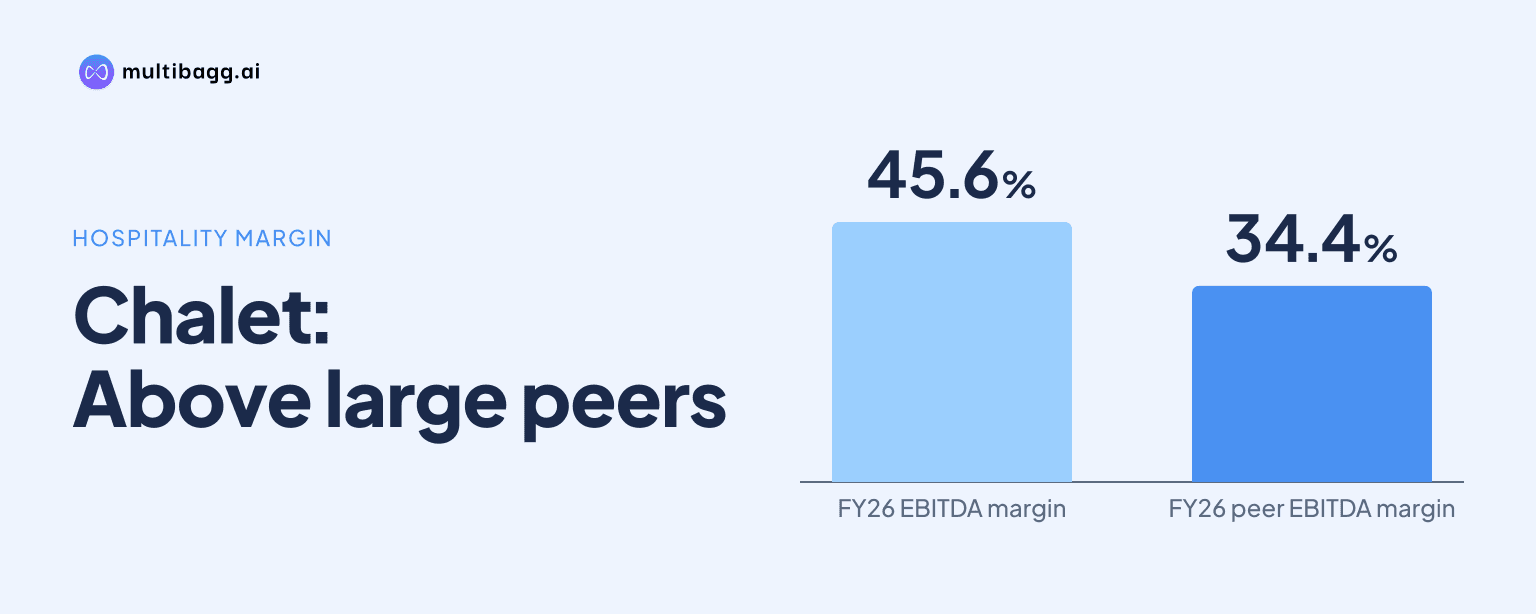
Chalet Hotels reported a 45.6% FY26 hospitality earnings before interest, tax, depreciation and amortisation (EBITDA) margin on an ex-residential basis, above the presentation’s 34.4% ex-HMA average for four large peers. Chalet attributes the result to asset management, operating efficiency and revenue generation from existing hotel spaces, including NOX’s reported Rs 1.55 crore monthly revenue.
Know Chalet Hotels inside out
Results, valuation, peers and who's buying, in one view.
Why did Chalet report a 45.6% FY26 EBITDA margin above peers?
Chalet reported a 45.6% FY26 hospitality EBITDA margin on an ex-residential basis, compared with the presentation’s 34.4% industry average ex-HMA and 37.4% industry average inc-HMA. The company describes both industry averages as the average of four large players, placing Chalet’s displayed margin 11.2 percentage points above the ex-HMA figure and 8.2 percentage points above the inc-HMA figure.
The categories are labelled differently: Chalet’s measure excludes residential operations, while peer measures are shown ex-HMA and inc-HMA. The presentation does not define HMA, provide property-level EBITDA, disclose hospitality revenue, or show a prior-year Chalet margin. It nevertheless identifies asset management as the mechanism intended to maximise hotel productivity and profitability.
Chalet lists eight drivers of its margin model: revenue and market-share optimisation, efficient design, economies of scale and scope at large hotels, operator relationships, workforce and energy efficiency, physical-asset stewardship, guest loyalty, and a diversified model that includes commercial real estate, or CRE. These are management’s stated operating mechanisms, not separately quantified contributions to the 45.6% FY26 margin.
How is Chalet generating revenue from existing hotel space?
Chalet is repurposing existing hotel areas into food-and-beverage, leisure and event venues, with NOX at Westin Powai providing its clearest disclosed financial example. NOX was converted from an executive lounge and reported monthly revenue of Rs 1.55 crore, although Chalet does not disclose the conversion cost, opening date, prior revenue, profit margin or payback period.
The disclosed programme spans three hotels and several revenue uses. At JW Marriott Sahar, Chalet identifies EL-BAR as a differentiated food-and-beverage destination and added two banquet spaces to support hotel inventory. At Westin Powai, Chalet expanded Gardenia’s banqueting infrastructure and converted a record room into a gaming arena, creating event and leisure capacity within the existing property footprint.
Novotel Pune adds another format through SOAK, a new poolside food-and-beverage offering. The six disclosed initiatives include food and beverage at NOX, EL-BAR and SOAK; events at the two new JW Marriott Sahar banquet spaces and Gardenia; and leisure through the Westin Powai gaming arena. Chalet does not state aggregate incremental revenue, capital expenditure or the FY26 EBITDA contribution for the broader programme.
Got a follow-up? Ask IRIS
What operating mechanisms does Chalet link to its margin strategy?
Chalet links its FY26 margin approach to people and leadership, technology and operating systems, strategic asset management, sustainability and resource efficiency, and design and development excellence. Its hotel operating framework also includes revenue optimisation, guest insights, commercial strategy, franchise and partnership management, and the proprietary Athiva brand.
Workforce, energy and engineering efficiency are specifically identified as supporting “flowthrough discipline,” while efficient design is intended to optimise resource allocation. Chalet also cites large-format hotels, described as “big boxes,” as a source of economies of scale and scope. The presentation supplies no FY26 staffing ratio, energy-cost figure, engineering saving or flowthrough percentage for those mechanisms.
Multiple operator relationships form another stated part of the model. The asset-productivity examples include Westin Powai, JW Marriott Sahar and Novotel Pune, showing initiatives at hotels with different brands. Chalet does not disclose operator-level management fees, operating costs, revenue, or EBITDA margins, so the presentation does not quantify the effect of any individual operator relationship.
Chalet’s human-capital plan includes four talent programmes: NEEV for internships and entry-level talent, UDAAN for fast-track development, LAKSHYA for management trainees, and SHIKHAR for leadership development. The November 2026 presentation also identifies integrated roles, flexible structures, succession for critical roles and internal mobility as responses to organisational and talent challenges, rather than as separately measured FY26 margin items.
What should readers watch in Chalet’s asset-productivity plan?
Readers should watch for financial detail on the six disclosed space-repurposing initiatives, especially after NOX reported Rs 1.55 crore in monthly revenue. Chalet has disclosed the converted executive lounge, two added banquet spaces, expanded banqueting infrastructure, a gaming arena and two additional food-and-beverage concepts, but not their investment, revenue run-rate or profit contribution.
Athiva’s development schedule is the other disclosed milestone. Chalet launched Athiva Resort & Spa, Khandala in October 2025 and Athiva Pulse, Navi Mumbai in August 2025, and says the brand has potential to achieve approximately 1,200 or more keys by FY30+. The schedule places Varca in FY28, Hyderabad in FY29, and Yerawada, Bambolim and Thiruvananthapuram in FY30+.
Chalet describes Athiva as a build-first strategy: establish the brand, reinvest fee savings into marketing, and use Autograph Collection distribution where it adds value, with Navi Mumbai cited as an example. The presentation does not quantify the fee savings, development spending, room rates, occupancy or EBITDA expected from the five announced pipeline locations.
Conclusion
Chalet’s 45.6% FY26 hospitality EBITDA margin was above the two large-peer averages displayed in its presentation, although the comparison categories are not identically labelled. Its stated model combines commercial, operating and asset-management mechanisms, while NOX provides the only directly reported financial outcome from repurposing space, at Rs 1.55 crore in monthly revenue.
The next disclosed operating milestones are Athiva’s Varca project in FY28, Hyderabad in FY29, and three locations scheduled for FY30+. Investors can also watch for whether Chalet discloses project spending, revenue and profit outcomes for NOX and the other five asset-productivity initiatives.