










Chalet commits Rs 3,500 crore capex through internal accruals
Key highlights
- Chalet has committed about Rs 3,500 crore of capex across FY27 to FY29.
- Chalet reported Sep-26 net debt of Rs 2,110 crore and net debt-to-EBITDA of 2.1 times.
- Chalet's FY26 revenue was Rs 2,070 crore and EBITDA was Rs 960 crore, excluding residential operations.
- Chalet's announced pipeline would increase keys from 3,389 to about 5,500.
powered by IRIS
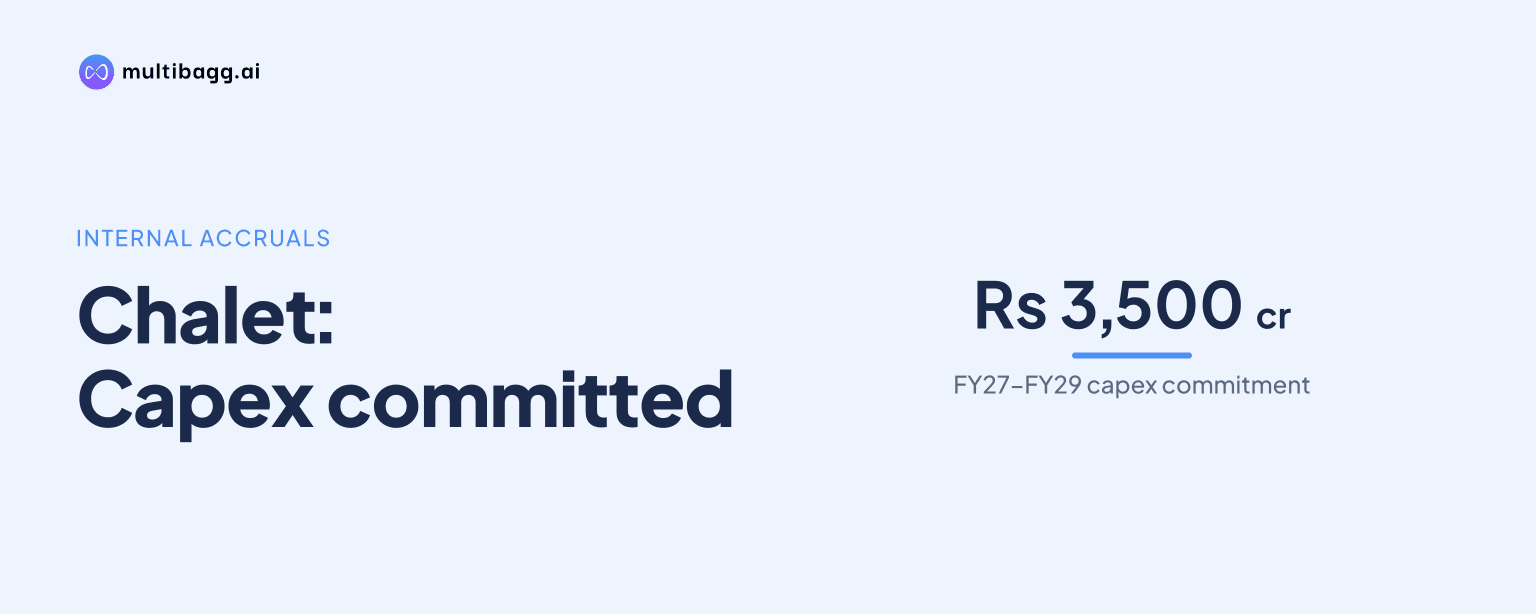
Chalet Hotels has committed about Rs 3,500 crore of capital expenditure from FY27 to FY29, which management says will be funded through internal accruals, following FY26 cash generation of about Rs 1,000 crore and a net debt-to-EBITDA ratio of 2.1 times in Sep-26.
Know Chalet Hotels inside out
Results, valuation, peers and who's buying, in one view.
How will Chalet fund its FY27-FY29 capex?
Chalet plans to fund its about Rs 3,500 crore FY27-FY29 capital-expenditure commitment through internal accruals. The annual allocation is Rs 1,200 crore in FY27, Rs 1,200 crore in FY28 and Rs 1,100 crore in FY29, while the presentation cites FY26 cash generation of about Rs 1,000 crore as the base for the funding plan.
The announced pipeline is intended to raise Chalet's key count from 3,389 to about 5,500 and area from 2.4 million square feet to 3.4 million square feet. That represents about 2,111 additional keys and 1.0 million square feet of area, with FY27 and FY28 each carrying Rs 1,200 crore of planned spending, more than the Rs 1,100 crore allocated to FY29.
Chalet also points to about Rs 2,500 crore of capital expenditure and acquisitions between Mar-24 and Sep-26 as its record of funding expansion. Net debt declined from Rs 2,510 crore in Mar-24 to Rs 2,110 crore in Sep-26, although it increased from Rs 1,920 crore in Mar-26 as the current expansion programme advanced.
How has Chalet's operating performance changed since FY20?
Chalet's revenue rose to Rs 2,070 crore in FY26 from Rs 1,010 crore in FY20, while earnings before interest, tax, depreciation and amortisation, or EBITDA, increased to Rs 960 crore from Rs 360 crore. These figures exclude residential operations and equate to revenue growth of 2.1 times and EBITDA growth of 2.6 times over the period.
EBITDA margin increased to 46.2% in FY26 from 36.1% in FY20, a rise of 10.1 percentage points. Chalet says portfolio diversification enabled it to remain cash-positive through business cycles, including the Covid-19 disruption in FY21 and FY22, while cash generation of about Rs 1,000 crore in FY26 is cited beside the FY27-FY29 capex programme.
The presentation does not provide annual forecasts for internal accruals in FY27, FY28 or FY29. It does, however, list phased investments, stable internal accruals, partnerships and an appropriate debt-equity and leverage mix among the mechanisms Chalet intends to use while deploying Rs 3,500 crore through FY29.
Got a follow-up? Ask IRIS
What happened to Chalet's leverage and borrowing cost?
Chalet's net debt-to-EBITDA ratio declined to 2.1 times in Sep-26 from 4.1 times in Mar-24, while borrowing cost fell to 7.5% from 8.9%. Net debt was Rs 2,110 crore in Sep-26, compared with Rs 2,510 crore in Mar-24 and Rs 1,920 crore in Mar-26; the net-debt and ratio measures exclude residential operations.
The FY20-to-FY26 comparison shows a similar change in leverage and returns. Net debt-to-EBITDA fell from 4.6 times in FY20 to 2.0 times in FY26, while return on capital employed, or ROCE, rose from 11.1% to 16.6%. Chalet also says its credit rating was upgraded from IND A-/Positive to IND AA/Stable during the Mar-24 to Sep-26 period.
Management describes the 2.1-times Sep-26 ratio as comfortable and says it has significant headroom to grow, but it does not disclose a specific leverage ceiling for FY29. It identifies non-operating assets equal to about 66% of current net debt, hospitality borrowing eligibility above Rs 4,000 crore and annuity-business eligibility above Rs 2,500 crore as funding possibilities beyond the announced plan.
How does Chalet intend to improve returns during expansion?
Chalet intends to raise EBITDA while controlling capital employed through better average daily rate, occupancy and revenue per available room, alongside revenue management, global distribution system access and global partnerships. The reported FY26 EBITDA margin of 46.2%, compared with 36.1% in FY20, is the operating outcome disclosed before the portfolio expands from 3,389 to about 5,500 keys.
The company lists efficient building design, energy optimisation, technology, shared services, manpower planning and resource allocation as productivity measures. It also intends to use active asset management, renovations, repositioning and repurposing of underutilised spaces for food and beverage, banqueting, events and leasing to increase earnings from existing assets alongside the Rs 3,500 crore pipeline.
For capital allocation, Chalet says it will prioritise selected micro-markets, use multiple operating models and optimise land and floor-space-index usage. Its funding and treasury approach includes phased investment, internal accruals, partnerships, management of cost of funds and credit ratings, as borrowing cost had reduced from 8.9% in Mar-24 to 7.5% by Sep-26.
Conclusion
Chalet's disclosed plan links about Rs 3,500 crore of FY27-FY29 capex to internal accruals, supported by about Rs 1,000 crore of FY26 cash generation. The operating and balance-sheet context includes FY26 EBITDA of Rs 960 crore, a 46.2% EBITDA margin and Sep-26 net debt-to-EBITDA of 2.1 times, compared with 4.1 times in Mar-24.
The next disclosed milestones are Rs 1,200 crore of planned expenditure in each of FY27 and FY28, followed by Rs 1,100 crore in FY29, and progress towards about 5,500 keys and 3.4 million square feet of area. Chalet has not disclosed annual internal-accrual forecasts or a FY29 leverage ceiling, leaving cash generation, project delivery and net debt as the key measures to watch.