










Chalet retains Marriott channels for ATHIVA Pulse strategy
Key highlights
- Chalet invested Rs 100 crore to reposition the former Four Points by Sheraton in Navi Mumbai as ATHIVA Pulse, Autograph Collection.
- ATHIVA Pulse retains Marriott distribution and loyalty access through Autograph Collection.
- Chalet said standalone ATHIVA will generally be used in markets led by domestic demand.
- Chalet targets resort occupancy of 60% to 65%, versus 46.1% in the first half and 41.2% in the second quarter.
powered by IRIS
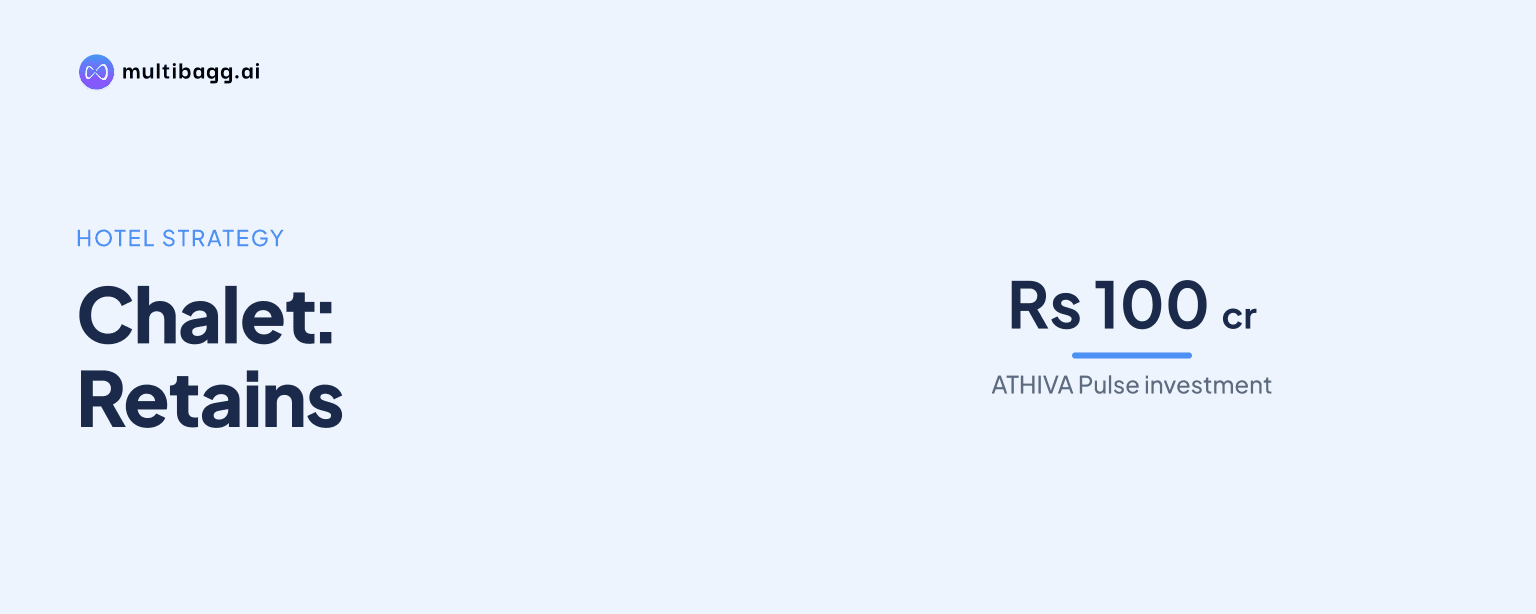
Chalet Hotels Limited said on November 5, 2026 that ATHIVA Pulse in Navi Mumbai will retain Marriott distribution and loyalty access through Autograph Collection after a Rs 100 crore refurbishment, while standalone ATHIVA will generally be used where demand is largely domestic. The approach combines own-brand positioning with global hotel channels where management sees international demand.
Know Chalet Hotels inside out
Results, valuation, peers and who's buying, in one view.
Why is Chalet retaining Marriott channels for ATHIVA Pulse?
Chalet is retaining Marriott channels for ATHIVA Pulse because the Navi Mumbai hotel remains within Marriott’s Autograph Collection and continues to access its distribution and loyalty programme. Management corrected the analyst’s assumption that the conversion from Four Points by Sheraton had ended that relationship, saying the distribution part of the business remained unchanged.
Chalet invested Rs 100 crore to refurbish the former Four Points by Sheraton property and move it to a higher positioning as ATHIVA Pulse, Autograph Collection. Management described demand as brilliant and guest feedback as highly positive, but did not disclose occupancy, average daily rate, revenue or a return on the investment after the conversion.
The repositioning includes a 30,000-square-foot wellness and wellbeing floor for staying guests and walk-ins. Chalet said the facility offers a spa, longevity experiences, sports and an ultra-modern gym, making the expanded product offer part of the hotel’s higher positioning alongside Marriott affiliation.
How will Chalet choose between standalone ATHIVA and Marriott?
Chalet will choose between standalone ATHIVA and a Marriott tie-up based on where customer demand originates, rather than on whether a hotel is in a city or leisure destination. Management said properties fed largely by domestic customers will tend to use standalone ATHIVA without soft branding, while internationally fed markets can use partnerships such as Marriott.
Chalet identified Navi Mumbai as an example of an internationally fed market, explaining why ATHIVA Pulse retains Marriott access. The company is therefore not presenting ATHIVA as a replacement for international hotel distribution. Instead, its disclosed model combines the ATHIVA identity with a global operator where management considers that demand mix relevant.
The strategy differs from the analyst’s suggestion that city hotels could use Marriott channels while leisure hotels could operate under ATHIVA. Chalet said the deciding factor is the customer base, not location type. Management did not disclose a numerical threshold for domestic or international demand, commercial terms with Marriott, or another property scheduled to adopt either format.
Got a follow-up? Ask IRIS
What does the ATHIVA approach mean for resort occupancy?
Chalet’s ATHIVA strategy operates alongside its stated ideal resort occupancy range of 60% to 65%, compared with 46.1% in the first half and 41.2% in the second quarter. Management said resort demand is seasonal, with the first half normally softer than the second half as weddings and the social calendar become more active.
ATHIVA in Khandala remains in its first year of operation, and Chalet said the brand will need time to ramp up. The company reported it had reached fair market share and beyond on weekends, while weekday demand required more work through meetings, incentives, conferences and exhibitions, or MICE, as well as social-calendar events.
Chalet said ATHIVA in Khandala had reached almost 80% of its fair market share on a blended basis. That measure is not an occupancy figure, and the company did not disclose its calculation or competitive set. Management linked further progress to sales execution, including expanding MICE outreach and improving weekday demand.
The wider resort portfolio grew nearly 34% year on year in the preceding quarter, according to management. The Westin Himalayas grew by more than 50% to 55%, while Khandala was stabilising and Marriott in Aravali was steady. The comparison shows that Chalet’s properties are at different stages of ramp-up, even as the group maintains its 60% to 65% occupancy objective.
What demand developments could affect ATHIVA Pulse in Navi Mumbai?
ATHIVA Pulse could benefit if air traffic shifts towards the newly launched Navi Mumbai terminal, as management expects. Chalet said the proposed movement from the old Terminal 1 could produce good uptake at the property, but it did not provide an occupancy target, revenue forecast or timing for that demand effect.
The Mumbai Metropolitan Region, or MMR, has also faced foreign-travel disruption during the West Asia crisis, according to management. Chalet said large MICE activity had been restricted and the prior quarter had lacked major wedding dates. These factors matter because the company cites internationally fed demand as the reason to keep Marriott distribution and loyalty access at ATHIVA Pulse.
Management said it had seen early MICE recovery signs, including the Mumbai Fintech Summit at Jio Convention Center in the prior month. It also cautioned that large events can benefit individual micro-markets differently, noting that this event supported central Mumbai more than Sahar or the airport region. Broader MMR event activity may therefore not translate evenly across Chalet’s hotels.
At Powai, Chalet said construction affected guest experience, crew business and the ability to host larger MICE and social events, although no rooms were shut. Management said those issues had been resolved. The contrast illustrates that a hotel can retain available inventory and established sales channels while operational conditions still reduce occupancy.
Conclusion
Chalet’s disclosed brand model is selective rather than a withdrawal from international hotel systems. ATHIVA Pulse combines an own-brand wellness positioning, supported by Rs 100 crore of investment and a 30,000-square-foot wellness floor, with Marriott’s distribution and loyalty platform. Standalone ATHIVA is intended primarily for markets that management judges to be domestically led.
The next indicators are whether the expected air-traffic movement to Navi Mumbai produces demand for ATHIVA Pulse and whether Chalet discloses operating metrics for the converted hotel. Investors can also watch resort occupancy against the 60% to 65% target, particularly after first-half occupancy of 46.1% and second-quarter occupancy of 41.2%, as wedding and MICE demand develops.