










Chalet Hotels commits net zero by 2040 with 61% renewable power
Key highlights
- Chalet Hotels says 61% of its electricity is sourced from renewable sources.
- Chalet Hotels reports renewable-energy consumption growth of more than 16% versus FY 2024-25.
- Chalet Hotels commits to achieve net-zero greenhouse-gas emissions by 2040.
- Chalet Hotels reports a 100% electric guest fleet and nine LEED Gold or Platinum certified assets.
powered by IRIS
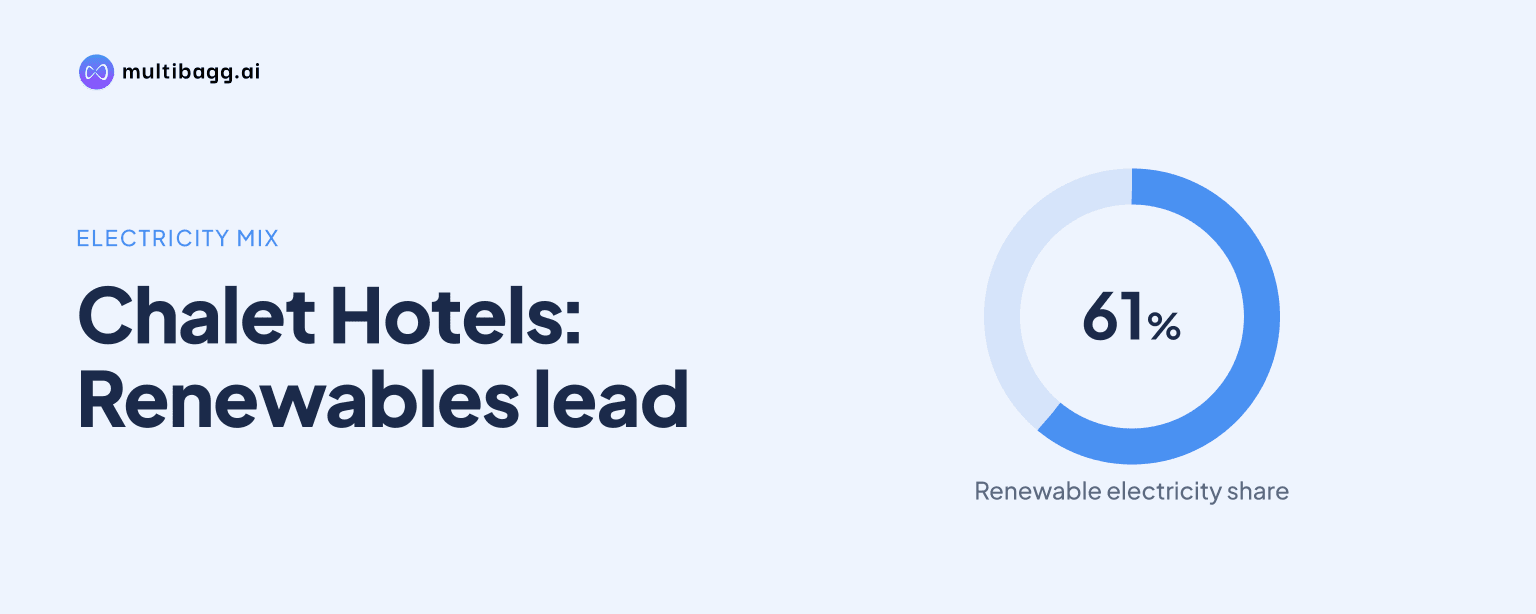
Chalet Hotels commits to net-zero greenhouse-gas emissions by 2040, supported by a reported 61% share of electricity sourced from renewable sources and renewable-energy consumption growth of more than 16% versus FY 2024-25. The company has also completed its stated transition of guest transportation to electric vehicles.
Know Chalet Hotels inside out
Results, valuation, peers and who's buying, in one view.
How much renewable electricity does Chalet Hotels use?
Chalet Hotels says 61% of its electricity is sourced from renewable sources. The company also reports that renewable-energy consumption increased by more than 16% compared with FY 2024-25, providing its only stated period-on-period comparison for renewable energy.
The 61% figure is a share of electricity sourced from renewable sources, whereas the more-than-16% comparison refers to renewable-energy consumption. The presentation does not state the number of electricity units consumed, identify the renewable procurement sources, or set out the renewable-electricity share for individual properties.
Chalet Hotels links its renewable-energy plan to Climate Group's RE100 initiative, under which it aims to move to 100% renewable energy by 2030. The reported 61% share leaves a 39-percentage-point difference to that stated objective, while the presentation provides no annual milestones for the period to 2030.
What is Chalet Hotels' net-zero emissions commitment?
Chalet Hotels commits to achieve net-zero greenhouse-gas, or GHG, emissions by 2040. The commitment is presented under its Parivartan sustainability platform alongside operational targets for renewable energy, energy productivity and electric guest transport.
The presentation does not disclose a GHG baseline year, emissions by scope, interim emissions-reduction targets, or the intended role of carbon credits in the 2040 commitment. It therefore identifies the target date but does not provide the emissions inventory or reduction pathway needed to measure progress to net zero.
Chalet Hotels also states that it is a member of the United Nations Global Compact Network India and supports its principles and Sustainable Development Goals for 2030. It is additionally a member and advisory-board participant of the India Business & Biodiversity Initiative, which the presentation says provides guidance on biodiversity conservation and sustainable ecosystem services.
Has Chalet Hotels achieved its EV100 and EP100 goals?
Chalet Hotels says 100% of its guest fleet is electric, meeting the EV100 objective to move the entire guest-transport fleet to electric vehicles by 2025. It also says all operational assets have EV charging points accessible to employees and visitors.
The company describes itself as the first hospitality brand to achieve Climate Group's EV100 target. However, the presentation does not disclose the number of electric vehicles, charging points, electricity used for charging, or the reduction in transport-related GHG emissions from the fleet transition.
Chalet Hotels reports 85% of energy productivity under Climate Group's EP100 initiative, which seeks to double energy productivity by 2028. The company defines energy productivity as revenue per unit of electricity consumed, but does not clarify whether 85% is progress towards the doubling target, an index value, or another calculation.
The cited energy-saving mechanisms are digital check-ins, mobile keys, a building management system, and an Internet of Things, or IoT, system for heating, ventilation and air conditioning, or HVAC. These measures are intended to reduce energy consumption, although the presentation does not quantify electricity savings by property or system.
Got a follow-up? Ask IRIS
What environmental measures does Chalet Hotels report beyond energy?
Chalet Hotels says 100% of its organic waste is treated through organic-waste composters. Its water and waste programme also includes wastewater recycling and rainwater-harvesting systems, but the presentation does not quantify wastewater recycled, rainwater captured, compost output, or the number of properties using each measure.
The 100% claim applies specifically to organic-waste treatment and does not cover all waste streams. That distinction matters because the presentation gives no recycling rate, landfill-diversion rate, or total waste volume for the company’s 11 existing assets.
Chalet Hotels reports nine assets certified Gold or Platinum under the U.S. Green Building Council's Leadership in Energy and Environmental Design, or LEED, programme. It also says three upcoming projects have LEED or Indian Green Building Council, or IGBC, design certifications.
The company reports 11 existing assets and 3,389 rooms, meaning the nine reported LEED-certified assets are fewer than the full operating portfolio. It does not identify the two existing assets without cited certification or state whether further certifications are planned for its nine upcoming assets with 2,036 keys.
How does Chalet Hotels' sustainability performance compare across measures?
Chalet Hotels reports a Corporate Sustainability Assessment score of 82 and says it was placed second globally among hotels, resorts and cruise lines. The presentation does not provide a prior score, assessment year, peer count, or scoring methodology, so it does not establish a trend in that external measure.
The company reports that women represent 24% of its workforce. It also says more than 500 young people were skilled, including dedicated batches for people with disabilities and women in food and beverage and housekeeping services, while more than 19,000 saplings were planted through an urban-forest initiative in Lonavala.
Chalet Hotels describes vendor assessment on environmental, social and governance, or ESG, criteria, supplier-code-of-conduct compliance, and preferential procurement of local materials within India. These supply-chain practices are not accompanied by figures for vendor coverage, procurement spending, or the share of local materials.
The clearest contrast in the disclosures is between an achieved 100% electric guest fleet and the renewable-energy programme, which stands at 61% against a 100% goal by 2030. The other dated milestone is the 2028 EP100 energy-productivity objective, for which Chalet Hotels reports 85% energy productivity.
Conclusion
Chalet Hotels has combined a 2040 net-zero commitment with reported operational measures: 61% renewable electricity, renewable-energy consumption growth of more than 16% versus FY 2024-25, a 100% electric guest fleet, and 100% treatment of organic waste through composters. Its disclosures also cover nine LEED Gold or Platinum certified assets and three certified upcoming projects.
The next disclosed milestones are the EP100 objective to double energy productivity by 2028 and the RE100 objective of 100% renewable energy by 2030. Future reporting will determine how clearly Chalet Hotels addresses unresolved elements of its 2040 commitment, including its GHG baseline, scope coverage, interim targets and emissions reductions from renewable electricity and fleet electrification.