










BHIL underlying consolidated profit rises 28% in H1 FY27
Key highlights
- BHIL’s adjusted consolidated PAT rose 28% to Rs 4,700 crore in H1 FY27 from Rs 3,665 crore.
- BHIL’s share of associate profits increased by Rs 1,115 crore to Rs 4,626 crore in H1 FY27.
- Bajaj Auto reported standalone PAT growth of 38% to Rs 6,337 crore in H1 FY27.
- BHIL’s investment portfolio market value was Rs 240,146 crore at 30 September 2026.
powered by IRIS
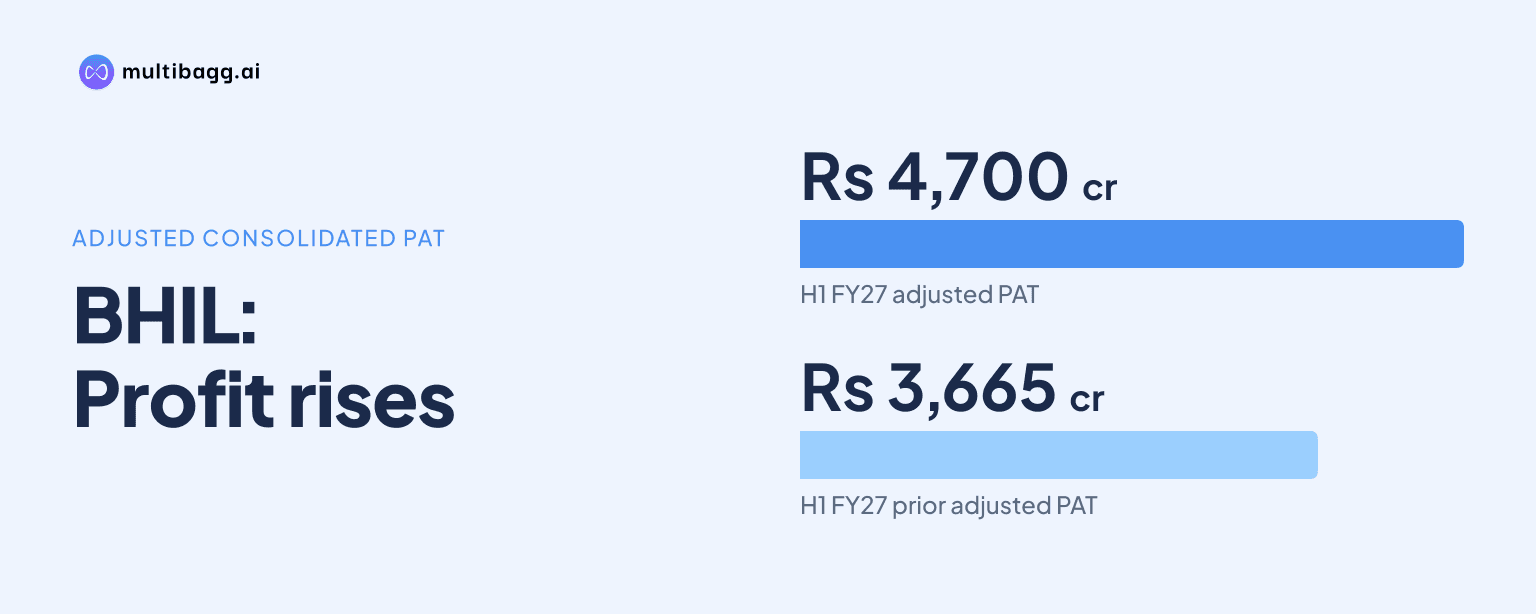
Bajaj Holdings & Investment Limited (BHIL) increased consolidated profit after tax excluding the Bajaj Finserv share-sale profit by 28% to Rs 4,700 crore in H1 FY27 from Rs 3,665 crore in H1 FY26, as its share of associates’ profits rose to Rs 4,626 crore from Rs 3,511 crore.
Know Bajaj Holdings & Investment inside out
Results, valuation, peers and who's buying, in one view.
What drove BHIL’s underlying consolidated profit growth?
BHIL’s adjusted consolidated profit growth was led by a Rs 1,115 crore increase in its share of profits from associates, which reached Rs 4,626 crore in H1 FY27 from Rs 3,511 crore in H1 FY26. Its adjusted profit after tax, or PAT, increased by Rs 1,035 crore over the same period after excluding the earlier Bajaj Finserv Ltd. share-sale profit.
The comparison shows reported PAT fell by Rs 346 crore year on year even as the adjusted measure increased. BHIL operates essentially as a holding company, and its consolidated earnings depend materially on equity pickup from Bajaj Auto Ltd. and Bajaj Finserv, alongside income from investments and its consolidated subsidiary Bajaj Nivesh Ltd.
Why did BHIL’s reported profit after tax decline?
BHIL’s reported PAT declined because H1 FY26 included profit from selling Bajaj Finserv shares, whereas H1 FY27 did not include that gain. In H1 FY26, BHIL sold 1.04 crore Bajaj Finserv equity shares through a block deal to partly fund equity stakes in two insurance companies; the report records Rs 1,522 crore of consolidated profit on the sale.
The prior-year transaction affects the headline comparison: reported PAT was Rs 5,046 crore in H1 FY26 versus Rs 4,700 crore in H1 FY27. BHIL says the prior-year profit on sale, net of relevant book and transaction costs, was included in both consolidated and standalone profit, while Bajaj Finserv continued to be an associate after the sale.
The standalone numbers show the same distortion. Standalone PAT was Rs 1,748 crore in H1 FY27, compared with Rs 4,217 crore in H1 FY26, when BHIL recorded Rs 1,983 crore of profit on sale of Bajaj Finserv shares. Standalone total income also decreased to Rs 2,124 crore from Rs 2,822 crore, with dividend received falling to Rs 2,014 crore from Rs 2,205 crore.
Got a follow-up? Ask IRIS
How did Bajaj Auto and Bajaj Finserv perform in H1 FY27?
Bajaj Auto and Bajaj Finserv reported higher profits in H1 FY27, with Bajaj Auto reporting standalone PAT of Rs 6,337 crore, up 38%, and Bajaj Finserv reporting consolidated PAT of Rs 12,249 crore, up 22%. BHIL accounts for these holdings through equity pickup rather than adding their full revenue and profit line by line.
Bajaj Auto recorded volumes of 2,987,135 units, up 24%, turnover of Rs 38,178 crore, up 35%, and earnings before interest, tax, depreciation and amortisation, or EBITDA, of Rs 7,768 crore, up 40%. Its domestic business delivered record revenue supported by sports-segment motorcycles and double-digit commercial-vehicle growth, while Chetak volumes more than doubled despite supply issues. Bajaj Auto also reported surplus funds of about Rs 15,500 crore at 30 September 2026.
Bajaj Finserv’s total income increased 18% to Rs 85,453 crore in H1 FY27. Within the group, Bajaj Finance booked 29.6 million new loans, up 15%, and reported PAT of Rs 12,447 crore, up 28%, on total income of Rs 47,742 crore. Bajaj General’s gross written premium was Rs 12,845 crore, up 11%, or 16% excluding tender-driven crop and government health insurance premium; Bajaj Life’s gross written premium rose 28% to Rs 17,675 crore.
How are BHIL’s associate earnings and investments structured?
BHIL consolidates a 37.29% stake in Bajaj Auto and a 40.75% stake in Bajaj Finserv through equity pickup, while it fully consolidates its 51% stake in Bajaj Nivesh. BHIL’s direct holdings account for 34.77% of Bajaj Auto and 38.38% of Bajaj Finserv, with Bajaj Nivesh contributing another 2.52% and 2.37%, respectively.
Bajaj Finserv includes a 51.30% stake in Bajaj Finance and 77.33% stakes in Bajaj General Insurance and Bajaj Life Insurance. BHIL separately holds 18.10% equity stakes in each of Bajaj General and Bajaj Life, providing exposure to the insurance businesses in addition to its associate interest through Bajaj Finserv.
BHIL’s investment portfolio had a market value of Rs 240,146 crore at 30 September 2026, compared with Rs 215,815 crore at 31 March 2026. Strategic equity investments in group companies accounted for Rs 238,407 crore of the September market value, while debt securities were Rs 1,368 crore and investment properties were valued at Rs 371 crore. The portfolio’s aggregate cost was Rs 21,371 crore at 30 September, down from Rs 21,660 crore at 31 March.
Conclusion
BHIL’s H1 FY27 results separate two earnings measures: reported consolidated PAT declined to Rs 4,700 crore from Rs 5,046 crore because H1 FY26 contained a Bajaj Finserv share-sale profit, while adjusted PAT rose from Rs 3,665 crore to Rs 4,700 crore. The rise in associate profits to Rs 4,626 crore, alongside higher reported profits at Bajaj Auto and Bajaj Finserv, was the main driver of the adjusted outcome.
The next disclosed matter to watch is BHIL’s application to be re-categorised as an Unregistered Core Investment Company, filed with the Reserve Bank of India on 12 November 2025 and still under review. BHIL also declared an interim dividend of Rs 65 per equity share, totalling Rs 723 crore, on 15 September 2026; it was paid on 13 October 2026.