










Bikaji Q2 revenue rises 13% but EBITDA margin falls 280 bps
Key highlights
- Bikaji's Q2FY27 revenue from operations was Rs 938.5 crore, up 13.0% year on year.
- Bikaji's Q2FY27 EBITDA margin declined to 12.6% from 15.4% in Q2FY26.
- Ethnic Snacks revenue increased 19.7% year on year to Rs 575.1 crore in Q2FY27.
- Bikaji operated 34 retail stores and recorded Rs 44.7 crore of retail revenue in Q2FY27.
powered by IRIS
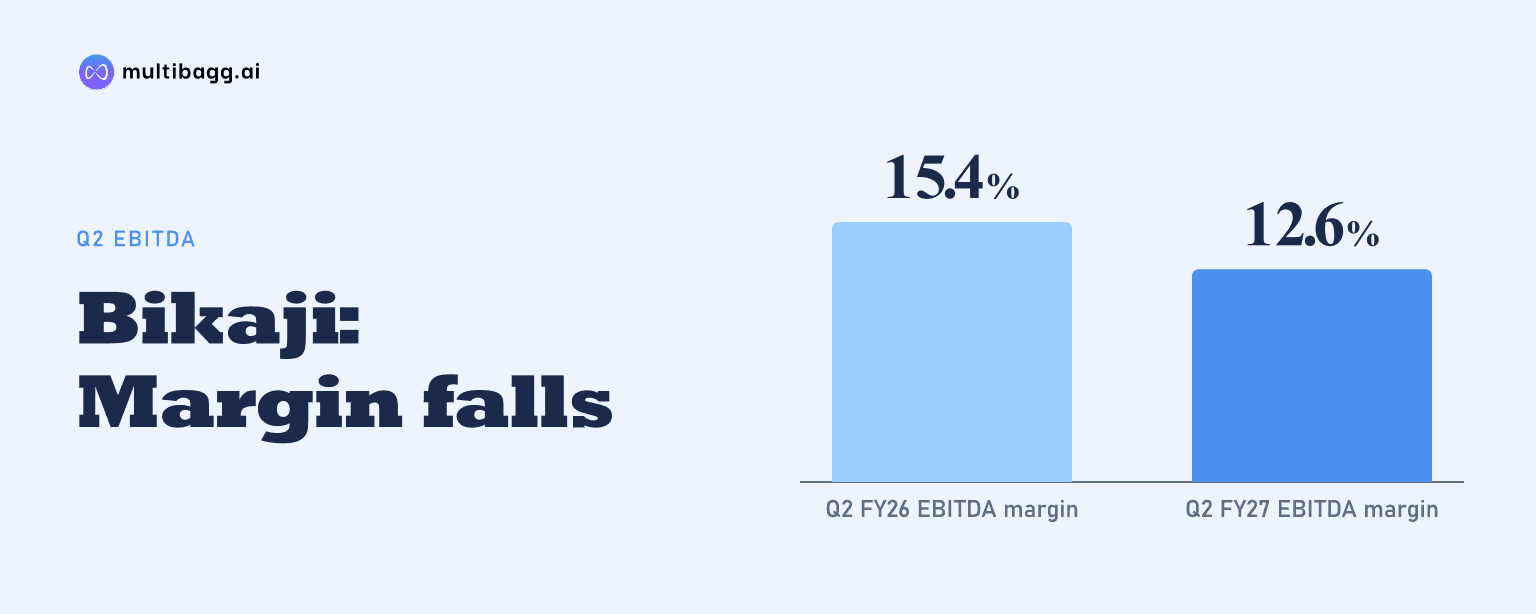
Bikaji Foods International Ltd. reported Rs 938.5 crore of revenue from operations in Q2FY27, up 13.0% year on year, but EBITDA margin fell 280 basis points to 12.6% from 15.4% as management cited higher marketing spending, fuel costs and commodity inflation. EBITDA declined 7.4% to Rs 118.7 crore despite the quarterly revenue high.
Know Bikaji Foods International inside out
Results, valuation, peers and who's buying, in one view.
Why did Bikaji's Q2FY27 revenue increase?
Bikaji's revenue from operations rose to Rs 938.5 crore in the quarter ended 30 September 2026, from Rs 830.3 crore a year earlier and Rs 734.3 crore in Q1FY27. The result represented 13.0% year-on-year growth and 27.8% quarter-on-quarter growth, making Q2FY27 the highest revenue quarter in the 10-quarter series disclosed by the company.
Ethnic Snacks was the category specifically identified by management as a growth driver. Its revenue increased 19.7% year on year to Rs 575.1 crore in Q2FY27, exceeding the 13.0% increase in total revenue from operations. Bikaji did not disclose the comparable Q2FY26 revenue figure for Ethnic Snacks, so the category's absolute year-on-year addition cannot be calculated from the presentation.
For H1FY27, revenue from operations increased to Rs 1,672.8 crore from Rs 1,483 crore in H1FY26, a rise of Rs 189.8 crore. Total revenue, including other income, reached Rs 1,694.7 crore against Rs 1,505.3 crore a year earlier, while other income was Rs 21.9 crore compared with Rs 22.3 crore.
Why did Bikaji's EBITDA margin decline to 12.6%?
Bikaji's EBITDA margin declined to 12.6% in Q2FY27 from 15.4% in Q2FY26, a contraction of 280 basis points, while EBITDA fell to Rs 118.7 crore from Rs 128.2 crore. Management attributed the margin movement mainly to increased marketing spending and rising costs, particularly fuel, so the 13.0% revenue growth did not result in higher EBITDA.
Gross margin narrowed by 60 basis points to 34.4% from 35.0% in Q2FY26, which management linked to inflationary pressure across key commodities. Gross profit still rose 11.2% to Rs 323.1 crore from Rs 290.6 crore because revenue growth outweighed the lower gross margin in absolute terms.
Sequentially, revenue rose by Rs 204.2 crore from Q1FY27, while EBITDA increased by Rs 19.7 crore, or 19.9%, from Rs 99 crore. EBITDA margin nevertheless declined from 13.5% in Q1FY27 to 12.6% in Q2FY27, while profit after tax, or PAT, rose sequentially to Rs 69 crore but remained below Rs 77.7 crore in Q2FY26.
Which input costs were higher in Q2FY27?
Bikaji's edible-oil sensitivity index reached 1.73 in Q2FY26-27, compared with 1.40 in Q2FY25-26 and 1.68 in Q1FY26-27. The year-on-year increase of 0.33 and sequential increase of 0.05 provide context for management's statement that commodity inflation affected gross margin, although the presentation does not define the index's currency basis or weighting.
Pulses and flours recorded an index of 0.92 in Q2FY26-27, up from 0.85 a year earlier and 0.88 sequentially. Laminates were at 1.19, compared with 1.04 in Q2FY25-26 but below 1.23 in Q1FY26-27, while corrugated boxes reached 1.17 versus 0.91 a year earlier and 1.10 sequentially.
Got a follow-up? Ask IRIS
What did Bikaji report for first-half profit and its balance sheet?
Bikaji reported H1FY27 EBITDA of Rs 217.7 crore, down from Rs 224.5 crore in H1FY26, despite revenue from operations rising Rs 189.8 crore to Rs 1,672.8 crore. The first-half EBITDA margin fell to 13.0% from 15.1%, while PAT declined to Rs 128.4 crore from Rs 136.2 crore and PAT margin decreased to 7.7% from 9.2%.
At 30 September 2026, total assets were Rs 2,558.5 crore, up from Rs 2,239.5 crore at 31 March 2026. Property, plant and equipment, including tangible and intangible assets, capital work in progress and right-of-use assets, increased to Rs 1,331.8 crore from Rs 1,184.7 crore.
Inventories rose to Rs 223.2 crore at 30 September 2026 from Rs 117.4 crore at 31 March 2026, while trade receivables rose to Rs 186.9 crore from Rs 107.1 crore. Borrowings increased to Rs 344.4 crore from Rs 209.8 crore, whereas cash and cash equivalents, including fixed deposits and accrued interest, were Rs 446.5 crore compared with Rs 449 crore. The presentation does not provide reasons for these balance-sheet movements.
How is Bikaji expanding its retail business?
Bikaji's retail revenue from operations rose 58.1% year on year to Rs 44.7 crore in Q2FY27 from Rs 28.3 crore in Q2FY26. Store count increased to 34 from 21 over the same period, a 61.9% increase, while Q1FY27 retail revenue was Rs 36.4 crore from 28 stores.
In H1FY27, retail revenue reached Rs 81.1 crore, up 64.0% from Rs 49.5 crore in H1FY26, with 34 stores compared with 21. Separately, family-pack revenue rose 9.6% to Rs 950.8 crore and impulse-pack revenue grew 15.9% to Rs 601.5 crore in H1FY27; the presentation labels Bikaji a market leader in family packs without disclosing an external market-share figure.
Conclusion
Bikaji's Q2FY27 result combined a record Rs 938.5 crore of revenue from operations with lower year-on-year profitability. Ethnic Snacks revenue grew 19.7% to Rs 575.1 crore and retail revenue rose 58.1% to Rs 44.7 crore, but higher marketing, fuel and commodity costs contributed to lower EBITDA of Rs 118.7 crore and a 12.6% margin.
The next results will show whether edible-oil sensitivity, which reached 1.73 in Q2FY26-27, and other material indices change. Investors can also monitor sales from the 34-store retail network and movements in borrowings of Rs 344.4 crore, inventories of Rs 223.2 crore and receivables of Rs 186.9 crore reported at 30 September 2026.