










Bikaji Western Snacks Gain Mix as Packaged Sweets Fall
Key highlights
- Bikaji Western Snacks revenue rose 44.2% year on year to Rs 81.5 crore in Q2FY27.
- Bikaji Western Snacks increased to 8.9% of Q2FY27 product mix from 7.0% in Q2FY26.
- Bikaji Packaged Sweets revenue declined 11.3% to Rs 141.9 crore in Q2FY27.
- Bikaji revenue from operations grew 13.0% to Rs 938.5 crore in Q2FY27.
powered by IRIS
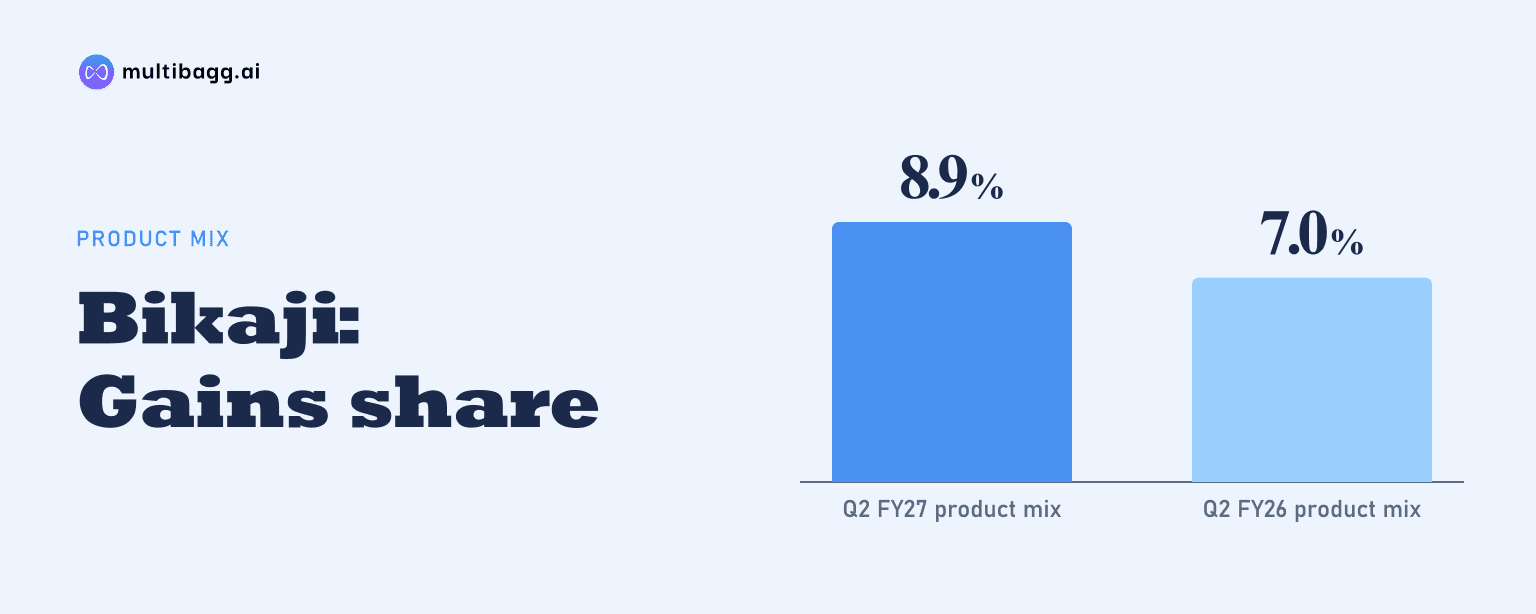
Bikaji Foods International Limited reported 44.2% year-on-year growth in Western Snacks revenue to Rs 81.5 crore in Q2FY27, raising the category’s product mix to 8.9% from 7.0%, while Packaged Sweets revenue fell 11.3% to Rs 141.9 crore and its mix declined to 15.5%.
Know Bikaji Foods International inside out
Results, valuation, peers and who's buying, in one view.
How did Bikaji’s product mix change in Q2FY27?
Bikaji’s Q2FY27 mix moved towards Ethnic Snacks and Western Snacks, while Packaged Sweets and Papad accounted for smaller portions of category sales. Ethnic Snacks increased its mix by 3.6 percentage points to 62.7% from 59.1% in Q2FY26. Western Snacks added 1.9 percentage points to 8.9%, whereas Packaged Sweets lost 4.2 percentage points and Papad lost 0.7 percentage points.
The shift followed materially different category revenue movements in Q2FY27. Western Snacks rose by Rs 25 crore from Rs 56.5 crore in Q2FY26, and Ethnic Snacks added Rs 94.6 crore to Rs 575.1 crore. In contrast, Packaged Sweets declined by Rs 18.1 crore from Rs 160 crore, and Papad decreased by Rs 2 crore from Rs 32.4 crore.
The reported mix measures categories as proportions of Bikaji’s product mix rather than as a share of total revenue from operations. Bikaji says revenue from operations also includes sales of raw material and packing materials, production-linked incentive income and service income, which are excluded from the category-wise breakup. Revenue from operations nevertheless rose 13.0% to Rs 938.5 crore in Q2FY27 from Rs 830.3 crore.
Which product categories drove Bikaji’s Q2FY27 growth?
Ethnic Snacks remained Bikaji’s largest category and the largest contributor to the Q2FY27 increase, with revenue up 19.7% year on year to Rs 575.1 crore. Its Rs 94.6 crore increase was greater in absolute terms than the Rs 25 crore increase in Western Snacks, despite Western Snacks recording the higher percentage growth rate of 44.2%.
Western Snacks was the fastest-growing disclosed category in Q2FY27 and also increased from Rs 68.4 crore in Q1FY27 to Rs 81.5 crore. Ethnic Snacks likewise rose from Rs 515.3 crore in Q1FY27 to Rs 575.1 crore. Both categories therefore increased against Q2FY26 and against the immediately preceding quarter.
Bikaji reported total volume of 46,075 tonnes in Q2FY27, 5.0% above 43,877 tonnes in Q2FY26 and above 35,778 tonnes in Q1FY27. Revenue from operations grew faster than volume, at 13.0% year on year, although the presentation provides no category-level volume, pricing or realisation data to explain the difference between sales growth and volume growth.
Why did Packaged Sweets and Papad take less of Bikaji’s mix?
Packaged Sweets and Papad took less of Bikaji’s Q2FY27 mix because both recorded lower year-on-year category revenue while Ethnic Snacks and Western Snacks expanded. Packaged Sweets fell 11.3% to Rs 141.9 crore, reducing its share to 15.5% from 19.7%. Papad declined 6.3% to Rs 30.4 crore, reducing its share to 3.3% from 4.0%.
The first-half figures show that the direction was not confined to one quarter. In H1FY27, Packaged Sweets revenue was Rs 184.5 crore, down 8.1% from Rs 200.9 crore in H1FY26, while Papad revenue fell 6.4% to Rs 63.5 crore from Rs 67.8 crore. Their product-mix shares declined to 11.3% and 3.0%, respectively, from 13.9% and 4.7%.
The presentation provides the reported revenue and mix changes but does not identify a cause for the declines in Packaged Sweets or Papad. It does not disclose whether distribution, pricing, festive demand, promotions or product availability affected either category. The disclosed data establishes a change in sales composition, but not the operational reasons behind it.
Got a follow-up? Ask IRIS
Is the mix shift visible across the first half?
Yes, Bikaji’s H1FY27 figures show the same direction of mix change as Q2FY27, with Ethnic Snacks and Western Snacks increasing their shares and Packaged Sweets and Papad declining. Ethnic Snacks represented 66.7% of H1FY27 product mix, up 1.6 percentage points from 65.1% in H1FY26, while Western Snacks rose 1.4 percentage points to 9.2%.
Western Snacks revenue increased 32.7% in H1FY27 to Rs 149.9 crore from Rs 112.9 crore, compared with 15.6% growth in Ethnic Snacks to Rs 1,090.4 crore from Rs 942.9 crore. Packaged Sweets declined by Rs 16.4 crore over the half year, while Papad decreased by Rs 4.3 crore. The Q2FY27 pattern was therefore consistent with the first-half category comparison.
Bikaji’s H1FY27 revenue from operations increased 12.8% to Rs 1,672.8 crore from Rs 1,483 crore, while volume grew 6.2% to 81,853 tonnes from 77,090 tonnes. Category sales are not directly reconcilable to revenue from operations because of the additional raw-material, packing-material, production-linked incentive and service-income items cited by Bikaji.
What does the changed mix mean for Bikaji’s reported sales base?
The changed mix means Bikaji generated a larger proportion of disclosed category sales from Ethnic Snacks and Western Snacks in Q2FY27 and a smaller proportion from Packaged Sweets and Papad. Ethnic Snacks plus Western Snacks represented 71.6% of product mix in Q2FY27, compared with 66.1% in Q2FY26, a 5.5-percentage-point increase.
The combined mix of Packaged Sweets and Papad was 18.8% in Q2FY27, down from 23.7% in Q2FY26. The remaining category was labelled Others & Retail at 10.2% in Q2FY26 and Others at 9.6% in Q2FY27. These reported percentages identify where category composition changed, rather than indicating profitability by category.
Bikaji does not disclose category margins, market shares, product-level prices or targets for Western Snacks, Packaged Sweets or Papad. The presentation therefore establishes revenue momentum and mix movement, but does not show whether the 44.2% Western Snacks growth produced a corresponding change in category profit or whether the sweets decline will continue beyond Q2FY27.
Conclusion
Bikaji’s Q2FY27 figures show a clear change in the composition of disclosed category sales. Western Snacks grew 44.2% to Rs 81.5 crore and increased its mix share to 8.9%, while Ethnic Snacks rose 19.7% to Rs 575.1 crore and reached 62.7%. Against that growth, Packaged Sweets and Papad both recorded lower revenue and smaller mix shares.
The unresolved issue is whether this category pattern persists, as Bikaji has not disclosed revenue targets, margin targets or a stated plan for Western Snacks, Packaged Sweets or Papad. Subsequent category and mix disclosures will show whether Western Snacks continues to grow above the 13.0% Q2FY27 increase in revenue from operations and whether Packaged Sweets, down 8.1% in H1FY27, stabilises.