










Binny Mills posts Rs 234.33 lakh loss as finance costs rise
Key highlights
- Binny Mills reported a Rs 234.33 lakh net loss for the quarter ended 30 September 2026.
- Finance costs of Rs 335.93 lakh exceeded quarterly total income of Rs 236.61 lakh by Rs 99.32 lakh.
- The six-month loss narrowed to Rs 513.95 lakh from Rs 564.19 lakh a year earlier.
- Cash and cash equivalents rose to Rs 3.61 crore at 30 September 2026 from Rs 2.97 crore at 31 March 2026.
powered by IRIS
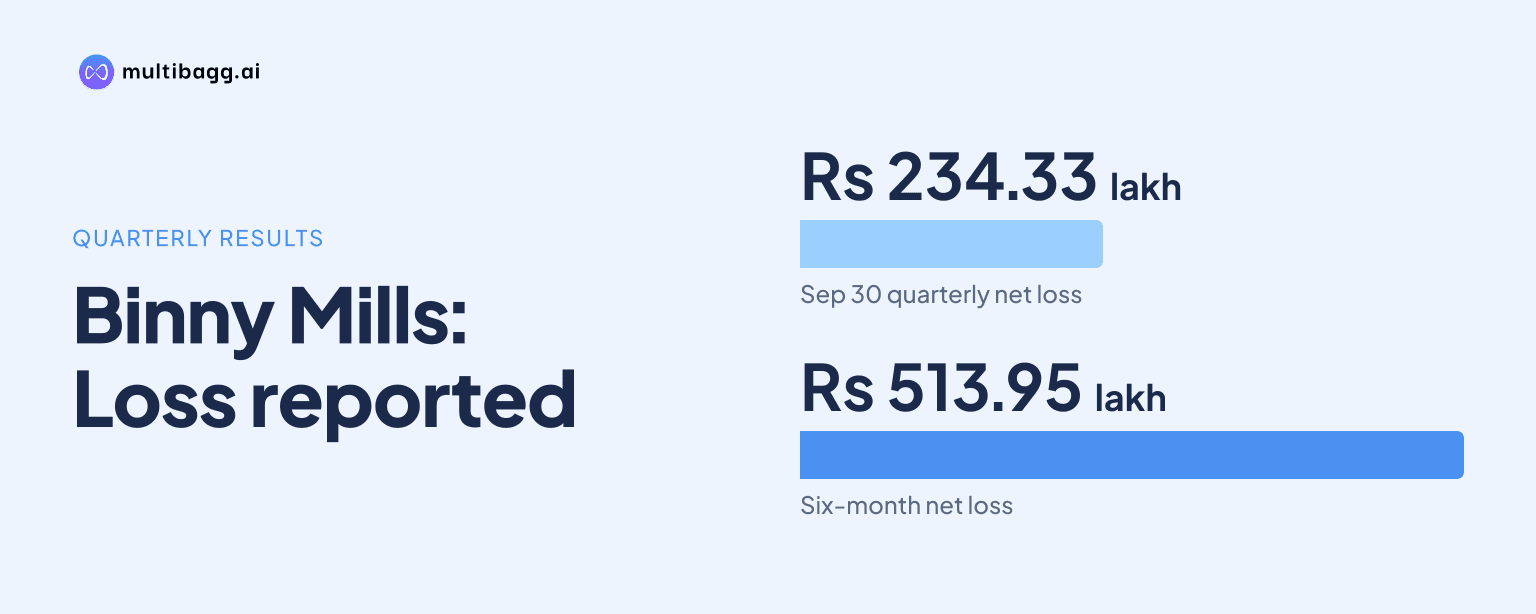
Binny Mills Limited posted a Rs 234.33 lakh net loss for the quarter ended 30 September 2026, as finance costs of Rs 335.93 lakh exceeded total income of Rs 236.61 lakh. Total expenses reached Rs 481.35 lakh, and the board approved the unaudited results on 6 November 2026.
Know Binny Mills inside out
Results, valuation, peers and who's buying, in one view.
Why did Binny Mills report a September-quarter loss?
Binny Mills reported a Rs 234.33 lakh loss because its Rs 481.35 lakh of quarterly expenses exceeded Rs 236.61 lakh of total income by Rs 244.74 lakh before tax effects. Finance costs were Rs 335.93 lakh, the largest expense, followed by purchases of stock in trade of Rs 112.66 lakh and other expenses of Rs 37.74 lakh.
Revenue from operations was Rs 190.20 lakh for the quarter ended 30 September 2026, while other income was Rs 46.42 lakh. The company reported a loss before tax of Rs 211.73 lakh, then recorded current tax expense of Rs 17.77 lakh and a deferred-tax credit of Rs 28.17 lakh. The resulting net tax credit of Rs 10.40 lakh reduced the final loss to Rs 234.33 lakh.
Binny Mills reported a basic and diluted loss per share of Rs 9.07 for the quarter, based on paid-up equity share capital of Rs 2.58 crore. Materials consumed were Rs 2.92 lakh, employee-benefit expense was Rs 8.28 lakh, and depreciation and amortisation expense was Rs 0.51 lakh. The disclosed finance-cost figure alone was higher than the company’s entire quarterly income.
How did Binny Mills perform in the first half?
Binny Mills narrowed its first-half loss to Rs 513.95 lakh for the six months ended 30 September 2026 from Rs 564.19 lakh in the corresponding 2025 period. Total income increased by Rs 103.83 lakh to Rs 441.33 lakh, while the loss before tax narrowed by Rs 47.10 lakh to Rs 498.38 lakh.
Revenue from operations rose to Rs 349.15 lakh in the six-month period from Rs 286.15 lakh a year earlier, and other income increased to Rs 92.18 lakh from Rs 51.03 lakh. Finance costs nevertheless rose by Rs 38.45 lakh to Rs 671.65 lakh from Rs 633.20 lakh, remaining above first-half total income.
Binny Mills said finance cost for the quarter ended 30 September 2026 includes the effect of fair-market-value measurements on an advance given to a related party, in accordance with Indian Accounting Standards, or Ind AS. This disclosure identifies a component affecting the Rs 335.93 lakh quarterly finance-cost line, without quantifying that component separately.
Got a follow-up? Ask IRIS
What does Binny Mills' balance sheet show?
Binny Mills reported total assets of Rs 172.15 crore at 30 September 2026, compared with Rs 171.98 crore at 31 March 2026. Total equity was negative Rs 253.46 crore at the September date, compared with negative Rs 248.01 crore at the March year-end, reflecting a wider equity deficit over the six months.
Investment property was Rs 159.04 crore at 30 September 2026, compared with Rs 159.05 crore at 31 March 2026, and formed most of non-current assets of Rs 165.10 crore. Cash and cash equivalents rose to Rs 3.61 crore from Rs 2.97 crore, while trade receivables fell to Rs 47.53 lakh from Rs 66.43 lakh and inventories declined to Rs 165.20 lakh from Rs 165.99 lakh.
Non-current borrowings were unchanged at Rs 144.70 crore at 30 September 2026 and 31 March 2026. Other financial liabilities classified as current increased to Rs 246.11 crore from Rs 239.75 crore, while trade payables declined to Rs 82.63 lakh from Rs 103.83 lakh. Total liabilities were Rs 426.21 crore at 30 September 2026.
Other equity was negative Rs 256.04 crore at 30 September 2026, compared with negative Rs 250.60 crore at 31 March 2026. Equity share capital remained Rs 2.58 crore at both balance-sheet dates. The movement in cash during the first half did not change the reported negative-equity position.
What did Binny Mills disclose about cash flow and provisions?
Binny Mills used Rs 21.98 lakh in operating activities during the six months ended 30 September 2026, compared with Rs 224.95 lakh used in the corresponding 2025 period. Cash generated from operations was negative Rs 2.09 lakh before net taxes paid of Rs 25.89 lakh, against negative Rs 203.50 lakh before taxes a year earlier.
Cash and cash equivalents increased by Rs 64.15 lakh during the first half to Rs 3.61 crore at 30 September 2026. The cash-flow statement reported Rs 92.13 lakh of net cash from investing activities and no financing cash flow for the six-month period. The closing cash balance comprised Rs 2.94 crore in deposit accounts, Rs 64.49 lakh in current accounts and Rs 1.91 lakh in cash on hand.
Binny Mills retained a Rs 28.65 lakh provision for possible rent and damages relating to its showroom at M.G. Road, Bengaluru. The company said the City Civil Judge of Bengaluru rejected the claim for rent arrears, but it retained the provision because it expects the possibility of further litigation. Property tax paid for the disputed period is shown as receivable from Square Projects Associates.
Binny Mills also provided Rs 36.52 lakh for a labour-court award involving 8 of 10 employees in a dispute involving Chennai Perunagar Jananayaka Thozhilalar Sangam. The company said it filed for a stay against the award. Separately, it said it had met Rs 9.73 crore of liabilities relating to former parent Binny Limited to facilitate the fast-track demerger and fully provided for the amount, which it describes as recoverable from the parent.
Conclusion
Binny Mills' September-quarter loss of Rs 234.33 lakh reflected expenses of Rs 481.35 lakh against income of Rs 236.61 lakh, with finance costs of Rs 335.93 lakh as the largest cost line. First-half income rose to Rs 441.33 lakh from Rs 337.50 lakh a year earlier and the six-month loss narrowed, although finance costs also increased to Rs 671.65 lakh.
The next results will show whether finance costs, including the disclosed Ind AS fair-value measurement effect on a related-party advance, change from the Rs 335.93 lakh reported for the September quarter. Binny Mills also disclosed unresolved matters to watch, including possible further Bengaluru litigation, its stay application on the Rs 36.52 lakh labour award, and liabilities that may arise from pre-demerger litigation not previously identified.