










Kaya narrows September loss, but net worth stays negative
Key highlights
- Kaya’s September 2026-quarter loss narrowed to Rs 12.5415 crore from Rs 18.7498 crore a year earlier.
- Revenue from operations rose to Rs 65.0242 crore in the September 2026 quarter from Rs 53.8475 crore.
- Kaya reported negative total equity of Rs 173.7598 crore at 30 September 2026.
- Net cash generated from operating activities was Rs 22.7914 crore in the half year ended 30 September 2026.
powered by IRIS
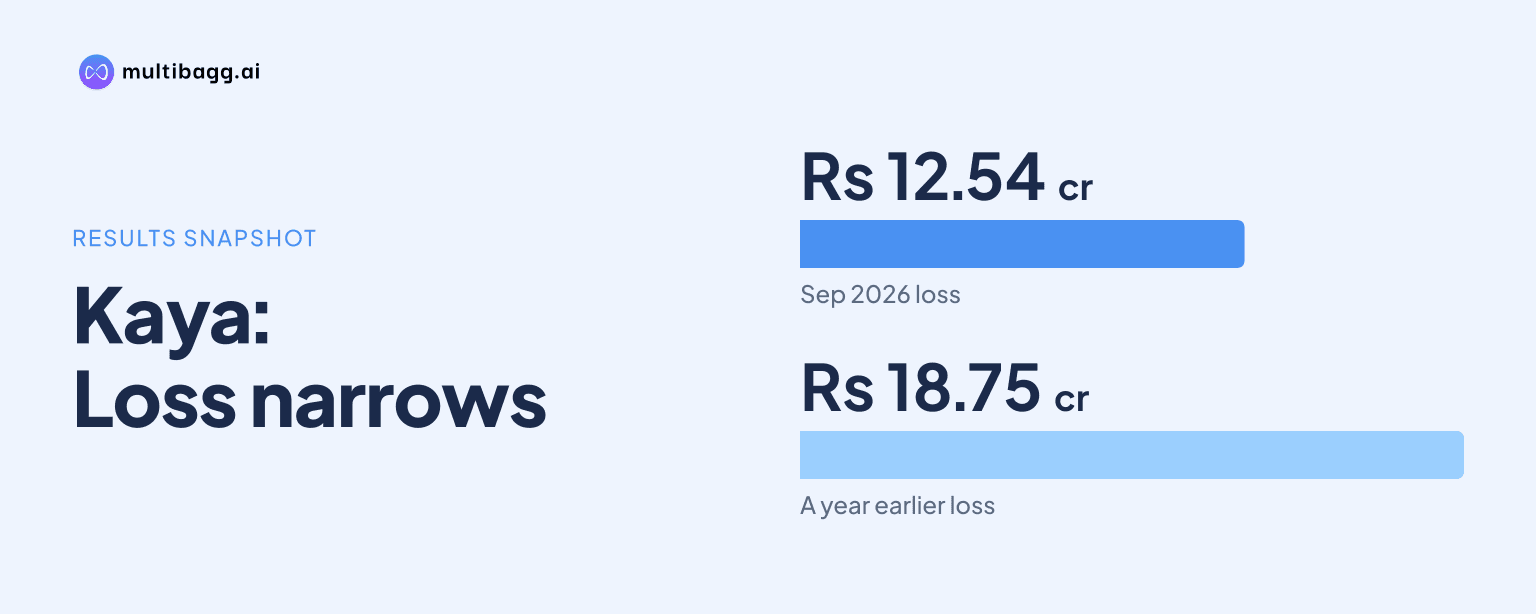
Kaya Limited narrowed its loss for the quarter ended 30 September 2026 to Rs 12.5415 crore from Rs 18.7498 crore a year earlier as revenue from operations rose to Rs 65.0242 crore, but its auditor highlighted the company’s negative net worth and working-capital position. Management said promoter-group support and available funds underpin its going-concern assessment.
Know Kaya inside out
Results, valuation, peers and who's buying, in one view.
How did Kaya perform in the September 2026 quarter?
Kaya reported a loss of Rs 12.5415 crore for the quarter ended 30 September 2026, compared with a loss of Rs 18.7498 crore for the quarter ended 30 September 2025. Revenue from operations increased by Rs 11.1767 crore year on year to Rs 65.0242 crore from Rs 53.8475 crore, while total income rose to Rs 65.9659 crore from Rs 58.2538 crore. Basic and diluted loss per equity share was Rs 8.26, against Rs 13.17 a year earlier.
The sequential result also improved. Kaya’s loss was Rs 15.1791 crore in the quarter ended 30 June 2026, making the September-quarter loss Rs 2.6376 crore lower. Revenue from operations rose by Rs 4.8886 crore from Rs 60.1356 crore in the June quarter. Other income fell to Rs 94.17 lakh from Rs 440.63 lakh in the comparable September 2025 quarter.
What changed in Kaya’s income and costs?
Kaya’s total expenses increased by Rs 1.5038 crore year on year to Rs 78.5074 crore in the September 2026 quarter, less than the Rs 7.7117 crore increase in revenue from operations. Finance costs rose to Rs 9.6791 crore from Rs 8.9154 crore, while employee-benefit expense declined to Rs 17.7553 crore from Rs 18.137 crore. Depreciation and amortisation remained broadly unchanged at Rs 10.8834 crore.
For the half year ended 30 September 2026, revenue from operations increased by Rs 18.5201 crore to Rs 125.1598 crore, while total expenses rose by Rs 10.4845 crore to Rs 154.9588 crore. The half-year loss narrowed by Rs 5.0954 crore to Rs 27.7206 crore. Consumption of stores and spares increased to Rs 20.106 crore from Rs 17.2033 crore, while purchases of stock-in-trade declined to Rs 95.40 lakh from Rs 234.96 lakh.
Kaya reports one operating segment, the Skin Care and Hair Care Business, under Indian Accounting Standard 108 on operating segments. The filing therefore does not separate revenue, profit or assets between skin care and hair care. The company recorded an impairment loss of Rs 11.7658 crore on a cash-generating unit in the year ended 31 March 2026, but reported no impairment charge in the September 2026 quarter or half year.
Got a follow-up? Ask IRIS
Why did the auditor highlight Kaya’s going-concern position?
The statutory auditor drew attention to Kaya’s losses in prior years and its negative net worth and working-capital position at 30 September 2026. The auditor said management prepared the results on a going-concern basis because it believes promoter-group financial support and funds available at that date will enable Kaya to meet obligations over the next 12 months as they fall due. The limited-review conclusion was unmodified.
Management said Kaya requires funds for operations and future development plans and continues to receive financial support from the promoter group, including during the current period and previous year. Its assessment relies on a board-approved annual operating plan, financing arrangements for working capital and necessary capital expenditure, and funds expected from operating activities. Management also said the eventual outcome may differ from estimates made at the date the results were approved.
Total equity was negative Rs 173.7598 crore at 30 September 2026, compared with negative Rs 152.7621 crore at 31 March 2026. Share capital was unchanged at Rs 15.1876 crore, while other equity was negative Rs 188.9474 crore, compared with negative Rs 167.9497 crore at the March year-end. The auditor did not modify its conclusion, but identified support arrangements and management estimates as central to the going-concern basis.
What do Kaya’s balance sheet and cash flows show?
Kaya’s total assets declined to Rs 260.8231 crore at 30 September 2026 from Rs 277.9096 crore at 31 March 2026. Current assets fell to Rs 60.45 crore from Rs 72.2433 crore, including current investments of Rs 29.6297 crore versus Rs 38.685 crore. Cash and cash equivalents increased to Rs 190.54 lakh from Rs 138.70 lakh, while non-current borrowings rose to Rs 159.2987 crore from Rs 149.2125 crore.
Current liabilities were Rs 163.7841 crore at 30 September 2026, lower than Rs 172.3819 crore at 31 March 2026, after current borrowings fell from Rs 14 crore to nil. Other current liabilities nevertheless increased to Rs 115.5731 crore from Rs 110.9487 crore. Kaya also disclosed a Rs 24.0612 crore provision for an Employees Provident Fund Organisation matter, compared with Rs 23.5327 crore at 31 March, pending the outcome of proceedings.
Net cash generated from operating activities was Rs 22.7914 crore in the half year ended 30 September 2026, compared with Rs 12.1062 crore in the prior-year period. Investing activities generated Rs 7.386 crore, versus a net use of Rs 79.4318 crore a year earlier, while financing activities used Rs 29.659 crore after generating Rs 65.3376 crore in the comparable period. Cash and cash equivalents closed at Rs 190.54 lakh, below Rs 449 lakh at 30 September 2025.
Conclusion
Kaya’s September-quarter revenue growth and narrower loss improved its reported year-on-year and sequential performance, while the half-year loss also narrowed to Rs 27.7206 crore. However, negative equity increased to Rs 173.7598 crore at 30 September 2026, and the auditor’s going-concern emphasis places management’s funding assumptions and promoter-group support alongside the improvement in operating results.
The next disclosure to watch is Kaya’s progress against the board-approved annual operating plan and its ability to meet obligations over the next 12 months through promoter-group support, financing arrangements and operating cash flows. Shareholders are also due to vote by postal ballot on a proposed grant of 4,80,000 employee stock options and on Shuchi Pandya’s appointment for a five-year independent-director term beginning 6 November 2026.